Massage Guns
The Best Massage Gun for Deep Tissue
Depth is not a marketing word. It is amplitude times stall force — how far the head travels, and how hard you can lean on it before the motor gives up. Two of the biggest brands in this category do not publish either figure.
By Stephen V.Published
Disclosure:Grip & Gait earns a commission when you buy through links on this page, at no extra cost to you. It never changes what we recommend or the order we rank things in — here is exactly how we’re funded.
Quick picks
Ranked on published manufacturer specs and what they mean for the job, not on testing we have not done. Tap a row for the full reasoning. How we score.
| # | Product | Best for | Score | Price |
|---|---|---|---|---|
| 1 |  Bob and Brad C2 Massage Gun The only gun here whose maker publishes amplitude, stall force, speed range and noise — and its published stall force beats the premium units. | Deep tissue on a real budget | 8.6 | |
| 2 | 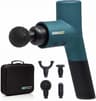 Ekrin Athletics B37v2 Massage Gun The 15-degree handle is the one real ergonomic idea in this category. Lifetime warranty. | Reaching your own back | 8.2 | $224.99 · View on Amazon Price as of October 21, 2026. #ad How we’re funded |
| 3 |  Therabody Theragun Prime (6th Gen) The 16 mm stroke Therabody quotes is genuinely long. It is not on the product page. | Long stroke, if you trust the number | 7.8 | $329.99 · View on Amazon Price as of October 21, 2026. #ad How we’re funded |
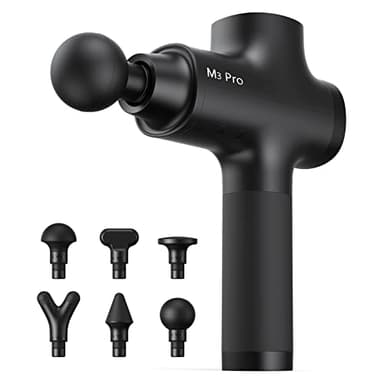
| 4 |  Opove M3 Pro 2 Massage Gun Has outlasted most of the brands launched alongside it, which is its own kind of data. | Mid-price durability | 7.4 | $129.99 · View on Amazon Price as of October 21, 2026. #ad How we’re funded |
| 5 |  TOLOCO Massage Gun (EM26) No published depth specs, but a real tool if the alternative is no tool. | Lowest cost that still works | 6.9 | |
| ✕ |  Therabody Theragun Pro Built for a practitioner running it for hours across many bodies. For your own calves it is the most expensive way to do a $70 job. Skip this | Clinic volume only | 6.2 |
What actually makes a massage gun “deep tissue”
Two published numbers decide it, and neither of them is the one on the box. Amplitude is how far the head travels on each stroke — 10 mm, 12 mm, 16 mm. That is the depth the device can physically reach into tissue, and nothing else on the spec sheet substitutes for it. Stall force is how hard you can press before the motor stops moving. A gun with a long stroke and a weak motor stops being a deep-tissue device the moment you lean on it, which is exactly when you wanted it to work.
Speed is the number every listing leads with, and it is the least important of the three. A 3,200 PPM device that travels 8 mm and stalls at 20 lb of pressure is a vibrator with good marketing. A 2,000 PPM device that travels 16 mm and holds 40 lb is a deep-tissue tool. Higher speed with a short stroke buys you a faster tickle.
The finding that shaped this page
We went looking for amplitude and stall force on every manufacturer’s own product page on 24 July 2026. Here is what we found, and you can check all of it in about four minutes.
Therabody’s current US Theragun Prime page publishes dimensions, weight, battery life, warranty and attachment count. It does not publish amplitude, stall force, percussions per minute or noise. Hyperice’s Hypervolt 2 page publishes weight, dimensions, motor wattage, speed count and battery life. It does not publish amplitude at all. The Hypervolt 3 Pro page does better — it states 1,500–2,500 RPM and 51 dB — and still no amplitude.
Bob and Brad publish all four.Amplitude 10 mm. Stall force over 44 lb. 2,000–3,200 PPM. Under 60 dB. On a gun that costs a fraction of the two above.
That is not an accusation of anything. Therabody and Hyperice both build good hardware and both quote figures elsewhere in their marketing. But if you are standing in front of a product page trying to work out whether a device will reach your glute, and the two numbers that answer that question are absent from the page you are buying from, the honest reading is that you are being asked to buy on brand rather than on specification. We would rather tell you that than score a number we cannot cite.
The arithmetic: what depth do you actually need?
Amplitude is not a “more is better” spec. It is matched to the structure you are trying to reach, and past that point the extra stroke is wasted or actively unpleasant.
- Superficial fascia and small muscles — forearm, calf belly, the top of a trapezius. These sit within a few millimeters of the skin. A 10 mm stroke is already past them. A 16 mm stroke on a bony forearm is a percussion device hammering a bone through a thin layer of muscle, and it is the most common way people decide they hate massage guns.
- Thick muscle bellies — glutes, quads, hamstrings, lats, the paraspinal muscles either side of the lower back. This is where the extra stroke genuinely earns its money, and it is the only category where the difference between 10 mm and 16 mm is something you will feel.
- Everything bony — shins, the top of the foot, the spine itself, elbows, the front of the knee. No amount of amplitude helps. This is a ball or a manual tool, or nothing.
Which means: if the muscle you are actually treating is a calf or a shoulder, a 10 mm gun with a strong motor is a better buy than a 16 mm gun with a weak one, and it is cheaper. Glutes and thick backs are the genuine case for the long stroke.
Stall force is the spec that decides whether depth survives contact
Here is the mechanical part people miss. Amplitude is the stroke length with nothing pushing back. The moment you press the head into muscle, the motor has to work against your body weight, and if it cannot, the stroke shortens or stops entirely. That threshold is stall force.
Bob and Brad publish over 44 lb for the C2. Therabody has historically quoted up to 30 lb of no-stall force for the Prime. If both figures are measured the same way — and we cannot verify that they are, because neither company publishes its test method — then the cheaper gun tolerates more pressure before it quits. That is a genuinely surprising result and it is the reason the C2 tops this list rather than the Theragun.
The honest caveat, stated plainly: stall force is not a standardized measurement. There is no published test protocol either manufacturer points to, so comparing 44 lb against 30 lb is comparing two numbers produced by two companies using methods neither has described. We are reporting what they publish, not certifying that the numbers are commensurable.
What the research actually supports
The evidence for percussive therapy is real, narrow, and much less dramatic than the marketing. A 2023 study on Theragun percussive therapy and hamstring range of motion found a significant reduction in tissue stiffness and an improvement in range of motion. A systematic review of percussive therapy concluded it can help acute and explosive muscle strength.
On soreness the picture is weaker. A randomized controlled trial found percussion massage did not accelerate recovery from delayed onset muscle soreness until 72 hours after eccentric exercise, though it did give immediate, temporary relief in perceived soreness each time it was applied. Another study comparing foam rolling against percussive massage found both accelerated the recovery of disrupted muscle properties but neither significantly reduced pain compared with simply resting.
Read together: a massage gun reliably makes you move better in the short term and reliably feels better while you use it. It does not reliably make you recover faster. Anyone telling you otherwise is selling something, and so are we — which is exactly why we are telling you this.
“Deep vein thrombosis, osteomyelitis; bone fracture or myositis ossificans; bleeding disorders; peripheral vascular insufficiency or disease; medications that thin the blood or alter sensations; pacemaker, ICD.”
The same document says to avoid direct application to the face, throat or genitalia, and direct pressure over a surgical site or hardware. If any of that describes you, this is a conversation with a clinician rather than a shopping decision. See our medical disclaimer — we are a tool site, not a health service.
How to choose, in three questions
- What are you actually treating? Calves, shoulders and forearms: buy on weight and noise, not amplitude. Glutes, quads and thick lower back: amplitude matters and the long stroke is worth paying for.
- Can you reach it?A 2.5 lb gun held at arm’s length behind your own shoulder is heavier than it sounds after ninety seconds. This is the argument for the angled-handle designs and for the lighter units generally.
- Will the maker tell you what it does? If two devices are otherwise comparable and one publishes its numbers, buy that one. Not as a moral position — because you can verify it.
Where a gun is the wrong purchase entirely
For a plantar fascia, a $6 spiked ball under your foot applies more concentrated pressure than any handheld gun, because your body weight is doing the work rather than a motor. For the muscle beside your shoulder blade, a lacrosse ball against a wall reaches under the scapula in a way no gun head can. For a broad quad, a foam roller covers more area per minute for a fifth of the price. We wrote the gun-versus-roller comparison and the gun-versus-ball comparisonprecisely because the honest answer is often “neither, and here is the cheaper thing.”
Every pick, in full
Specs below are the manufacturer’s own published figures, each linked to the page it came from. Where a maker does not publish a number, the table says so and names the page we checked — that absence is information too.
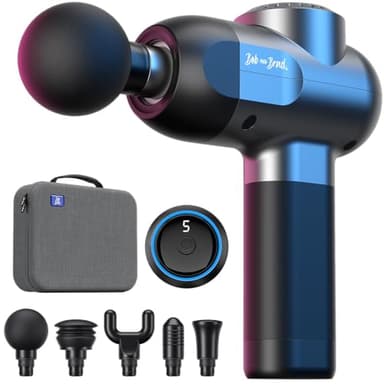
Bob and Brad C2 Massage Gun
The only gun in this roundup whose maker publishes all four numbers that decide whether it reaches the muscle — amplitude, stall force, speed range and noise — and the stall-force figure is higher than the premium units that hide theirs.
What it gets right
- Publishes amplitude, stall force, speed range and noise — the two market leaders publish none of the first three
- Published stall force of over 44 lb is higher than the figure Therabody publishes for the Prime
- 1.5 lb is light enough to hold overhead against your own shoulder without your arm giving out first
- FSA/HSA eligible, which quietly makes it cheaper again for a lot of buyers
What it does not
- 10 mm amplitude is genuinely shorter than a 16 mm premium stroke — that difference is real for glutes and thick back muscle
- No app, no pressure-feedback screen, no ecosystem
- Five fixed speeds rather than a continuous range
Price as of October 21, 2026. #ad How we’re funded
Ekrin Athletics B37v2 Massage Gun
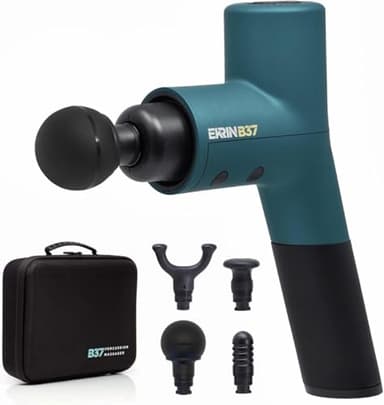
The 15-degree angled handle is the one genuine ergonomic idea in this category — it is the difference between reaching your own mid-back and asking someone else to.
What it gets right
- Angled handle materially extends self-treatment reach
- Lifetime warranty is unusual at any price in this category
- Quieter than most mid-priced guns
What it does not
- Costs several times a fully-specified budget gun
- Heavier than the lightest premium handhelds
Price as of October 21, 2026. #ad How we’re funded
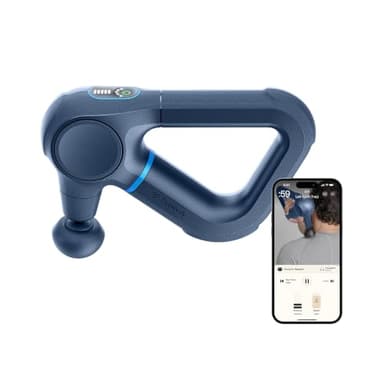
Therabody Theragun Prime (6th Gen)
The long-stroke option, and the build quality is not in question — but Therabody's current US product page publishes dimensions, weight, battery and warranty and does not publish amplitude, stall force, PPM or noise, so the numbers most buyers are shopping on are not on the page they are shopping from.
What it gets right
- The 16 mm stroke Therabody quotes is genuinely long, and stroke length is what determines depth
- Real-time pressure feedback stops the most common user error — leaning on it far too hard
- Rated by Therabody to survive drops from 10 feet, which matters more than it sounds for a thing you use on a hard floor
What it does not
- Amplitude, stall force, PPM and dB are absent from the current US product page — we checked
- Two attachments in the box, against five on guns costing a fifth as much
- 120 minutes of battery is quoted at the LOWEST speed setting, which is not the setting you will use
- One-year limited warranty on a device at this price
| Amplitude | Not published page we checked |
|---|---|
| Stall force | Not published page we checked |
| Speed range | Not published page we checked |
| Speed settings | 5 source |
| Weight | 2 lb source |
| Noise | Not published page we checked |
| Battery | 2 h source |
| Attachments | 2 source |
| Warranty | 1-year limited source |
| Dimensions | 238 × 153 × 61 mm source |
Price as of October 21, 2026. #ad How we’re funded
Opove M3 Pro 2 Massage Gun
A long-running mid-price percussion gun that has outlasted most of the brands launched alongside it, which on its own tells you something about how it holds up.
What it gets right
- Long product life on the market — a real durability signal when nobody publishes MTBF
- Solid metal-bodied construction
What it does not
- Amplitude and stall force not published on the listing
- Heavier than the premium lightweights
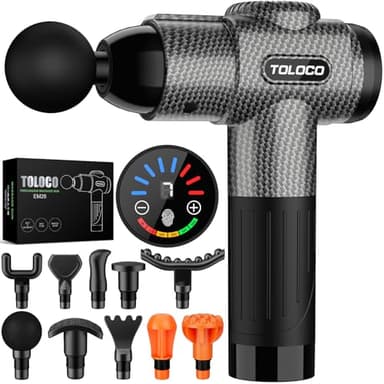
TOLOCO Massage Gun (EM26)
The cheapest gun worth owning, and the ten-attachment box is not the selling point the listing thinks it is — but if the alternative is not buying one at all, this is a real tool.
What it gets right
- Cheap enough that it is not a decision
- Ten attachments, of which you will use two
- Light enough for self-application
What it does not
- No published amplitude or stall force from the manufacturer
- Build quality is what the price implies — treat it as a two-year tool
- Loud relative to premium units
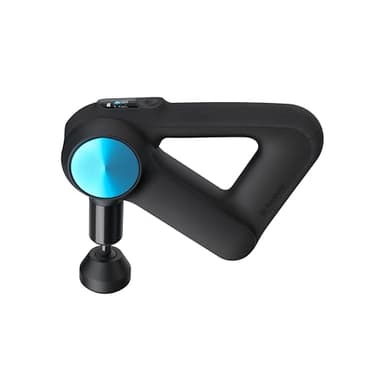
Therabody Theragun Pro
Built for a practitioner who runs it for hours a day across many bodies. For one person's own calves and shoulders it is the most expensive way to do a job a $70 gun does — which is why it is our skip.
What it gets right
- Rotating arm genuinely helps reach your own back
- Built for continuous professional use in a way the consumer models are not
What it does not
- The price gap over a fully-specified budget gun buys durability you will not consume at home
- Heavy in the hand for self-treatment
- Same unpublished-amplitude problem as the rest of the range
Common questions
What amplitude do I need for deep tissue?
For thick muscle — glutes, quads, hamstrings, lower back — a longer stroke of around 14–16 mm is where the extra travel earns its money. For calves, shoulders and forearms, 10–12 mm is already past the tissue you are trying to reach, and a stronger motor at 10 mm beats a weaker one at 16 mm. Over bone, no amplitude helps. If the thick muscle in question is a lifter’s, the weightlifters roundup ranks the same guns for glutes, lats and reach.
What is stall force and does it actually matter?
Stall force is how hard you can press the head into muscle before the motor stops moving. It matters more than amplitude in practice, because a long stroke that collapses under pressure is not a long stroke when you are using it. Bob and Brad publish over 44 lb for the C2; Therabody has quoted up to 30 lb of no-stall force for the Prime. Neither company publishes its test method, so treat the comparison as indicative rather than exact.
Do expensive massage guns go deeper than cheap ones?
Not automatically, and on the published figures not at all in this set. The most expensive guns here do not publish amplitude or stall force on their product pages; the cheapest one that does publishes a higher stall force than the premium quoted figure. What the money reliably buys is build quality, quieter operation, better ergonomics and longer warranty support — all real, none of them depth.
How long should I use a massage gun on one muscle?
The common guidance is short: roughly 30 seconds to two minutes per muscle group, moving continuously rather than parking the head in one spot. Longer is not better and parking on a single point is how people bruise themselves. Our full protocol guide covers timing per body area.
Can a massage gun break up scar tissue?
The claim is common in marketing and thin in the literature. Percussive therapy demonstrably reduces measured tissue stiffness and improves range of motion in the short term, which is a real and useful effect. That is not the same as mechanically breaking down established scar tissue, and we have not found evidence that supports the stronger claim. We cover this in more detail in the scar tissue and fascia guide.
Sources
- 1.Bob and Brad — C2 massage gun product page — amplitude, stall force, PPM, weight, dB
- 2.Therabody — Theragun Prime product page — dimensions, weight, battery, warranty, attachments; amplitude and stall force absent
- 3.Hyperice — Hypervolt 2 product page — weight, dimensions, motor, speeds, battery; amplitude absent
- 4.Hyperice — Hypervolt 3 Pro product page — RPM range, dB, speeds, weight, battery; amplitude absent
- 5.Therabody — Product Safety & Precautions — contraindications, quoted verbatim above
- 6.Acute Effects of Theragun Percussive Therapy on Viscoelastic Tissue Dynamics and Hamstring Range of Motion (PMC10499144)
- 7.Percussion massage therapy and recovery from delayed onset muscle soreness — randomized controlled trial (PMC11979224)
- 8.Foam Rolling or Percussive Massage for Muscle Recovery: Insights into DOMS (PMC12286022)
- 9.The Effect of Percussive Therapy on Musculoskeletal Performance and Experiences of Pain: A Systematic Literature Review (PubMed 37020441)