Recovery Tech
The Best Heating Pads for Neck and Shoulders
A lower back is a flat surface you lie on. A neck and a pair of shoulders are neither, which is why the pad that works on your back spends the whole session sliding off your traps. Here is what is actually cut for this part of the body, the two specs that matter, and an honest account of how thin the evidence for heat on a neck really is.
By Stephen V.Published Updated
Disclosure:Grip & Gait earns a commission when you buy through links on this page, at no extra cost to you. It never changes what we recommend or the order we rank things in — here is exactly how we’re funded.
Quick picks
Ranked on published manufacturer specs and what they mean for the job, not on testing we have not done. Tap a row for the full reasoning. How we score.
| # | Product | Best for | Score | Price |
|---|---|---|---|---|
| 1 |  Sunbeam Neck and Shoulder Heating Pad Cut to the shape of a neck and shoulders, so it stays where you put it without a hand holding it. Moist-heat option and an auto shutoff, which is the combination this job wants. | Best overall for traps | 8.6 | $47.99 · View on Amazon Price as of October 21, 2026. #ad How we’re funded |
| 2 |  Comfytemp Weighted Heating Pad (12 × 24 in) Weight is a contact feature, not a gimmick: on a sloping shoulder gravity is the only thing keeping a pad pressed to the muscle. Listed FSA and HSA eligible. | Staying in contact | 8.3 | $29.99 · View on Amazon Price as of October 21, 2026. #ad How we’re funded |
| 3 |  Comfytemp Cordless Heating Pad with Massager The one case where cordless genuinely wins, because neck and shoulder stiffness is a working-day problem and you are not lying down for it. Check the listed runtime first. | A desk, away from an outlet | 7.8 | |
| 4 |  Pure Enrichment PureRelief XL Heating Pad (12 × 24 in) A plain 12 x 24 in rectangle you drape over both shoulders. It will slide, and it is the right buy if you want one pad that also covers a lower back. | One pad for the whole body | 7.6 | $37.99 · View on Amazon Price as of October 21, 2026. #ad How we’re funded |
| ✕ |  Boileau XXXL Electric Heating Pad (17 × 33 in) 17 x 33 in is a brilliant lumbar pad and the wrong object entirely on a neck - too heavy to stay on a shoulder, and slower to come up to temperature. Skip this | The one to skip here | 6.2 |
Start with the honest version of the evidence
A 2026 systematic review on heat for non-specific neck pain searched the literature and found ninety-one candidate studies, of which exactly two met the inclusion criteria. Between them those two trials included sixty-seven participants in total. Both looked at dry heat delivered by wraps or heat cells, and both reported reductions in neck pain and neck-related disability — but the authors graded the evidence as very limited on account of the tiny sample sizes and the low methodological quality of both studies, and concluded that the evidence is “insufficient to support either a recommendation for or against its use.” Their closing point is the practical one: given the absence of expected serious adverse effects, heat may still be considered as a self-management option.
That is the correct frame for this entire page. You are buying a cheap, low-risk, pleasant thing that two small studies suggest helps and nobody has properly tested. We are not going to dress that up. What we can do usefully is tell you which pads are physically built for a neck and which ones will spend twenty minutes sliding onto the floor, because that is a question about objects rather than about physiology, and it is the question that decides whether you use the thing you bought.
Why shape is the whole specification
Heating pads have almost no meaningful spec sheet. Wattage varies little, “six heat settings” is marketing arithmetic, and no maker publishes a surface temperature you could compare across brands. On a back, we have argued before that the only two things that matter are how much of you the pad covers and whether it turns itself off — that is the reasoning in the best heating pads for back pain.
A neck changes the calculus, because a neck and a pair of shoulders are not a plane. They are a column meeting two downward slopes, and anything draped over that arrangement is being asked to stay put on a gradient. Three consequences follow, and they are the ranking criteria below.
First, a cut-out shape beats area. A pad with a neck opening and two arms that hang down the front is held in place by its own geometry. A rectangle is held in place by your hand, and you will not hold it for twenty minutes.
Second, weight is a feature here rather than a drawback. On a lower back a weighted pad is a comfort preference. On a trapezius it is the mechanism: gravity pressing the heated surface into the muscle is the only reason contact is maintained at all, and contact is what transfers heat.
Third, the cord matters more than it does anywhere else on the body. Neck and shoulder stiffness is overwhelmingly a desk-and-screen problem, which means the useful session is twenty minutes in the middle of a working day, in a chair, possibly nowhere near a socket. That is the one scenario in which paying extra for a battery is rational.
How we ranked these
- Does it stay on a shoulder unattended? Weighted first, then shaped, then flat. If you have to hold it, the session ends when your arm gets tired.
- Auto shutoff, non-negotiable. People use these in an armchair in the evening and fall asleep on them. A pad without a shutoff is marked down regardless of everything else it does.
- Moist-heat capability. A sponge insert or a dampenable cover is a cheap feature that makes the heat feel like it reaches further. We rank it as a genuine plus and not as a claim about tissue depth, because nobody has measured that here.
- Washable cover. This one lives against the back of your neck. It gets greasy. A cover you cannot wash is a pad you stop using.
- Honest coverage math. We say when a pad is too big for this job as plainly as when it is too small, which is why the largest pad on the page is the skip.
How to actually use one on a neck
Where it goes.Over the top of the shoulders and across the back of the neck — the thick slab of trapezius either side of the spine. Not wrapped around the front of the throat. Not pressed against the bony knobs of the spine itself, where there is no muscle to warm and the skin is thin.
How long. Fifteen to twenty minutes is the session. Longer is not better; it is how people end up with the mottled skin discoloration that comes from repeated prolonged low heat on the same patch. Two or three sessions a day is a reasonable ceiling.
What setting. The lowest one that feels like anything. The temptation with a neck is to go high because the sensation is pleasant and the area is small, and the back of the neck is exactly where people give themselves a burn without noticing, because you cannot see it.
What to do while it is on. Not nothing. Heat on a stiff trapezius is a way of making the next ten minutes of movement more comfortable, so use those ten minutes: shoulder rolls, chin tucks, gentle rotation to each side. The stiffness that comes back every afternoon is a loading and position problem, and the full order of operations for it is in neck and shoulder pain.
Which pad for which person, in one line each
- You want the right tool for this one job: the Sunbeam neck and shoulder pad. Shaped so it stays put, moist-heat option, auto shutoff. The trade is that it is useless on a lower back, which is a fair trade if you have a neck problem.
- You want it to stay pressed against the muscle: the Comfytemp weighted pad. On a sloping shoulder the weight is doing real work, and it is listed as FSA and HSA eligible, which for a lot of buyers is a third off the real price.
- You want it at your desk:the Comfytemp cordless pad. This is the only region of the body where cordless is a genuine advantage rather than a convenience, because the session happens mid-afternoon in an office chair. Check the listing’s stated runtime before you buy: runtime per charge is the constraint, not heat.
- You want one pad for your whole body: the PureRelief XL. A plain 12 x 24 in rectangle. It will slide off a shoulder and it will cover a lumbar spine properly, and if your back is also a customer, that is the sensible compromise.
- Skip the XXXL pad for a neck. The Boileau at 17 x 33 in is the best thing on this site for a whole lower back and an actively bad object on a shoulder: too heavy to stay up there, and it takes longer to come up to temperature because there is more of it.
A large share of the people buying a shaped pad are really buying it for headaches that start in the neck. That is a reasonable use and it is not the whole answer: tension headaches covers the nine-trial meta-analysis in which neck and shoulder strength work, not heat, was what reduced how often they happen.
Heat, or something else
Heat is the cheapest option on this site and it is not always the right one. If the complaint is one hard knot rather than a diffuse ache, pressure does more than temperature — a ball against a wall, or a gun used within the strict boundaries set out in the best massage gun for neck and shoulders. If you want to compare the two mechanisms directly, massage gun vs heating pad is the page. If the pain is electrical and you would rather modulate it than warm it, the best TENS units for neck and shoulder pain covers that route and the carotid no-go zone that comes with it, and heating pad vs TENS sets the two side by side. For a fresh strain rather than chronic stiffness, the timing question is in ice vs heat for sore muscles. And if your shoulders are stiff because the rest of your upper back is, upper back pain is the better starting point than any purchase.
One last thing, because it travels with this complaint more often than people expect: the desk that leaves your traps stiff every afternoon is frequently the same desk that has your hand going numb at night. That second symptom is a compressed nerve rather than a tight muscle, and heat is not the answer for it — carpal tunnel: what helps and what makes it worse covers what is.
The same shaped pad is the one we recommend for a shoulder that has stiffened in every direction, with an honest caveat about what heat changes there: see frozen shoulder.
Every pick, in full
Specs below are the manufacturer’s own published figures, each linked to the page it came from. Where a maker does not publish a number, the table says so and names the page we checked — that absence is information too.
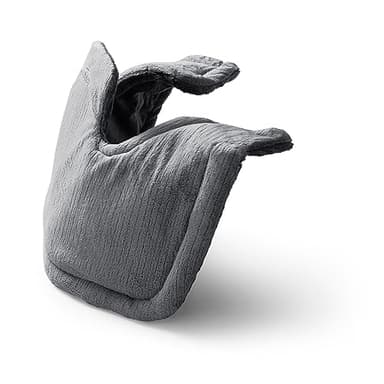
Price as of October 21, 2026. #ad How we’re funded
Sunbeam Neck and Shoulder Heating Pad
Cut to the shape of the problem: it sits over the trapezius and down both sides without being held there, which is the only thing a flat rectangle cannot do on a neck.
What it gets right
- Shaped for the neck and shoulders, so it stays put without a hand on it
- Moist-heat option as well as dry
- Auto shutoff — the feature that matters because people use this one in an armchair in the evening
What it does not
- The shape that makes it good on a neck makes it useless on a lower back
- Corded, so you are anchored to the outlet
- Covers less total area than a flat XL pad
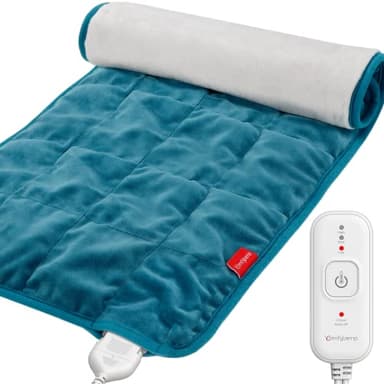
Price as of October 21, 2026. #ad How we’re funded
Comfytemp Weighted Heating Pad (12 × 24 in)
The weight is the whole point and it is not a gimmick: a weighted pad stays in contact with the curve of a lower back when you are sitting, which is exactly where an unweighted pad lifts off.
What it gets right
- Weighted, so it holds contact against a lumbar curve instead of tenting away from it
- Listed as FSA and HSA eligible, which changes the real price for a lot of buyers
- Auto shutoff and a washable cover
What it does not
- The weight is the reason to buy it and the reason some people dislike it on a sore back
- Heavier to hold in place anywhere other than a back
- Corded
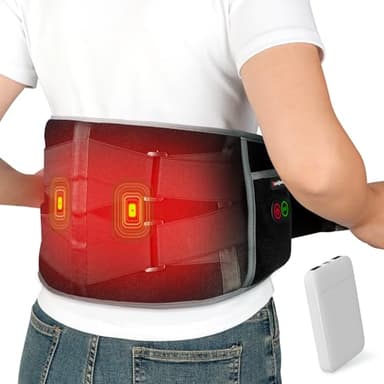
Comfytemp Cordless Heating Pad with Massager
Battery heat plus vibration, aimed at people who want to walk around while treating a back — which is the one thing a sore lower back is usually least interested in doing.
What it gets right
- No cord, so it works in a car, at a desk away from a socket, or standing at a counter
- Adds vibration on top of heat, which some people prefer to heat alone
- Listed as FSA and HSA eligible
What it does not
- Runtime per charge is the limiting factor for a 20-30 minute session; check the current listing figure before buying for that
- Costs more than a corded pad of the same size
- A lower back is usually treated sitting or lying down, which is where a cord is not a problem
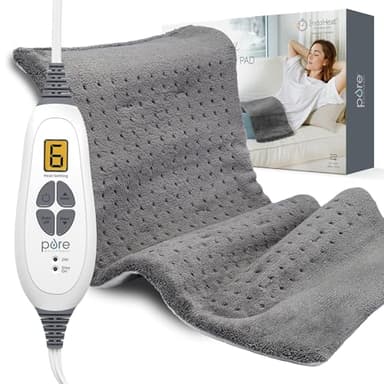
Price as of October 21, 2026. #ad How we’re funded
Pure Enrichment PureRelief XL Heating Pad (12 × 24 in)
The default answer in this category: standard 12 × 24 in footprint, multiple heat settings, auto shutoff, and a washable cover — nothing clever, everything you actually need for a back.
What it gets right
- 12 × 24 in is the size that spans a lower back rather than treating a patch of it
- Auto shutoff, which is the one feature that matters if you fall asleep on it
- Machine-washable microplush cover
What it does not
- Corded, so you are treating your back wherever the outlet is
- No weight to it, so it lifts away from the curve of your back when you sit upright
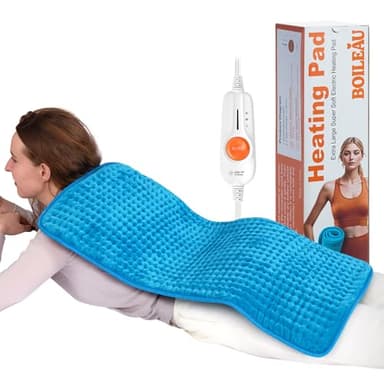
Boileau XXXL Electric Heating Pad (17 × 33 in)
Large enough to cover a whole lumbar region and both sides of it at once, which a standard pad cannot do — and area is the only heating-pad spec that changes the experience.
What it gets right
- 17 × 33 in covers the full lumbar span rather than a patch of it
- Multiple heat settings with auto shutoff
What it does not
- Bulky to store
- Takes longer to reach temperature
Common questions
What is the best heating pad for neck and shoulder pain?
A pad cut to the shape of a neck and shoulders, because shape is what keeps it in contact without a hand holding it — the Sunbeam neck and shoulder pad is our pick, with moist heat and an auto shutoff. If you want contact pressure as well, the Comfytemp weighted pad uses gravity to stay pressed into the trapezius. Avoid the extra-large flat pads for this job: they are built for a lumbar spine and will not stay on a shoulder.
Does heat actually help neck pain?
The evidence is much thinner than the popularity of heating pads suggests. A 2026 systematic review on heat for non-specific neck pain screened ninety-one studies and found only two that met its criteria, covering sixty-seven participants in total. Both reported reductions in pain and disability, but the authors judged the evidence very limited because of the small samples and low methodological quality, and concluded it is insufficient to recommend either for or against heat. They noted that, with no expected serious adverse effects, it remains a reasonable self-management option.
How long should you put a heating pad on your neck?
Fifteen to twenty minutes per session, two or three times a day, on the lowest setting that feels like anything. Longer sessions are not more effective and repeated prolonged low heat on the same patch of skin can leave a lasting mottled discoloration. Use the ten minutes after the pad comes off for shoulder rolls, chin tucks and gentle rotation — that is the part that changes anything.
Is a cordless heating pad worth it for your shoulders?
For this one region, more than anywhere else. Neck and shoulder stiffness is mostly a desk-and-screen problem, so the useful session is twenty minutes mid-afternoon in an office chair that may be nowhere near a socket. The constraint is runtime per charge rather than heat, so check the figure on the current listing before buying. For a lower back, where you are lying down anyway, a cord costs you nothing and you should not pay to remove it.
Sources
- 1.Use of Heat for the Self-Management of Non-Specific Neck Pain: A Systematic Review - Journal of Pain Research 2026 (PMC13269032) — 91 studies screened, 2 included, 67 participants; evidence insufficient to recommend for or against
- 2.Thermotherapy for treating rheumatoid arthritis - Cochrane Database of Systematic Reviews (PubMed 11406046) — the Cochrane position on thermotherapy in a different condition, for calibration
- 3.camelcamelcamel — GENIANI heating pad price history — price history for the heating-pad category on this site