Guides
Foam Rolling for Achilles Tendonitis
Nobody searches this hoping to be told they are rolling the wrong thing, but that is the honest answer: the Achilles is dense collagen lying against bone, and the tissue that responds to a roller is the calf sitting on top of it. Here is the technique for the part that does respond.
By Stephen V.Published
Disclosure:Grip & Gait earns a commission when you buy through links on this page, at no extra cost to you. It never changes what we recommend or the order we rank things in — here is exactly how we’re funded.
The short version
Roll the calf from just above the ankle to just below the back of the knee, and stop before the tissue turns tendon-hard under the roller. Two or three passes of about 45–60 seconds per calf, slow enough that a full length of the muscle takes ten seconds. Regulate the pressure with your body position, not by buying a firmer roller. Then do the loading work, which is the part that actually changes an irritated tendon.
Where the roller stops, and how to feel the line
Sit on the floor with the roller under one calf and slide up toward the knee. About a third of the way up from the heel the tissue changes character under you: it goes from soft and springy to a narrow, hard cord that does not deform. That cord is the Achilles. It is the line you stop at on the way back down.
There is no technique that makes rolling that cord productive. A tendon transmits force from muscle to bone. It is not a muscle that shortens and lengthens, it has a comparatively poor blood supply, and at the heel it inserts directly onto the calcaneus with almost nothing between the two. Pressing a hard cylinder into an irritated tendon that is lying on a bone compresses it against that bone. Which is why the calf gets the work and the tendon gets left alone.
The calf, by contrast, is the most cooperative muscle on the body to roll. It is superficial, it is long, it has a broad belly, and the two muscles in it — the gastrocnemius crossing the knee and the soleus underneath it — both feed into that same tendon. Slack in the calf is slack the tendon does not have to carry.
The four positions, in the order to try them
1. Seated, one leg, on the floor
Sit with your legs out in front, roller across the middle of one calf, hands flat on the floor behind you. Lift your hips just enough to load the calf and roll from above the ankle to below the knee. Keep the foot relaxed — a flexed foot tightens the muscle you are trying to work into.
This is the lowest-pressure version and the one to start on if the leg is genuinely sore. You can dial it down further by leaving your hips on the floor and dragging the calf across the roller with your hands instead.
2. Seated, stacked legs
Same position, but cross the other ankle over the working calf. That is a large, immediate jump in pressure — stacking is worth roughly double, not a nudge — so treat it as a progression rather than a starting point.
3. Rotated, inside and outside
The calf is not a cylinder. Roll with the leg turned slightly out, then slightly in, and the inside and outside borders feel different from the middle. Most people find one specific spot on the inside of the calf, a few inches above the ankle, that is more tender than anything else. Two slow passes over it is enough. Parking on it for three minutes is not more effective, it is just longer.
4. Seated in a chair with a stick, if standing hurts
If the foot is sore to weight-bear at all, the floor positions are unpleasant for reasons that have nothing to do with the calf. A roller stick lets you work a calf sitting in a chair with the pressure set by your arms, which is both gentler and far more controllable. It is the format most people with an irritable Achilles actually stick with.
How firm the roller should be for this
Softer than you think, and not for gentleness’ sake. A sore calf on an aggressive knobbed roller produces a session you cut short and then stop doing altogether. Consistency over weeks is the only thing that makes any of this worth owning.
The evidence supports the cheap answer here. A randomized trial comparing soft, medium and hard density rollers found no statistically significant difference between the three for knee range of motion or pressure pain threshold — all three produced similar post-intervention effects. Density is a comfort and tolerance decision, not a therapeutic one. The full argument is in the roller density guide.
| If this is you | Format | Why |
|---|---|---|
| First roller, sore calf | Smooth cylinder | Broad flat contact, no knobs digging into one spot, and the cheapest thing that does the mechanical job. |
| Rolled before, want more bite | Textured roller | Raised sections concentrate pressure into strips instead of spreading it, which some people need in order to feel anything at all. |
| Standing on the foot hurts | Roller stick | Works a calf from a chair with pressure set by your arms. No weight through the sore foot at any point. |
| Calf is sore after every run | Cylinder plus cold | Cold is comfort rather than treatment, but a comfortable calf is one you keep working on. |
What we would actually buy for this
Start here
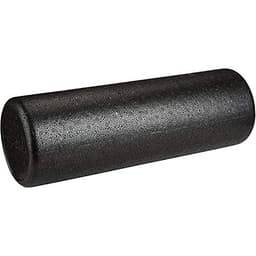
Amazon Basics High-Density Foam Roller (18 in)
A dense smooth cylinder does the mechanical work, and 18 in is long enough to lay a whole calf along. For a first roller aimed at a sore calf, spending more buys texture you do not yet want.
Price as of October 21, 2026. #ad How we’re funded
If flat feels blunt
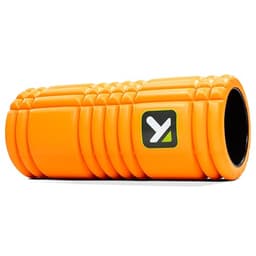
TriggerPoint GRID Foam Roller (13 in)
The multi-density surface gives three pressure intensities on one roller, so there is a tolerable strip for a bad day and a firmer one for a good day.
If the foot is sore
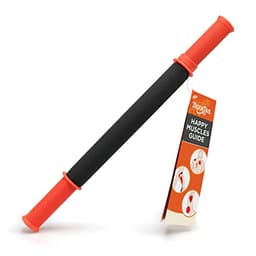
Tiger Tail 18 in Massage Stick
Work the calf from a chair with no weight through the foot at all. Smooth one-piece sleeve, so nothing pinches skin on the way past.
Price as of October 21, 2026. #ad How we’re funded
The part that is not a purchase, and it is the part that works
For midportion Achilles tendinopathy, the intervention with real trial support is progressive loading — slow, heavy calf raises done consistently for months. A randomized controlled trial of 58 patients with chronic midportion Achilles tendinopathy compared twelve weeks of eccentric training against twelve weeks of heavy slow resistance training. Both groups improved significantly on function, symptoms and pain during activity, and those improvements were still present at the 52-week follow-up. Heavy slow resistance tended to produce greater patient satisfaction at 12 weeks, though not at 52.
Two honest points about that. The timescale is twelve weeks and up, not a fortnight. And the specifics — how much load, how many sets, how much discomfort is acceptable during a rep — are exactly the things a physical therapist individualizes and a website cannot. Get the program from a person.
Rolling the calf does not replace any of that. What it does is make the calf less unpleasant to load, which makes the loading program easier to keep doing. That is a genuine supporting role, and it is the honest size of it.
Mistakes that make it worse
- Rolling down onto the tendon to “break up scar tissue.” You cannot mechanically remodel dense collagen with body weight on foam, and the structure you are compressing it against is a bone.
- Rolling hardest on the day it hurts most. Sore-then-sorer is the pattern that makes people quit. On a bad day, do the unloaded seated version or skip it.
- Going fast. A whole calf in two seconds is a warm-up motion. Ten seconds a length is the pace that lets you feel where you are.
- Rolling and nothing else. The roller is the easy part. It is also the part that changes the least.
- Rolling the front of the shin because the calf helped. That is a thin muscle over a bone, and it is covered in the shins and calves guide.
What the makers say about pressure near an irritated tendon
Foam rollers do not ship with contraindication documents. Percussion devices do, and that published list is the closest thing to a written standard in this category. It applies to anything that puts mechanical force into tissue:
“Local tissue inflammation, bruises; bone fracture or myositis ossificans; recent surgery or injury; connective tissue disorders; peripheral vascular insufficiency or disease; medications that thin the blood or alter sensations.”
“Local tissue inflammation” and “recent injury” are the two that matter here, and an angry Achilles is usually both.
Common questions
Can you foam roll the Achilles tendon itself?
No, and there is no technique that makes it productive. The Achilles is dense collagen transmitting force from calf to heel, with poor blood supply and almost nothing between it and the bone it inserts onto. A roller pressed into it compresses an already irritated structure against that bone. Roll the calf above it instead, stopping where the tissue goes from soft and springy to a hard cord.
How long should you foam roll your calf for Achilles pain?
Two or three passes of roughly 45–60 seconds per calf, moving slowly enough that a full length of the muscle takes about ten seconds. Longer is not better; parking on one tender spot for several minutes mostly buys soreness. Doing it most days for weeks matters far more than doing it for a long time on any one day.
Does foam rolling help Achilles tendonitis?
It helps the calf, which is a supporting role rather than a treatment. The intervention with real trial support for midportion Achilles tendinopathy is progressive loading: a randomized trial of 58 patients found both eccentric training and heavy slow resistance produced significant improvements that were still present at 52 weeks. Rolling makes the calf more comfortable so that loading program is easier to keep doing.
What kind of foam roller is best for Achilles and calf pain?
A smooth, dense cylinder is the right first purchase. A randomized trial comparing soft, medium and hard density rollers found no statistically significant difference between them for knee range of motion or pressure pain threshold, so firmness is a tolerance decision rather than a therapeutic one. Buy the one you will actually use on a sore day and regulate pressure with body position instead.
Should I roll my calf before or after running?
After, or on rest days. Rolling beforehand is harmless but is not doing anything for the tendon. If mornings are your worst time, a gentle version sitting on the edge of the bed before your first steps — ankle circles first, then the roller or stick — is the slot most people find useful.
Is a massage gun better than a foam roller for the Achilles?
Neither belongs on the tendon. On the calf, a gun is faster and needs no floor space, while a roller applies broader pressure for a fraction of the price. If you already own a gun, use it on the calf belly with a ball or flat head. If you own neither, a cylinder is the cheaper way to do the same job.
Sources
- 1.Heavy Slow Resistance Versus Eccentric Training as Treatment for Achilles Tendinopathy: A Randomized Controlled Trial - American Journal of Sports Medicine (PubMed 26018970) — 58 patients, 12 weeks of eccentric training or heavy slow resistance; both improved significantly and held at 52 weeks
- 2.Comparison of Three Different Density Type Foam Rollers on Knee Range of Motion and Pressure Pain Threshold: A Randomized Controlled Trial - International Journal of Sports Physical Therapy (PMC6044602) — 36 adults, soft vs medium vs hard rollers - no significant between-group difference in knee ROM (p=.78) or pressure pain threshold (p=.37)
- 3.Therabody — Product Safety & Precautions — contraindication list quoted verbatim above
- 4.Foam Rolling or Percussive Massage for Muscle Recovery: Insights into DOMS (PMC12286022)
- 5.Plantar fascia-specific stretching improves outcomes in chronic plantar fasciitis — two-year follow-up (PubMed 16882901)