Guides
How Often Should You Use a Massage Gun?
Daily is fine for most people, provided each session is short and you are not parking the head on one spot. The limiting factor is almost never frequency — it is duration and pressure, which is where nearly all the harm and all the wasted effort come from.
By Stephen V.Published
Disclosure:Grip & Gait earns a commission when you buy through links on this page, at no extra cost to you. It never changes what we recommend or the order we rank things in — here is exactly how we’re funded.
Quick picks
Ranked on published manufacturer specs and what they mean for the job, not on testing we have not done. Tap a row for the full reasoning. How we score.
| # | Product | Best for | Score | Price |
|---|---|---|---|---|
| 1 |  Bob and Brad C2 Massage Gun Light and fully specified, so a short daily pass is easy and you can verify what it is doing. FSA eligible. | The everyday gun | 8.6 | |
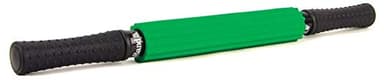
| 2 |  THERABAND Roller Massager+ A stick sets the pressure with your arms, so daily use never turns into leaning too hard on one spot. | When you want zero risk of over-pressing | 7.8 | $35.50 · View on Amazon Price as of October 21, 2026. #ad How we’re funded |
The short answer
Once a day is fine for most people, and you can use it more than once on different muscle groups in a day if you want to. What matters far more than how many times you pick it up is how long you stay on each muscle and how hard you press. A daily two-minute pass on your calves is unremarkable; a daily ten-minute grind parked on one tender spot is how people bruise themselves and irritate nerves.
The numbers that actually limit you
- Per muscle group: roughly 30 seconds to 2 minutes, moving the head continuously. Not longer, and not stationary.
- Per whole-body session: keep it under about 15 minutes. Beyond that you are usually treating muscles that did not need it.
- Per spot: if you pause on a tender point, 20-30 seconds, then move on. Parking the head on one place is the single most common mistake.
Get those right and daily use is not a problem. Get them wrong and even twice-a-week use can cause trouble. The full technique — pressure, angle, where not to go — is in how to use a massage gun, and the before-versus-after timing is in before or after a workout.
Why more is not better
The evidence for percussion is real but modest, and it does not scale with frequency. A randomized controlled trial found percussion gave immediate, temporary relief in perceived soreness each time it was applied, without accelerating recovery until 72 hours — which tells you the benefit is a repeatable in-the-moment effect, not something that compounds if you do it five times a day. The systematic review of percussive therapy supports short-term range-of-motion and strength effects, again without suggesting that more volume produces proportionally more benefit. Using it when you are stiff or sore makes sense; using it constantly does not do more, and does risk more.
Signs you are overdoing it
Stop and cut back if you see any of these:
- Bruising, or tenderness that lingers into the next day.
- Numbness, tingling or a pins-and-needles feeling — a sign you are near a nerve.
- Pain during use that is sharp rather than a dull “good hurt”.
- Redness or skin irritation where you have been working.
These mean too long, too hard, or too close to bone or nerve — not too often. Reduce the duration and pressure first before you change the frequency.
If daily use is tempting because a specific area never settles, the honest move is to check whether a gun is even the right tool for it. Superficial spots over bone, broad leg muscles and a lower back in spasm are all better served by something else — start from the symptom pages, which route each problem to the tool that fits.
Every pick, in full
Specs below are the manufacturer’s own published figures, each linked to the page it came from. Where a maker does not publish a number, the table says so and names the page we checked — that absence is information too.
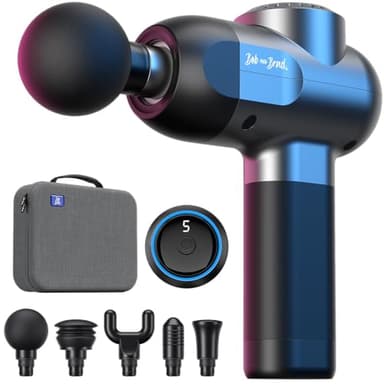
Bob and Brad C2 Massage Gun
The only gun in this roundup whose maker publishes all four numbers that decide whether it reaches the muscle — amplitude, stall force, speed range and noise — and the stall-force figure is higher than the premium units that hide theirs.
What it gets right
- Publishes amplitude, stall force, speed range and noise — the two market leaders publish none of the first three
- Published stall force of over 44 lb is higher than the figure Therabody publishes for the Prime
- 1.5 lb is light enough to hold overhead against your own shoulder without your arm giving out first
- FSA/HSA eligible, which quietly makes it cheaper again for a lot of buyers
What it does not
- 10 mm amplitude is genuinely shorter than a 16 mm premium stroke — that difference is real for glutes and thick back muscle
- No app, no pressure-feedback screen, no ecosystem
- Five fixed speeds rather than a continuous range
Price as of October 21, 2026. #ad How we’re funded
THERABAND Roller Massager+
A handheld stick lets you control the pressure with your arms instead of your body weight, which is the whole argument for it — you can treat a calf sitting in a chair, and you can back off instantly.
What it gets right
- You set the pressure with your arms, so you can stop the instant it is too much
- Usable on a calf without getting on the floor — a genuine accessibility point
- Nothing to charge
What it does not
- Cannot generate the pressure body weight on a ball produces
- Awkward on your own back
Common questions
Can you use a massage gun every day?
Yes, for most people, as long as each session is short and you keep the head moving. Daily use of a couple of minutes per muscle group is unremarkable. The thing that causes problems is not frequency but duration and pressure — long sessions parked on one tender spot are how people bruise themselves and irritate nerves.
How long should a massage gun session be?
Around 30 seconds to 2 minutes per muscle group, moving continuously, with the whole-body session kept under about 15 minutes. If you pause on a tender point, 20-30 seconds is enough before you move on. Longer sessions do not deliver proportionally more benefit and do increase the risk of bruising.
Can you overuse a massage gun?
Yes — usually by pressing too hard or staying on one spot too long rather than by using it too many times. Warning signs are bruising, lingering tenderness, numbness or tingling, and sharp pain during use. If those appear, cut the duration and pressure first. Persistent pain that keeps you reaching for the gun daily is a reason to see a clinician, not to increase the dose.
Sources
- 1.Percussion massage therapy and recovery from delayed onset muscle soreness — randomized controlled trial (PMC11979224)
- 2.The Effect of Percussive Therapy on Musculoskeletal Performance and Experiences of Pain: A Systematic Literature Review (PubMed 37020441)
- 3.Therabody — Product Safety & Precautions