Guides
Are Massage Guns Worth It?
A massage gun does one small, real thing well and several things the marketing implies it does not. Here is what the evidence supports, who should buy one, and who should spend a fraction of the money on a ball instead.
By Stephen V.Published Updated
Disclosure:Grip & Gait earns a commission when you buy through links on this page, at no extra cost to you. It never changes what we recommend or the order we rank things in — here is exactly how we’re funded.
Quick picks
Ranked on published manufacturer specs and what they mean for the job, not on testing we have not done. Tap a row for the full reasoning. How we score.
| # | Product | Best for | Score | Price |
|---|---|---|---|---|
| 1 |  Bob and Brad C2 Massage Gun The budget gun whose maker publishes the depth numbers. The honest yes. | If you buy one, this one | 8.6 | |
| 2 |  TOLOCO Massage Gun (EM26) A real tool at the bottom of the market to find out whether percussion helps you. | Cheapest way to test the idea | 6.8 | |
| 3 |  Kieba Massage Lacrosse Balls For a glute or foot spot, body weight on a ball beats any motor for a fraction of the cost. | The cheaper tool that often wins | 8.7 | $7.99 · View on Amazon Price as of October 21, 2026. #ad How we’re funded |
The short answer
A massage gun is worth it if you will actually use it, if you are honest about what it does, and if you are not expecting it to fix the thing making you sore in the first place. It is a tool for temporary relief and short-term mobility that happens to feel good. It is not a recovery accelerator, and it is not a cure for anything. Buy one on that basis and you will be happy with it. Buy one expecting it to heal an injury or shorten your soreness and you will feel cheated.
The more useful question is not whether massage guns work — they do a small, real thing — but whether they are the right small thing for you, and whether a ball or a roller would do the same job for a fraction of the money. For most people the honest answer is a qualified yes, with two large exceptions we will come to.
What the evidence actually shows
The research on percussive therapy is real, and it is modest. A systematic review of percussive therapy on musculoskeletal performance and pain found it can reduce perceived pain and produce short-term gains in range of motion, while noting that the quality of the underlying studies is mixed and the effects are not large. That is the honest shape of it: something happens, and what happens is temporary.
On soreness specifically, a randomized controlled trial on percussion massage and delayed-onset muscle soreness looked at whether a gun speeds recovery from the ache you get a day or two after hard training. The picture there is muted: percussion can make a muscle feel and move better in the moment without meaningfully accelerating the underlying repair. A direct comparison of foam rolling and percussive massage for DOMS makes the same point from the other side — both helped restore the muscle properties that soreness disrupts, and neither reduced the pain significantly more than simply resting did.
Used before training rather than after, the story is similar. A study on massage gun and foam roller use during a warm-up in trained athletes found it did not meaningfully improve performance. So a gun is a reasonable way to feel loose and ready, but it is not a substitute for an actual warm-up, and it will not make you stronger or faster.
Put those together and the evidence supports three claims and no more: a massage gun can give you temporary pain relief, it can give you a short-term bump in range of motion, and it feels good enough that people who own one tend to keep using it. That last point is not nothing — the recovery tool you enjoy is the one you actually pick up, and a tool you never use is worth less than the cheapest tool you do.
What a massage gun will not do
It will not accelerate recovery in the sense the marketing implies. Your muscle repairs on its own timeline, and buzzing it does not shorten that timeline. It will not cure an injury, a strain, a trapped nerve or a tendon problem — at best it manages the symptom for an hour or two. It will not break up scar tissue or “release” fascia in any structural, permanent way; the looseness you feel afterward is a short-term neurological effect, not tissue you have physically remodelled.
And it will not fix the cause of a recurring problem. If your shoulders are tight every evening because of how you sit all day, the gun treats the tightness and the chair keeps making more of it. Nothing you buy fixes the cause. This matters because the most common way people waste money here is not buying the wrong gun — it is buying any gun at all to solve a problem a gun cannot solve.
Who a massage gun is worth it for
- People with broad, meaty muscle to cover.Quads, calves, big backs and glutes are exactly what a gun is good at — it covers a lot of area quickly and it feels good doing it. If your main complaint is general post-training tightness in large muscles, a gun earns its place.
- People who train and want to feel loose and ready. The short-term range-of-motion bump is real, and using a gun as part of a warm-up or between sets is a legitimate, if minor, use. Just do not confuse feeling ready with being warmed up.
- People who will not or cannot get on the floor.A gun works upright, in a chair, in a few seconds. For stiff hips, weak grip or limited mobility, that accessibility is the whole value — it is the difference between doing something and doing nothing.
- People who simply enjoy it. Adherence is the quiet variable in every recovery study. If the buzzing is the thing that makes you spend ten minutes on your legs you would otherwise skip, that is a real benefit even if the mechanism is mostly that it feels nice.
Who should save the money
If you want to treat one stubborn spot — a knot deep in a glute, a tight point in the arch of a foot, the muscle under a shoulder blade — a gun is the wrong tool and a hard rubber ball is the right one. Your body weight on a ball concentrates far more pressure into a single point than any handheld motor can generate, it reaches places the head of a gun skims straight past, and it costs a tiny fraction of the price. This is the case where the cheap tool does not just tie the expensive one, it wins outright.
If you want general mobility across large muscles and you are happy to get on the floor, a foam roller does much the same short-term job as a gun and the two have been compared head to head — see massage gun vs foam roller. And if you are buying a gun to make an ongoing pain go away, the money is better spent finding out why the pain keeps coming back; the tool routing for the most common version of that, post-workout muscle soreness, is a good place to see how small a role any device really plays.
Premium versus budget: what the extra money buys
Here is the point the category does not want made plainly: spending more does not buy you more depth. Depth comes from stroke length and the force the motor holds under load, and a good budget gun matches or beats the premium ones on both. What the extra money buys is quiet, a nicer handle, better battery behavior, and a brand. Those are real things — a gun quiet enough to use while someone else is in the room is genuinely more usable — but they are comfort upgrades, not effectiveness upgrades.
There is a transparency angle that makes this concrete. The one budget brand here publishes the numbers that decide whether a gun reaches muscle — stroke, the force it holds under load, speed range and noise — while the two biggest premium brands leave the depth figures off their current US product pages entirely. You are being asked to pay more for a gun that tells you less about what it does. That is not a reason to never buy premium; it is a reason to stop assuming premium means deeper. The longer version of this argument is on cheap vs expensive massage guns, and if you have decided a gun is worth it, the shortlist is the best budget massage guns.
So: are massage guns worth it? For broad muscle, for people who will use one, and bought with clear eyes about what it does, yes — and a well-specified budget gun is worth it more often than a premium one. For a single stubborn spot, or to fix a pain with a cause, no — buy a ball, or spend the money on the cause. Once you own one, how to get value out of it is covered in how to use a massage gun and how often to use one.
The comparison that puts the hardest limit on what a gun is worth is not against another gun: massage gun vs shockwave therapy sets the home device against the clinic procedure that has randomized trials in five named tendinopathies.
Every pick, in full
Specs below are the manufacturer’s own published figures, each linked to the page it came from. Where a maker does not publish a number, the table says so and names the page we checked — that absence is information too.
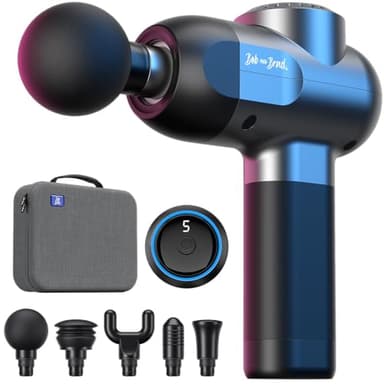
Bob and Brad C2 Massage Gun
The only gun in this roundup whose maker publishes all four numbers that decide whether it reaches the muscle — amplitude, stall force, speed range and noise — and the stall-force figure is higher than the premium units that hide theirs.
What it gets right
- Publishes amplitude, stall force, speed range and noise — the two market leaders publish none of the first three
- Published stall force of over 44 lb is higher than the figure Therabody publishes for the Prime
- 1.5 lb is light enough to hold overhead against your own shoulder without your arm giving out first
- FSA/HSA eligible, which quietly makes it cheaper again for a lot of buyers
What it does not
- 10 mm amplitude is genuinely shorter than a 16 mm premium stroke — that difference is real for glutes and thick back muscle
- No app, no pressure-feedback screen, no ecosystem
- Five fixed speeds rather than a continuous range
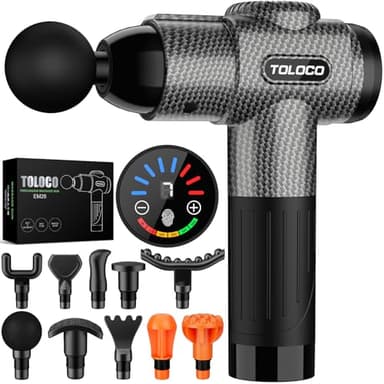
TOLOCO Massage Gun (EM26)
The cheapest gun worth owning, and the ten-attachment box is not the selling point the listing thinks it is — but if the alternative is not buying one at all, this is a real tool.
What it gets right
- Cheap enough that it is not a decision
- Ten attachments, of which you will use two
- Light enough for self-application
What it does not
- No published amplitude or stall force from the manufacturer
- Build quality is what the price implies — treat it as a two-year tool
- Loud relative to premium units
Price as of October 21, 2026. #ad How we’re funded
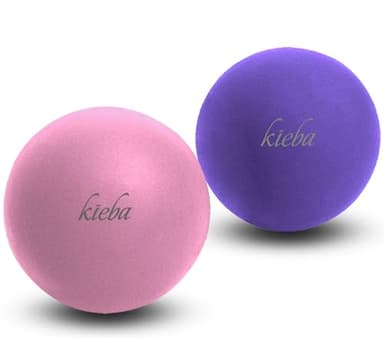
Kieba Massage Lacrosse Balls
The highest work-per-dollar tool on this entire site. A hard rubber sphere concentrates all your body weight into one square inch, which is more pressure than any handheld gun can generate.
What it gets right
- Concentrates body weight into a single point — more local pressure than any percussion device
- Nothing to charge, nothing to break, fits in a coat pocket
- Reaches under the shoulder blade against a wall, which a roller physically cannot
What it does not
- Unforgiving — very easy to overdo on a first session
- Wrong tool for broad surfaces like quads or lats
Common questions
Are massage guns worth the money?
For broad muscle groups and for people who will actually use one, yes — but only as a tool for temporary relief and short-term mobility, not as a recovery accelerator or a cure. A well-specified budget gun is worth it more often than a premium one, because the extra money buys quiet and ergonomics rather than more depth. For a single stubborn knot, a hard rubber ball does the job better for a fraction of the price.
Do massage guns actually speed up muscle recovery?
Not in the way the marketing implies. The evidence supports temporary pain relief and a short-term bump in range of motion, and a percussion device can make a sore muscle feel and move better in the moment. But controlled comparisons with DOMS found percussion did not reduce soreness significantly more than resting did, and it does not shorten the timeline your muscle repairs on. It feels good and it helps you move; it does not accelerate the underlying repair.
Should I buy a massage gun or a massage ball?
It depends on the job. For broad muscle groups like quads, calves and the big back muscles, a gun covers a lot of area quickly and feels good. For a single deep spot — a glute knot, the arch of a foot, the muscle under a shoulder blade — a ball wins, because your body weight on it concentrates far more pressure into one point than any handheld motor can, and it costs a tiny fraction of the price. Many people are best served owning both a cheap gun and a ball.
Sources
- 1.The Effect of Percussive Therapy on Musculoskeletal Performance and Experiences of Pain: A Systematic Literature Review (PubMed 37020441)
- 2.Percussion massage therapy and recovery from delayed onset muscle soreness — randomized controlled trial (PMC11979224)
- 3.Foam Rolling or Percussive Massage for Muscle Recovery: Insights into DOMS (PMC12286022)
- 4.Does Massage Gun or Foam Roller Use During a Warm-Up Improve Performance in Trained Athletes? (PMC12473898)
- 5.Bob and Brad — C2 massage gun product page
- 6.Therabody — Theragun Prime product page