Compare
Massage Gun vs Shockwave Therapy
These are not two versions of the same treatment, and the marketing that implies otherwise is the reason this page exists. Shockwave is an energy delivered by a clinician and studied in specific tendon problems. A massage gun is a comfort and range-of-motion tool you own. If you have a diagnosed tendinopathy that has not responded to loading, ask about the first. For everything else, the second is the sensible purchase.
By Stephen V.Published
Disclosure:Grip & Gait earns a commission when you buy through links on this page, at no extra cost to you. It never changes what we recommend or the order we rank things in — here is exactly how we’re funded.
The verdict in one paragraph
If you have a diagnosed tendinopathy— tennis elbow, rotator cuff tendinopathy, Achilles tendinopathy, pain over the side of the hip, or patellar tendon pain — that has not responded to months of progressive loading, extracorporeal shockwave therapy is a real clinical option with a substantial randomized-trial literature behind it, and the conversation belongs with a clinician. If what you have is sore, stiff, tight muscle, or you want something at home for after training and before a session, buy a massage gun; the Bob and Brad C2 is the one we would start with because it publishes the two numbers that matter. What you cannot do is buy shockwave. No handheld device sold to consumers delivers it, whatever the listing copy suggests.
Two different physical events
A massage gun is a motor driving a head back and forth. The specifications that describe it are amplitude (how far the head travels), stall force (how hard you can lean on it before the motor gives up) and percussions per minute — the Hypervolt Go 3, for instance, publishes a 1,500 to 2,500 RPM range and 55 dB. It is mechanical, repetitive, and applied through skin to muscle at a pressure you control with your own arm.
Extracorporeal shockwave therapy is an acoustic pressure wave generated in a handpiece and transmitted into tissue, delivered in a clinic at an energy level set per protocol and per patient, in a course of sessions rather than a single visit. The target is usually a specific tendon or its insertion, located on examination or imaging. Those are not the same event at different intensities, and the clue is in who is allowed to operate the device.
| What you have | Which one | Why |
|---|---|---|
| Sore, tight muscle after training | Massage gun | Short bouts of percussion reliably produce immediate, short-lived gains in range of motion and reductions in perceived soreness. That is exactly this problem. |
| Stubborn tendon pain, months of loading already done | Shockwave, via a clinician | The randomized-trial literature on ESWT is built on five named tendinopathies. A gun has nothing comparable to offer a tendon. |
| Stiffness before a workout | Massage gun | Cheap, immediate, and the effect lasts long enough to get you into the session. No clinic appointment can be scheduled at 6am in your kitchen. |
| Tennis elbow that will not settle | Loading first, then ask about shockwave | Lateral epicondylitis is one of the five tendinopathies in the network meta-analysis, and progressive loading is still the first thing to have tried properly. |
| Plantar heel pain | Loading and a clinician | Shockwave is used here and is compared against other physical modalities in the current literature. Percussion on a heel is comfort, not treatment. |
| A tendon you have never had assessed | Neither yet | Both routes depend on knowing which structure is involved. Guessing costs more than the appointment. |
What the trial evidence actually covers
On the clinic side, the 2026 systematic review and network meta-analysis of extracorporeal shockwave therapy in tendinopathy is the reference worth knowing. It included 65 publications from 2002 to 2024, a total sample of 3,921 cases, and five types of tendinopathy: lateral epicondylitis, rotator cuff tendinopathy, Achilles tendinopathy, greater trochanteric pain syndrome and patellar tendinopathy. It compared ESWT with other conservative treatments rather than with nothing, graded the evidence with GRADE, and set out to establish where ESWT has value by tendinopathy type — its own stated reason for existing being that previous meta-analyses were too small to say whether ESWT works for all tendinopathies or only some. That is the honest shape of it: a real literature, with the open question being which tendons it helps most, not whether the field exists.
On the home side, the literature is about something else entirely. A 2023 review of percussive massage therapy and a randomized trial on range of motion describe the effect a gun does have: immediate, short-lived increases in range of motion and reductions in perceived soreness. A 2025 comparison of foam rolling against percussive therapy found both do broadly similar things for soreness — which is a useful reality check on the premium end of the gun market, and a reminder that nothing in this corner of the evidence is about tendon healing.
Put plainly: the two bodies of evidence do not compete, because they are not measuring the same outcome on the same tissue.
What matters if you are buying the home half
- Published amplitude and stall force. These are the only two numbers that separate a percussive device from a vibrating one, and plenty of expensive guns publish neither. A budget gun that states both tells you more than a premium gun that states nothing.
- Weight, if you are treating yourself. You hold this against your own shoulder, calf or hip. Under about 1.6 lb is the difference between a tool you use and a forearm workout.
- A stated noise figure, if anyone else is in the room. Few makers publish decibels. The ones that do are usually the ones with nothing to hide elsewhere.
- Battery life you will actually hit. Two hours of stated runtime is several weeks of real sessions. Four is better and rarely the deciding factor.
- Nothing that claims to treat a tendon. That claim belongs to the clinic route, and a device making it is telling you how carefully the rest of its copy was written.
What we would actually buy for the home half
If the decision has come down to “I will ask about shockwave for the tendon, and I want something for the muscle at home”, these are the three we would choose between.
The one that publishes its numbers
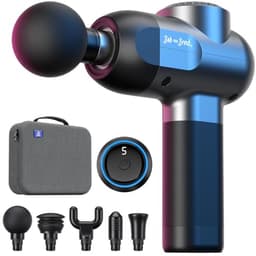
Bob and Brad C2 Massage Gun
Amplitude and stall force both stated, at a budget price, which is more than most premium guns manage. If you want to know what you bought rather than how it was marketed, start here.
Light enough to reach yourself
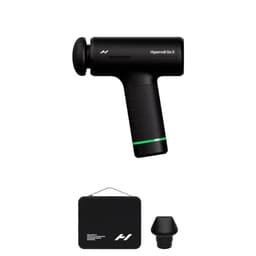
Hyperice Hypervolt Go 3
A published 1.6 lb, 55 dB and a 1,500-2,500 RPM range. The weight is what decides whether you can hold it against your own shoulder or Achilles for ninety seconds without the other arm complaining.
Price as of October 21, 2026. #ad How we’re funded
If you want the premium ergonomics
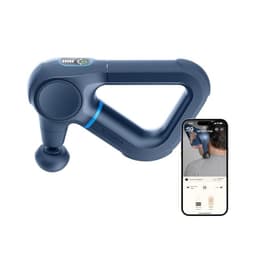
Therabody Theragun Prime (6th Gen)
The handle geometry and the brand's support are what the money buys. It still does not publish an amplitude figure, which is worth knowing before you pay for it.
Price as of October 21, 2026. #ad How we’re funded
So, which one
- Tendon pain that has outlasted a proper loading program: shockwave, through a clinician. The literature is in five named tendinopathies and yours may be one of them.
- Muscle soreness, stiffness, pre-workout and post-workout: a massage gun. Short bouts, real effect, fades quickly, costs once.
- Both, honestly: plenty of people use a gun for the surrounding muscle while a clinician works on the tendon. They are not in competition, which is the point of this page.
- Neither, yet: if nobody has told you which structure hurts, an appointment is cheaper than either path and makes both of them work better.
Where to go next
For the specific tendons: tennis elbow, Achilles and heel pain, rotator cuff pain and plantar fasciitis each have their own routine and tool list. For the gun side, are massage guns worth it is the honest value question and how to use a massage gun is worth more than any upgrade. And if you are comparing the gun against the other home options rather than against a clinic, massage gun vs foam roller is the comparison most people actually need.
Common questions
Is a massage gun the same as shockwave therapy?
No. A massage gun is a motor driving a head back and forth against your skin at a pressure you control, described by amplitude, stall force and percussions per minute. Shockwave therapy is an acoustic pressure wave generated in a clinical handpiece, delivered at a set energy by a clinician in a course of sessions, usually aimed at a specific tendon. No consumer handheld delivers shockwave, so listings using the word are describing marketing rather than a specification.
Which conditions is shockwave therapy actually studied in?
The 2026 network meta-analysis of extracorporeal shockwave therapy in tendinopathy included 65 publications from 2002 to 2024 and 3,921 cases across five types: lateral epicondylitis (tennis elbow), rotator cuff tendinopathy, Achilles tendinopathy, greater trochanteric pain syndrome and patellar tendinopathy. It compared ESWT against other conservative treatments and graded the evidence with GRADE, with the open question being which tendinopathies benefit most rather than whether the treatment has a literature.
Can a massage gun help tendonitis?
It can make the muscle around an irritated tendon more comfortable, and it does not treat the tendon. The percussion literature describes short-lived gains in range of motion and reductions in perceived soreness, not tendon healing. The treatment that changes a tendon is progressive loading, and the clinic escalation if loading has genuinely failed is shockwave. Using a gun directly on a painful tendon insertion is a good way to flare it.
Is shockwave therapy worth it?
It is worth asking about if you have a tendinopathy that has not responded to a properly progressed loading program over months, and it is priced per session by the clinic delivering it, so the cost is a local question rather than one we can publish. It is not a first move, it is not for everyone — pregnancy, clotting disorders, anticoagulants, local infection and recent steroid injection into the same site are all reasons a clinician may decline — and it is not something to substitute for the loading work.
Sources
- 1.The Effect of Extracorporeal Shockwave Therapy in Tendinopathy: A Systematic Review and Network Meta-Analysis of Randomized Controlled Trials - Orthopaedic Surgery 2026 (PMC13572833) — 65 publications 2002-2024, 3,921 cases, five tendinopathies, GRADE-assessed
- 2.The Effect of Percussive Therapy on Musculoskeletal Performance and Experiences of Pain: A Systematic Literature Review (PubMed 37020441) — what percussive therapy does and does not do
- 3.Acute Effects of Theragun Percussive Therapy on Viscoelastic Tissue Dynamics and Hamstring Range of Motion (PMC10499144) — immediate, short-lived range-of-motion and soreness effects
- 4.Foam Rolling or Percussive Massage for Muscle Recovery: Insights into DOMS (PMC12286022) — foam rolling and percussion produce broadly similar soreness effects
- 5.Hyperice — Hypervolt Go 3 product page — 1.6 lb, 55 dB, 1,500-2,500 RPM - the published figures quoted