Guides
Massage Gun Before or After a Workout?
Both, but differently. A brief pass before training is a mobility and activation tool; a longer, gentler pass after is about how you feel, not how fast you recover. The evidence supports the first more cleanly than the second, and the difference is worth understanding before you build a routine around it.
By Stephen V.Published
Disclosure:Grip & Gait earns a commission when you buy through links on this page, at no extra cost to you. It never changes what we recommend or the order we rank things in — here is exactly how we’re funded.
Quick picks
Ranked on published manufacturer specs and what they mean for the job, not on testing we have not done. Tap a row for the full reasoning. How we score.
| # | Product | Best for | Score | Price |
|---|---|---|---|---|
| 1 |  Bob and Brad C2 Massage Gun Published specs, light, and it turns down far enough for a controlled pre-workout pass without hammering cold muscle. | The gun this guide assumes | 8.6 | |
| 2 |  Therabody Theragun Prime (6th Gen) The pressure-feedback display keeps a pre-workout pass light, which is exactly when people press too hard. | If you tend to over-press | 7.9 | $329.99 · View on Amazon Price as of October 21, 2026. #ad How we’re funded |
Before training: short, light, and about mobility
Used before a workout, a massage gun is a warm-up and activation tool, not a treatment. The goal is a brief pass — roughly 15 to 30 seconds per muscle group — on a lower speed, to raise tissue temperature and improve short-term range of motion before you load the muscle. It replaces or supplements the mobility part of a warm-up; it does not replace actually warming up by moving.
A study on massage gun or foam roller use during a warm-up examined exactly this question in trained athletes, and the broader systematic review of percussive therapy supports short-term improvements in range of motion and acute, explosive strength. The practical read: a short pre-workout pass can leave you moving a little more freely without dulling power, which is the opposite of what long static stretching can do before explosive work. The full gun-versus-stretch comparison, including the one trial that put them head to head, is in massage gun vs stretching.
The key word is short. A long, deep session before training is counterproductive — you want the muscle switched on and mobile, not worked over. Keep it brief, keep it light, and finish with the actual movement you are about to do.
After training: longer, gentler, and about how you feel
Used after a workout, the honest goal is comfort, not accelerated recovery. This is where the research gets more sobering. A randomized controlled trial on percussion massage found it gave immediate, temporary relief in perceived soreness at 24, 48 and 72 hours — but did not actually accelerate recovery from delayed onset muscle soreness until the 72-hour mark. A study on percussive massage after eccentric exercise-induced muscle damage looked at the same territory.
Read together with the foam-rolling-versus-percussion comparison — which found neither reduced pain significantly more than simply resting — the conclusion is consistent: a post-workout pass reliably feels good and reliably improves how sore you perceive yourself to be in the moment. It does not reliably make the soreness resolve faster. That is still a genuinely useful thing; feeling less sore now has real value. Just buy it for what it does, not for a recovery claim the evidence does not support.
A simple routine for each
- Pre-workout: lower speed, 15-30 seconds per muscle group you are about to train, moving continuously. Then do a movement-based warm-up. Total: two or three minutes.
- Post-workout: a comfortable speed, up to about two minutes per group, moving continuously and never parking on one spot. Keep the whole session under fifteen minutes.
The mechanics of using it well — how hard to press, where not to go — are the same either way, and we cover them in full in how to use a massage gun. How frequently to do this is its own question, answered in how often to use a massage gun.
What about compression, heat and cold around a workout?
A gun is one option among several, and the timing question applies to them too. Compression boots are a passive after-session tool; heat suits stiffness and guarding; a percussion gun suits mobility and targeted soreness. We compare the after-workout options in before or after a workout for compression boots and route the whole decision by symptom on the DOMS and soreness page.
Every pick, in full
Specs below are the manufacturer’s own published figures, each linked to the page it came from. Where a maker does not publish a number, the table says so and names the page we checked — that absence is information too.
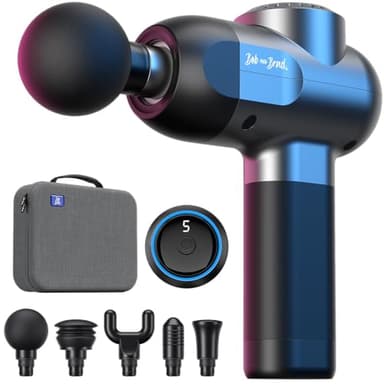
Bob and Brad C2 Massage Gun
The only gun in this roundup whose maker publishes all four numbers that decide whether it reaches the muscle — amplitude, stall force, speed range and noise — and the stall-force figure is higher than the premium units that hide theirs.
What it gets right
- Publishes amplitude, stall force, speed range and noise — the two market leaders publish none of the first three
- Published stall force of over 44 lb is higher than the figure Therabody publishes for the Prime
- 1.5 lb is light enough to hold overhead against your own shoulder without your arm giving out first
- FSA/HSA eligible, which quietly makes it cheaper again for a lot of buyers
What it does not
- 10 mm amplitude is genuinely shorter than a 16 mm premium stroke — that difference is real for glutes and thick back muscle
- No app, no pressure-feedback screen, no ecosystem
- Five fixed speeds rather than a continuous range
Price as of October 21, 2026. #ad How we’re funded
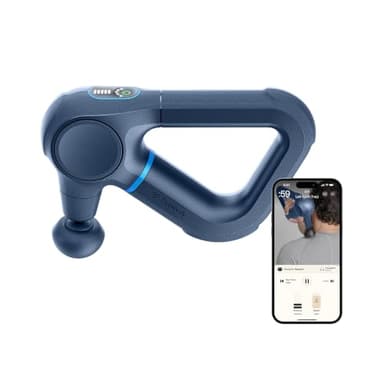
Therabody Theragun Prime (6th Gen)
The long-stroke option, and the build quality is not in question — but Therabody's current US product page publishes dimensions, weight, battery and warranty and does not publish amplitude, stall force, PPM or noise, so the numbers most buyers are shopping on are not on the page they are shopping from.
What it gets right
- The 16 mm stroke Therabody quotes is genuinely long, and stroke length is what determines depth
- Real-time pressure feedback stops the most common user error — leaning on it far too hard
- Rated by Therabody to survive drops from 10 feet, which matters more than it sounds for a thing you use on a hard floor
What it does not
- Amplitude, stall force, PPM and dB are absent from the current US product page — we checked
- Two attachments in the box, against five on guns costing a fifth as much
- 120 minutes of battery is quoted at the LOWEST speed setting, which is not the setting you will use
- One-year limited warranty on a device at this price
| Amplitude | Not published page we checked |
|---|---|
| Stall force | Not published page we checked |
| Speed range | Not published page we checked |
| Speed settings | 5 source |
| Weight | 2 lb source |
| Noise | Not published page we checked |
| Battery | 2 h source |
| Attachments | 2 source |
| Warranty | 1-year limited source |
| Dimensions | 238 × 153 × 61 mm source |
Common questions
Should I use a massage gun before or after a workout?
Both, differently. Before training, use short 15-30 second passes on a lower speed as a mobility and activation tool — the research supports short-term range-of-motion and acute strength benefits. After training, use longer, gentler passes for comfort; percussion gives temporary relief from soreness but does not reliably speed recovery. Keep pre-workout brief and post-workout under fifteen minutes.
Does a massage gun help muscle recovery?
It helps how you feel more than how fast you recover. A controlled trial found percussion gave immediate, temporary relief in perceived soreness but did not accelerate recovery from DOMS until 72 hours, and a direct comparison with foam rolling found neither reduced pain more than rest. Feeling less sore now is real and useful — just do not expect it to shorten the soreness itself.
Is it bad to use a massage gun before lifting?
Not if you keep it short and light. A brief, low-speed pass before lifting can improve short-term mobility without dulling power, unlike long static stretching. A long, deep session beforehand is the mistake — it works the muscle over when you want it switched on. Keep the pre-workout pass to seconds per group and finish with the movement you are about to do.
Sources
- 1.Does Massage Gun or Foam Roller Use During a Warm-Up Improve Performance in Trained Athletes? (PMC12473898)
- 2.The Effect of Percussive Therapy on Musculoskeletal Performance and Experiences of Pain: A Systematic Literature Review (PubMed 37020441)
- 3.Percussion massage therapy and recovery from delayed onset muscle soreness — randomized controlled trial (PMC11979224)
- 4.Effects of Percussive Massage Treatments on Symptoms Associated with Eccentric Exercise-Induced Muscle Damage (PMC10915620)
- 5.Foam Rolling or Percussive Massage for Muscle Recovery: Insights into DOMS (PMC12286022)