Massage Guns
Theragun Prime vs Theragun Pro
Both are good hardware from a brand that builds good hardware. The question is not which is better — it is whether the Pro’s considerable price premium buys anything a person treating their own body at home will ever use. For most people, it does not.
By Stephen V.Published
Disclosure:Grip & Gait earns a commission when you buy through links on this page, at no extra cost to you. It never changes what we recommend or the order we rank things in — here is exactly how we’re funded.
Quick picks
Ranked on published manufacturer specs and what they mean for the job, not on testing we have not done. Tap a row for the full reasoning. How we score.
| # | Product | Best for | Score | Price |
|---|---|---|---|---|
| 1 |  Therabody Theragun Prime (6th Gen) The long-stroke Therabody most people should actually buy. Pressure feedback, drop-rated, and hundreds of dollars less than the Pro. | The right Therabody for home | 7.9 | $329.99 · View on Amazon Price as of October 21, 2026. #ad How we’re funded |
| 2 |  Therabody Theragun Pro The rotating arm and continuous-use build are real, and wasted on one person's calves. Built for a practitioner running it for hours. | Clinic-volume use only | 6.4 | |
| 3 |  Bob and Brad C2 Massage Gun Publishes the amplitude and stall force both Theraguns omit, at a fraction of either price. The honest third answer. | The option Therabody won't mention | 8.6 |
The short answer
For treating your own body at home, buy the Prime. The Prois a better clinic tool — a rotating arm that helps reach awkward angles, and a build rated for hours of continuous daily use across many bodies — but those are exactly the things a single home user never draws on. You would be paying a large premium for durability you will not consume and an ergonomic feature you will use occasionally.
What they share
Both are Therabody percussive guns with the brand’s long stroke and its ecosystem. And both share the same frustration we document across the range: Therabody’s current US product pages publish dimensions, weight, battery and warranty, and do not publish amplitude, stall force, percussions per minute or noise. Those are the numbers that decide depth, and they are absent from the pages you buy from. We checked, and wrote it up in cheap vs expensive massage guns.
Where the Pro genuinely differs
- Rotating arm.The adjustable arm is the Pro’s signature, and it does genuinely help you reach your own back. Whether that is worth a large premium over a fixed-handle gun is the entire decision.
- Continuous-use build. The Pro is engineered to be run for hours a day, every day, on different people. A home user runs a gun for a few minutes a few times a week. The durability is real and it is aimed at a duty cycle you do not have.
- Price. The gap between them is not small, and it does not buy more depth. It buys the arm and the duty cycle.
Where the Prime is the smarter home buy
- The same long stroke. The therapeutic reach into thick muscle is a Therabody strength on both units.
- Pressure feedback.The Prime’s display corrects the single most common user error — leaning on the gun far too hard — which matters more for a home user than a rotating arm does.
- Drop rating. Rated by Therabody to survive drops from ten feet, which is more relevant to a thing you use on a hard floor than clinic-grade duty cycle is.
- Hundreds of dollars kept. Money better spent on nothing, or on a ball and a roller that cover the jobs a gun does badly.
The comparison neither product page invites
Here is the uncomfortable part for a Therabody-versus-Therabody piece: on the published numbers that decide depth, a $70 gun beats both. The Bob and Brad C2 publishes 10 mm amplitude and over 44 lb of stall force — a stall force higher than the figure Therabody has historically quoted for the Prime — while both Theraguns publish neither on their product pages. What the Therabody premium buys is build quality, ergonomics, the pressure display and brand support, all real, none of them depth. If you are choosing on specification rather than brand, read Bob and Brad vs Theragun before you spend. And if the real question is the Prime against the smaller Theragun rather than the bigger one, Theragun Prime vs Mini is that comparison.
Both guns carry the same manufacturer precautions, which apply regardless of which you choose — percussion is not for everyone, and older hands and thin skin deserve the gentler end of the range or a different tool entirely.
Every pick, in full
Specs below are the manufacturer’s own published figures, each linked to the page it came from. Where a maker does not publish a number, the table says so and names the page we checked — that absence is information too.
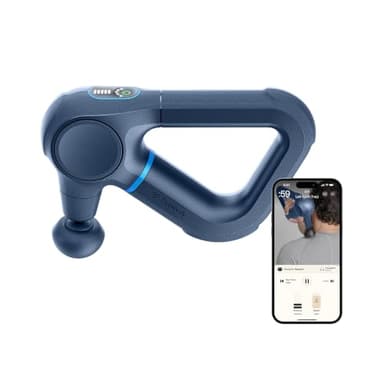
Price as of October 21, 2026. #ad How we’re funded
Therabody Theragun Prime (6th Gen)
The long-stroke option, and the build quality is not in question — but Therabody's current US product page publishes dimensions, weight, battery and warranty and does not publish amplitude, stall force, PPM or noise, so the numbers most buyers are shopping on are not on the page they are shopping from.
What it gets right
- The 16 mm stroke Therabody quotes is genuinely long, and stroke length is what determines depth
- Real-time pressure feedback stops the most common user error — leaning on it far too hard
- Rated by Therabody to survive drops from 10 feet, which matters more than it sounds for a thing you use on a hard floor
What it does not
- Amplitude, stall force, PPM and dB are absent from the current US product page — we checked
- Two attachments in the box, against five on guns costing a fifth as much
- 120 minutes of battery is quoted at the LOWEST speed setting, which is not the setting you will use
- One-year limited warranty on a device at this price
| Amplitude | Not published page we checked |
|---|---|
| Stall force | Not published page we checked |
| Speed range | Not published page we checked |
| Speed settings | 5 source |
| Weight | 2 lb source |
| Noise | Not published page we checked |
| Battery | 2 h source |
| Attachments | 2 source |
| Warranty | 1-year limited source |
| Dimensions | 238 × 153 × 61 mm source |
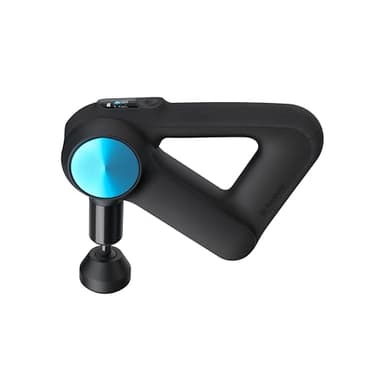
Therabody Theragun Pro
Built for a practitioner who runs it for hours a day across many bodies. For one person's own calves and shoulders it is the most expensive way to do a job a $70 gun does — which is why it is our skip.
What it gets right
- Rotating arm genuinely helps reach your own back
- Built for continuous professional use in a way the consumer models are not
What it does not
- The price gap over a fully-specified budget gun buys durability you will not consume at home
- Heavy in the hand for self-treatment
- Same unpublished-amplitude problem as the rest of the range
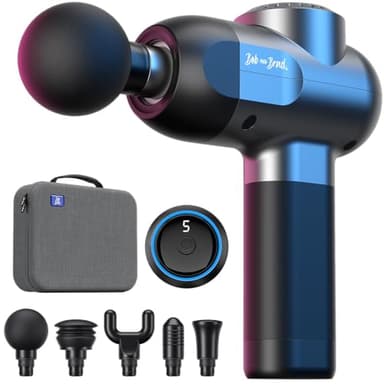
Bob and Brad C2 Massage Gun
The only gun in this roundup whose maker publishes all four numbers that decide whether it reaches the muscle — amplitude, stall force, speed range and noise — and the stall-force figure is higher than the premium units that hide theirs.
What it gets right
- Publishes amplitude, stall force, speed range and noise — the two market leaders publish none of the first three
- Published stall force of over 44 lb is higher than the figure Therabody publishes for the Prime
- 1.5 lb is light enough to hold overhead against your own shoulder without your arm giving out first
- FSA/HSA eligible, which quietly makes it cheaper again for a lot of buyers
What it does not
- 10 mm amplitude is genuinely shorter than a 16 mm premium stroke — that difference is real for glutes and thick back muscle
- No app, no pressure-feedback screen, no ecosystem
- Five fixed speeds rather than a continuous range
Common questions
Is the Theragun Pro worth it over the Prime?
For home use, usually not. The Pro’s advantages — a rotating arm and a build rated for hours of continuous daily use — are aimed at practitioners treating many people. A home user runs a gun for minutes at a time and never reaches that duty cycle, so the large price premium buys durability you will not consume. Buy the Prime and keep the difference.
What is the difference between the Theragun Prime and Pro?
The Pro adds a rotating adjustable arm and a build engineered for continuous professional use, at a considerable price premium. The Prime keeps the same long stroke and adds pressure feedback and a ten-foot drop rating in a lighter, cheaper, fixed-handle body. Neither publishes amplitude or stall force on its current US product page.
Is a Theragun better than a cheaper massage gun?
On build quality, ergonomics and support, a Theragun is a nicer object. On the published numbers that decide depth, a well-specified budget gun matches or beats both Theraguns here — it publishes amplitude and stall force, which neither Theragun does. Pay the Therabody premium for the object and the ecosystem, not for more reach into muscle.
Sources
- 1.Therabody — Theragun Prime product page — no amplitude or stall force published
- 2.Therabody — Theragun Pro product page
- 3.Bob and Brad — C2 massage gun product page — amplitude and stall force published
- 4.Therabody — Product Safety & Precautions