Massage Guns
The Best Massage Guns for Sciatica
The honest framing first: a percussion gun does not treat sciatica. It treats the glute and hamstring muscle that tightens protectively around an irritated nerve root, and for a lot of people that is enough to move more normally - which is the thing the evidence actually supports. That makes this a ranking about reach and control rather than power, because the muscle in question is behind you and the nerve you must not percuss runs right past it.
By Stephen V.Published
Disclosure:Grip & Gait earns a commission when you buy through links on this page, at no extra cost to you. It never changes what we recommend or the order we rank things in — here is exactly how we’re funded.
Quick picks
Ranked on published manufacturer specs and what they mean for the job, not on testing we have not done. Tap a row for the full reasoning. How we score.
| # | Product | Best for | Score | Price |
|---|---|---|---|---|
| 1 |  Ekrin Athletics B37v2 Massage Gun The 15-degree angled handle is what lets you hold a head on your own buttock without crossing your body and losing control of where it is pointing. Lifetime warranty. | Best overall, reaching your own glute | 8.5 | |
| 2 |  Bob and Brad C2 Massage Gun The only gun here that publishes amplitude, stall force, speed range and noise - and when you are working a hand's width from a nerve, knowing what the device actually delivers is worth more than it is anywhere else on the site. | Best value, and the budget pick | 8.4 | |
| 3 |  Therabody Theragun Relief Deliberately gentler than the rest of the Therabody range and the lightest gun here, which is the right direction for an irritable back. Therabody publishes none of the depth specs. | When percussion flares it up | 8.1 | |
| 4 |  Therabody Theragun Prime (6th Gen) The gluteus maximus is the thickest muscle on the body and this is the longest stroke anyone here claims. Pressure feedback helps you not lean on it. The figures are not on the product page. | Thick glutes, longest quoted stroke | 7.6 | |
| ✕ |  TOLOCO Massage Gun (EM26) A fine cheap gun on a quad, and the wrong one near a nerve: no published depth specs at all, and a ten-head box whose bullet attachment encourages exactly the placement this page tells you to avoid. Skip this | The one to skip for this job | 5.8 |
The short version
Buy the Ekrin B37v2 if you can stretch to it, and the Bob and Brad C2if you cannot. Both decisions follow from the same fact: the muscle you are treating for sciatica is your own gluteus maximus and the top of your own hamstring, and the hard part of that job is holding a device at a controlled angle behind your own back for a minute at a time. The Ekrin’s angled handle is the only design in this category that genuinely helps with that. The C2 is the only gun that publishes what it actually delivers, which matters more here than anywhere else on the site.
If percussion makes your symptoms worse rather than better — a common pattern with an irritable nerve root — the Theragun Relief is the gentler unit, and the correct move may be to stop percussing and use heat or TENS instead, both of which have a better-documented case for this condition than a gun does.
What a gun can and cannot do for sciatica
This belongs before the picks. “Sciatica” names a symptom — pain referred along the path of the sciatic nerve — not a cause. The usual driver is an irritated or compressed lumbar nerve root, and the muscle around it tightens protectively in response. A percussion device does nothing whatsoever to the compression. What it can do is work on the guarding muscle, which for many people takes enough of the ache out of the buttock and the back of the thigh to move more normally.
Moving more normally is the part that matters. A 2026 systematic review of conservative treatment for lumbar radiculopathy pulled together nineteen randomized trials and could not pool them because of heterogeneity, but every quantified win it reports came from movement: spinal mobilization with leg movement reduced leg pain by a mean 2.0 points at two weeks and 2.6 at six months, and targeted neural mobilization beat conventional therapy at eight weeks on both pain and disability. Nothing in that literature is about percussion devices.
So the honest claim for a gun here is narrow and second-order: it is a symptom tool that may make the movement-based treatment tolerable. If you are choosing between spending on a gun and spending on getting assessed and moving, spend it on the second thing.
The placement rule, and the paper behind it
Do not put a percussion head on a numb area, and do not chase the pain down the leg. The first half of that is not general caution; it is specific and measured. A quantitative sensory testing study in the Scandinavian Journal of Pain examined 26 patients with unilateral leg pain in the L5 or S1 distribution and split them by presentation: 8 had radicular pain only, and 18 had radicular pain plus radiculopathy. The radiculopathy group showed a localized loss of function in the painful leg — reduced warm detection, reduced mechanical detection and reduced vibration detection in the main pain area and in the relevant dermatome. Seventy-eight percent of them reported numbness. None of the radicular-pain-only group did.
Read that in practical terms. A large share of people shopping for a massage gun for sciatica have measurably reduced ability to feel pressure and vibration in exactly the area they are thinking of treating. A device whose entire feedback mechanism is “stop when it hurts too much” is unreliable on skin that cannot report properly. So the gun goes on the buttock and the upper back of the thigh, on the side that is not numb, and nowhere near the calf or the foot where the pain is only being referred to.
The second half — do not chase it down the leg — follows from the same anatomy. Percussing a calf because that is where it hurts treats tissue that is not the source of anything, and the sciatic nerve itself runs close to the surface in the back of the thigh and behind the knee. There is nothing to gain there and a nerve to irritate.
How we ranked these for sciatica
- Can you reach your own glute at a controlled angle? Weighted above everything else, because this is the whole job. An angled handle lets you come around the outside of your hip rather than reaching across your own body, and a grip you can actually hold is what keeps the head where you put it.
- Control over power. Near a nerve, the ability to work gently and keep the head moving matters more than depth. A gun that only feels right at full intensity is the wrong gun for this.
- Published numbers. The Bob and Brad C2 publishes 10 mm of amplitude, over 44 lb of stall force, a 2,000–3,200 PPM range and a figure under 60 dB. Therabody’s current US Prime page publishes none of those four; Hyperice publishes no amplitude for any handheld. Everywhere else on this site that is an argument about value. Here it is an argument about knowing what you are applying next to a nerve root.
- Weight behind your own back. Treating your own glute means an arm bent behind you, and the gun you can hold steady for ninety seconds there is not necessarily the most powerful one on the shelf.
- Head set, and what is missing from it.A large flat or round head for the glute. We rank a bullet head as a liability on this page, not a feature — see the skip row.
- Value against a lacrosse ball, honestly assessed. For one deep glute knot, bodyweight on a hard ball on the floor applies more force than any motor here and costs less than a sandwich. A gun has to beat that, and its advantage is control rather than force.
Where the gun goes, muscle by muscle
Gluteus maximus. The main target. Sit on a chair or a bench and shift your weight onto the opposite side so the muscle you are treating is unloaded, then work slowly across it with a large round head at a mid speed for sixty to ninety seconds. Come around the outside of your hip rather than reaching across your body. Stay off the tailbone and off the bony crest of the pelvis.
Deep buttock, including the piriformis.Under the gluteus maximus and not directly reachable by a head the size of a plum; a ball under bodyweight does better. If pressing there reproduces the shooting pain down the leg, stop — that is the nerve, not the muscle. The full routine is on the glutes and piriformis page.
Upper hamstring. Fair game, treated seated with the heel on the floor and the muscle slack. Stay in the upper third, well away from the crease behind the knee.
Lumbar paraspinals.Possible, but only the muscular columns either side of the spine, never the spine itself and never the bony processes down the middle. Light pressure. If your pain is central rather than referred down a leg, you are on the wrong page — go to the massage gun for back pain roundup.
Calf, foot, outer shin. Not for this. That is referred pain, not its source, and percussing it achieves nothing while the nerve runs nearby. If your calves are simply tight from training rather than referring pain from your back, that is the legs roundup instead.
Which gun for which pattern
| How it behaves | Buy | Why |
|---|---|---|
| Deep ache in one buttock, no numbness | Ekrin B37v2 | The angled handle is what lets you hold a head on your own glute from the outside of the hip, at an angle you control, for as long as the muscle needs. |
| Same thing, but you are not spending $200 | Bob and Brad C2 | Published amplitude, stall force, PPM and noise, and 1.5 lb to hold behind your back. The best-documented device near a nerve, at the lowest credible price on the page. |
| Percussion seems to wind the pain up | Theragun Relief - or stop percussing | The gentlest and lightest unit here, built to be less aggressive rather than more. If it still flares, that is useful information: switch to heat or TENS and leave the gun for muscle soreness. |
| Large, dense glutes and a settled, aching pattern | Theragun Prime | The longest stroke claimed on this page for the thickest muscle on the body, with pressure feedback to stop you leaning. You are trusting Therabody's reputation for the figure, because the page omits it. |
| Any numbness, pins and needles, or weakness | No gun yet - get assessed | Reduced warm, mechanical and vibration detection in the affected dermatome is documented in this population, and 78% of the radiculopathy group in that study reported numbness. A device you steer by feel is not safe on skin that cannot report. |
| One deep, specific knot in the buttock | A lacrosse ball, not a gun | Bodyweight on a hard ball reaches the deep glute with more force than any motor here for the price of a sandwich. Use it gently, and stop if it reproduces the shooting pain. |
| You want the modality with the better evidence | Heat or TENS first | Neither treats the compression either, but both have more of a literature behind them for this problem than percussion does, and both cost less than every gun on this page. |
Why the cheap gun is the skip here and the budget pick elsewhere
The TOLOCO EM26 is our budget pick on the legs page and our skip row on this one, and that is not an inconsistency — it is the point of ranking per page. On a quad, a gun that moves is a gun that works, and no published amplitude figure costs you nothing because there is nothing nearby to damage. A hand’s width from a nerve root the calculus inverts: the device publishes no amplitude, no stall force and no decibel figure, so you have no idea what it is delivering, and its ten-attachment box leads with a bullet head whose only real use is pinpoint pressure. Pinpoint pressure next to the sciatic notch is the single most common way people make this worse.
It is a good cheap gun. It is the wrong cheap gun for this job, and the C2 costs little more and tells you what it does.
“Deep vein thrombosis, osteomyelitis; bone fracture or myositis ossificans; bleeding disorders; peripheral vascular insufficiency or disease; medications that thin the blood or alter sensations; pacemaker, ICD.”
One more reason not to hunt for the knot
People with sciatic pain spend a lot of time trying to find the exact spot. A systematic review of the reliability of trigger point examination found that trained clinicians agree poorly with each other about where a trigger point is. If examiners who do this professionally cannot reliably agree on a location, the confidence with which you locate your own through your own glute is not well founded. Treat the broad muscle, keep the head moving, and give up on the coordinate.
The same logic is why we are cautious about percussive therapy claims generally. The systematic review of percussive therapy on musculoskeletal performance and pain describes a small, uneven literature — useful, not conclusive, and not about nerve pain at all.
How to actually use it
- Sixty to ninety seconds on the glute, mid speed, large head. Not five minutes, not full power, not the bullet head.
- Unload the muscle first. Sit and shift your weight off the side you are treating, or stand and lean away. A glute under load is a glute that will not soften.
- Keep it moving and let it float. Pressing hard enough to stall the motor turns percussion into vibration and is the most common error in this category.
- Use the window. The conservative-care review found its gains in movement. Treat the glute, then walk, then do the mobility work — do not treat the glute instead of those things.
- Track whether it helps. An irritable nerve root sometimes responds badly to percussion. If two or three sessions reliably make the leg worse for the rest of the day, that is an answer: stop, and move to heat or TENS.
Where to go next
The sciatica page is the right starting point if you want the whole problem mapped rather than one product category — it routes by symptom and says which tools are worth trying in what order. The TENS roundup and the heating pad roundup rank the two cheaper modalities with the same honesty about their evidence base. If the buttock is the loudest part of the picture, read glutes and piriformis and the glutes and hips gun roundup. And for the rules about where a percussion head should never go, in any condition, there is where not to use a massage gun.
Every pick, in full
Specs below are the manufacturer’s own published figures, each linked to the page it came from. Where a maker does not publish a number, the table says so and names the page we checked — that absence is information too.
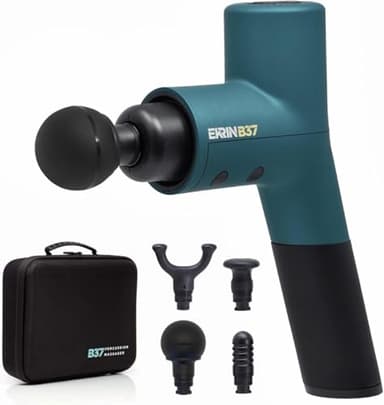
Ekrin Athletics B37v2 Massage Gun
The 15-degree angled handle is the one genuine ergonomic idea in this category — it is the difference between reaching your own mid-back and asking someone else to.
What it gets right
- Angled handle materially extends self-treatment reach
- Lifetime warranty is unusual at any price in this category
- Quieter than most mid-priced guns
What it does not
- Costs several times a fully-specified budget gun
- Heavier than the lightest premium handhelds
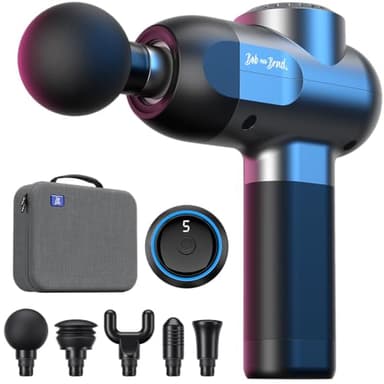
Bob and Brad C2 Massage Gun
The only gun in this roundup whose maker publishes all four numbers that decide whether it reaches the muscle — amplitude, stall force, speed range and noise — and the stall-force figure is higher than the premium units that hide theirs.
What it gets right
- Publishes amplitude, stall force, speed range and noise — the two market leaders publish none of the first three
- Published stall force of over 44 lb is higher than the figure Therabody publishes for the Prime
- 1.5 lb is light enough to hold overhead against your own shoulder without your arm giving out first
- FSA/HSA eligible, which quietly makes it cheaper again for a lot of buyers
What it does not
- 10 mm amplitude is genuinely shorter than a 16 mm premium stroke — that difference is real for glutes and thick back muscle
- No app, no pressure-feedback screen, no ecosystem
- Five fixed speeds rather than a continuous range
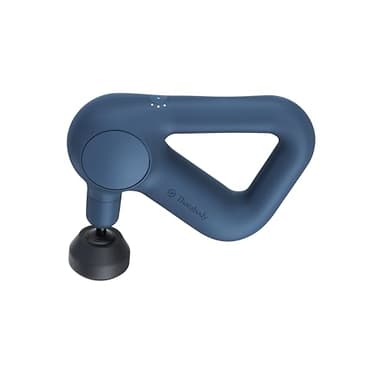
Therabody Theragun Relief
Therabody's deliberately gentle model — lighter, simpler and less aggressive than the Prime, which is the right direction for stiff hands and thin skin rather than a compromise.
What it gets right
- Simple controls with no app required — a real advantage if the buyer is not going to pair anything to a phone
- Lighter and less aggressive than the Prime, which is the point rather than a limitation
- Therabody's ergonomic handle geometry makes it easier to hold with a weak grip
What it does not
- Same missing-spec problem as the rest of the Therabody range
- Not the tool for dense glute or thick paraspinal muscle
- Costs more than fully-specified budget guns that hit harder
| Amplitude | Not published page we checked |
|---|---|
| Stall force | Not published page we checked |
| Speed range | Not published page we checked |
| Weight | 1.37 lb source |
| Noise | Not published page we checked |
| Battery | 2 h source |
| Attachments | 3 source |
| Warranty | 1-year source |
| Dimensions | 9.66 × 2.58 × 1.37 in source |
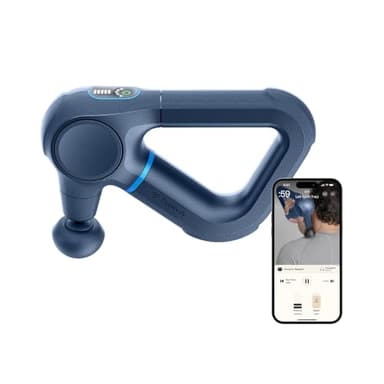
Therabody Theragun Prime (6th Gen)
The long-stroke option, and the build quality is not in question — but Therabody's current US product page publishes dimensions, weight, battery and warranty and does not publish amplitude, stall force, PPM or noise, so the numbers most buyers are shopping on are not on the page they are shopping from.
What it gets right
- The 16 mm stroke Therabody quotes is genuinely long, and stroke length is what determines depth
- Real-time pressure feedback stops the most common user error — leaning on it far too hard
- Rated by Therabody to survive drops from 10 feet, which matters more than it sounds for a thing you use on a hard floor
What it does not
- Amplitude, stall force, PPM and dB are absent from the current US product page — we checked
- Two attachments in the box, against five on guns costing a fifth as much
- 120 minutes of battery is quoted at the LOWEST speed setting, which is not the setting you will use
- One-year limited warranty on a device at this price
| Amplitude | Not published page we checked |
|---|---|
| Stall force | Not published page we checked |
| Speed range | Not published page we checked |
| Speed settings | 5 source |
| Weight | 2 lb source |
| Noise | Not published page we checked |
| Battery | 2 h source |
| Attachments | 2 source |
| Warranty | 1-year limited source |
| Dimensions | 238 × 153 × 61 mm source |
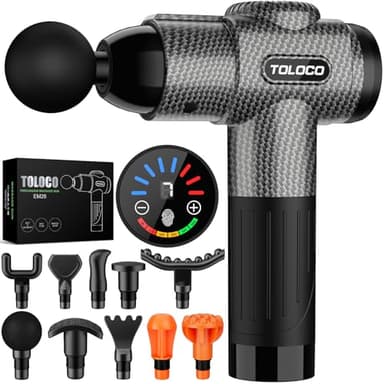
TOLOCO Massage Gun (EM26)
The cheapest gun worth owning, and the ten-attachment box is not the selling point the listing thinks it is — but if the alternative is not buying one at all, this is a real tool.
What it gets right
- Cheap enough that it is not a decision
- Ten attachments, of which you will use two
- Light enough for self-application
What it does not
- No published amplitude or stall force from the manufacturer
- Build quality is what the price implies — treat it as a two-year tool
- Loud relative to premium units
Common questions
What is the best massage gun for sciatica?
The Ekrin B37v2, because the job is holding a head on your own glute at a controlled angle and its 15-degree handle is the only design in this category that genuinely helps with that. The Bob and Brad C2 is the value answer and the better-documented device: it publishes amplitude, stall force, speed range and noise, which matters more near a nerve than anywhere else. If percussion seems to aggravate your symptoms, the Theragun Relief is the gentler unit — and heat or TENS may be the better purchase entirely.
Where do you use a massage gun for sciatica?
On the buttock and the upper third of the back of the thigh on the painful side, plus the muscular columns either side of the lower spine — never the spine itself. Not on the calf, not on the foot, not behind the knee, and not anywhere that feels numb. Sciatic pain is referred from an irritated nerve root at the spine, so the tissue further down the leg is not the source of anything, and the nerve runs close to the surface through the back of the thigh and behind the knee.
Can a massage gun make sciatica worse?
Yes, in three ways. Used on numb skin it is genuinely unsafe: a quantitative sensory testing study of patients with L5 or S1 leg pain found the radiculopathy group had reduced warm, mechanical and vibration detection in the painful dermatome, and 78 percent of them reported numbness — so the “stop when it hurts” feedback a gun relies on is not reliable there. Used aggressively on an irritable nerve root it can wind the pain up for the rest of the day. And used as a substitute for moving it costs you the only thing with quantified benefit in the conservative-care literature.
Is a massage gun or a TENS unit better for sciatica?
Neither treats the compression, but TENS has more of a literature behind it for nerve-pattern pain and costs a fraction of any gun here, so for most people shopping on this page it is the better first purchase. The gun’s case is different in kind: it addresses the guarding muscle in the buttock and upper hamstring, which TENS pads do not. Plenty of people end up using both, which is cheap to try in the order of TENS first.
Should you use a massage gun on the sciatic nerve itself?
No. There is nothing to be gained by percussing a nerve and there is something to lose. The target is the muscle guarding around the irritated root — gluteus maximus, the deep buttock, the upper hamstring — and the technique is a broad head kept moving across the muscle belly rather than a bullet head parked on the spot where the pain seems to start. If pressure in one place reproduces the shooting or burning sensation down the leg, that is the nerve answering, and it means move the head somewhere else.
How long before a massage gun helps sciatica?
If it helps at all, it helps the same session — the benefit from percussion is immediate and temporary rather than cumulative, which is also true of the recovery trials in healthy muscle. That gives you a cheap test: three sessions of sixty to ninety seconds on the glute, each followed by a short walk. If the leg is easier afterward, you have found a useful symptom tool. If it is reliably worse for the rest of the day, stop and try heat or TENS instead. Either way, the lasting change in this condition comes from the movement-based care, not the device.
Sources
- 1.Disentangling 'sciatica' to understand and characterise somatosensory profiles and potential pain mechanisms - Scandinavian Journal of Pain 2022 (PubMed 34333881) — 26 patients with L5/S1 leg pain; the radiculopathy group showed localized loss of warm, mechanical and vibration detection and 78% reported numbness - the basis for the never-on-numb-skin rule
- 2.Evidence-Based Conservative Treatment Strategies for Lumbar Radiculopathy: A Systematic Review - Cureus 2026 (PMC13349735) — 19 RCTs; pooling precluded by heterogeneity; quantified gains came from movement-based care (SMWLM -2.0 at two weeks, -2.6 at six months), none from percussion devices
- 3.Reliability of physical examination for diagnosis of myofascial trigger points: a systematic review of the literature - The Clinical Journal of Pain (PubMed 19158550) — trained examiners agree poorly on trigger point location - why we say treat the broad muscle rather than hunt a coordinate
- 4.The Effect of Percussive Therapy on Musculoskeletal Performance and Experiences of Pain: A Systematic Literature Review (PubMed 37020441) — systematic review of percussive therapy on musculoskeletal performance and pain; a small, uneven literature and not a literature about nerve pain
- 5.Neuropathic Pain Relief Through Transcutaneous Electrical Neuromuscular Stimulation: Insights From a Systematic Review and Meta-Analysis of Clinical Evidence - BioMed Research International 2025 (PMC12543013) — the comparison modality's evidence base, for the argument that TENS is the cheaper first purchase here
- 6.Bob and Brad — C2 massage gun product page — published 10 mm amplitude, 44+ lb stall force, 2,000-3,200 PPM and a sub-60 dB figure
- 7.Therabody — Theragun Prime product page — checked for amplitude, stall force, PPM and dB; the current US page publishes none of the four
- 8.Therabody — Theragun Relief product page — 1.37 lb and 3 attachments published; no amplitude, stall force, PPM or decibel figure
- 9.Therabody — Product Safety & Precautions — the manufacturer contraindication list quoted above, verbatim