Massage Guns
The Best Massage Guns for Legs
Legs are the easiest job in this category and the one where paying more buys you the least. A quad is a big, flat, accessible slab of muscle with no bone to dodge and no nerve to worry about, so the only specs that change the experience are stroke length, stall force and whether you can still hold the thing against your own hamstring after a minute. One gun here publishes all three of those numbers and costs a fraction of the most expensive pick on the page.
By Stephen V.Published
Disclosure:Grip & Gait earns a commission when you buy through links on this page, at no extra cost to you. It never changes what we recommend or the order we rank things in — here is exactly how we’re funded.
Quick picks
Ranked on published manufacturer specs and what they mean for the job, not on testing we have not done. Tap a row for the full reasoning. How we score.
| # | Product | Best for | Score | Price |
|---|---|---|---|---|
| 1 |  Bob and Brad C2 Massage Gun The only gun here whose maker publishes amplitude, stall force, speed range and noise, which on a leg is the entire decision. At 1.5 lb you can still hold it on your own calf at the end of a session. | Best overall, and the value pick | 8.8 | |
| 2 |  Therabody Theragun Prime (6th Gen) Therabody's long-stroke model, with pressure feedback that stops the usual mistake of leaning on it. The depth numbers are not on the product page, so you are paying on reputation. | Deepest stroke for a thick quad | 7.9 | |
| 3 | 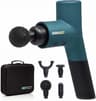 Ekrin Athletics B37v2 Massage Gun The 15-degree angled handle is the difference between treating the back of your own thigh properly and treating the bit of it you can get to. Lifetime warranty. | Reaching your own hamstring | 8.3 | |
| 4 |  Hyperice Hypervolt 3 Pro 51 dB and 1,500-2,500 RPM published, four hours of stated battery, heated head in the box. Legs take the longest sessions of any region, which is where those three things pay. | Long sessions, quiet room | 8.0 | |
| 5 |  TOLOCO Massage Gun (EM26) No published depth specs and a build that reflects the price, but a real tool on a quad if the alternative is owning nothing. The budget pick for anyone who will not spend more. | Cheapest that still works | 7.0 | |
| ✕ | 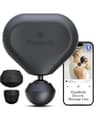 Therabody Theragun Mini (3rd Gen) A good travel object aimed at the wrong muscle group. A short body cannot deliver a long stroke, and a quad is the one place where stroke is the whole point. Skip this | The one to skip for legs | 6.0 |
The short version
Buy the Bob and Brad C2. Legs are the only region on this site where the cheapest credible gun is also the technically best-documented one, and that is not a coincidence — the specs that decide whether a percussion head reaches through a quad or a hamstring are amplitude and stall force, and the budget brand publishes both while the two market leaders publish neither. On a thick, accessible, bone-free muscle there is very little left for the extra money to buy.
Three reasons to pay more, and they are all about your body rather than the motor. If you cannot comfortably reach the back of your own thigh, the Ekrin B37v2 and its angled handle solve a real problem. If you want the longest stroke available and will accept buying it on reputation rather than a published figure, that is the Theragun Prime. And if you run twenty-minute sessions on both legs in a room with other people in it, the Hypervolt 3 Pro is the one unit here that publishes a decibel figure worth having. If none of those apply, spend the difference on something else.
Why legs are the easy case
Every other region this site covers has a complication. A neck has a carotid artery and a spine. A shoulder has a joint you can percuss straight into. A hand has bone a millimeter under the skin. A lower back has kidneys and spinous processes. Legs have almost none of that: the quadriceps, the hamstrings, the adductors and the calves are large parallel muscle bellies with thick, forgiving envelopes of tissue, and the few structures to avoid — the back of the knee, the bony front edge of the shin, the groin crease — are easy to identify and easy to stay off.
That is why the ranking on this page looks different from the rest of the site. When there is nothing delicate to work around, finesse stops being a feature. What is left is a simple mechanical question: how far does the head travel, how much force does it keep delivering when you press it into something dense, and can you hold the device in the awkward positions a leg demands — because treating your own hamstring means sitting with your arm reaching behind your own thigh, and treating your own calf means either folding yourself up or working upside down over the edge of a chair.
Those three things are amplitude, stall force and weight. Two of them are published by one brand on this page and withheld by most of the rest.
How we ranked these for legs
- Published amplitude, first. Stroke length is depth, and a leg is where depth is actually consumed. The Bob and Brad C2 publishes 10 mm of amplitude, over 44 lb of stall force, a 2,000–3,200 PPM range and a figure under 60 dB. Therabody has quoted a 16 mm stroke for the Prime for years, but its current US product page publishes no amplitude, no stall force, no PPM and no decibel figure. Hyperice publishes no amplitude for any handheld it sells. We rank on what a maker will put in writing, and we say so when the number is missing.
- Stall force, second.Stall force is the force at which the head stops moving because you are pressing too hard. On a thin area it barely matters, because you would never press that hard. On a quad, under a forearm’s worth of leaning, it is the difference between percussion and buzzing.
- Weight, in the positions a leg actually demands. A hamstring and a calf are both treated with your arm at a bad angle. An ounce behind your own thigh is felt differently from an ounce on a tabletop, and the lightest full-size gun here is a pound and a half.
- Handle geometry for the back of the leg. The front of the thigh is easy from any grip. The back of it is not, and an angled handle is the only design idea in this category that addresses it.
- Session length, which means battery and noise. Legs are the biggest surface area you will ever treat. Two quads, two hamstrings and two calves at sixty to ninety seconds each is a ten-minute job minimum, and a battery figure quoted at the lowest speed setting is not a battery figure for the setting you will use.
- Value against a nine-dollar stick. For calves in particular, a roller stick applies more pressure than any motor on this page and costs less than a lunch. A gun has to justify itself against that, and on quads and hamstrings it does.
What percussion actually does to a leg muscle
The evidence for percussion is real, narrow, and mostly about how you feel and move right now rather than about repair. It is also, unusually, evidence gathered largely on legs — squats, jumps and eccentric knee work are what sports science uses to make people sore, which means the studies below were run on more or less exactly the muscles this page is about.
A randomized trial on squat-induced soreness found percussion more effective than static stretching for recovering jump height and range of motion at 48 hours. A study on eccentric exercise-induced muscle damage found it restored range of motion faster than rest without changing strength or accelerating the underlying repair — which is the honest shape of the benefit: immediate, temporary, and available again every time you use it. A direct comparison of foam rolling and percussive massage for DOMS is worth reading before you spend anything, because the two modalities come out closer together than the price difference between them implies.
Two findings cut the other way, and we would rather print them than hide them. A warm-up study in trained athletes found that gun or roller use before a session did not meaningfully improve performance, so if you are buying this to add weight to a squat, do not. And a systematic review of percussive therapy across musculoskeletal performance and pain describes a literature that is small and uneven rather than settled.
So the sane expectation for a leg: a gun makes a sore quad feel and move better for a while after each use, it does not make you recover faster in any structural sense, and the decisions you make about training volume and sleep still matter far more than which of these you own.
Muscle by muscle
Quadriceps. The friendliest target on the body. Sit with the leg extended, work slowly from above the knee up toward the hip with a large flat or round head at a mid speed, sixty to ninety seconds per thigh. Stay off the kneecap and off the bony front point of the hip. This is the one place where a long stroke is unambiguously worth having.
Hamstrings.Sit on the edge of a chair with the heel on the floor so the muscle is slack, and come at it from the outside of the thigh rather than reaching across your own body. The limiting factor is almost never the gun’s power; it is your shoulder. Stop well short of the crease behind the knee, which carries vessels and nerves close to the surface. If tightness here is your main complaint rather than soreness, the hamstring page sets out why length work and loading beat percussion for that specific problem.
Calves. Prop the leg on a chair or a step and keep the head on the two muscle bellies, off the Achilles tendon and off the bony shin. This is the region where a roller stick genuinely competes with a gun, because you can press as hard as you like with both hands and a stick costs almost nothing. For shin pain specifically rather than calf tightness, go to the Achilles, IT band and shin page, which is about which structure you are actually aiming at.
Glutes and the outside of the hip. Thick, behind you, and awkward. The geometry problem dominates everything else there, which is why we rank it separately in the glutes and hips roundup.
Adductors, the inside of the thigh. Treatable, but keep well away from the groin crease, where the femoral artery, vein and nerve run close to the surface. Light pressure and short sessions; the inner thigh is thinner than it feels.
Which gun for which leg problem
| What is going on | Buy | Why |
|---|---|---|
| Generally sore legs after training | Bob and Brad C2 | Published 10 mm stroke, over 44 lb stall force and under 60 dB, at a price that makes being wrong about it a non-event. Nothing dearer on this page does more for a sore quad. |
| Very large or very dense thighs | Theragun Prime | The longest stroke anyone on this page claims, plus pressure feedback so you stop leaning on it. You are buying that figure on Therabody's reputation, because the product page does not publish it. |
| You cannot reach the back of your own thigh | Ekrin B37v2 | The 15-degree handle changes the angle your wrist has to make. It is the only ergonomic idea in the category that survives contact with a real hamstring, and the warranty is for life. |
| Long sessions, shared room, evenings | Hypervolt 3 Pro | 51 dB and a published 1,500-2,500 RPM range, four hours of stated battery and a heated head. Legs are the biggest surface you will treat, so runtime and noise are real here in a way they are not on a wrist. |
| You will not spend more than the minimum | TOLOCO EM26 | No published depth specs and a build that matches the price, but it moves and it is cheap. Owning a working gun beats admiring a better one you did not buy. |
| Calves only, and you want to spend almost nothing | A roller stick, not a gun | Two hands on a stick apply more pressure to a calf than any motor here, and it costs less than a lunch. We would rather tell you that than sell you a gun you do not need. |
| Pain that shoots or burns down the leg | Neither - read the nerve page first | Referred nerve pain is a different problem with different rules, including where you must not put a percussion head at all. The sciatica gun page covers it. |
Where a gun loses to a stick
We would be selling you something if we did not say this plainly: for calves and the outside of the lower leg, a roller stick is the better purchase for most people, and it costs a small fraction of what any gun on this page costs. You can apply as much pressure as your arms will produce, there is no battery, and it fits in a gym bag. The gun wins on quads and hamstrings mostly because it lets you work on a muscle that is fully slack while you sit still, which is hard to do with a stick and impossible to do on a floor roller.
The broader version of this argument — what percussion gives you that pressure does not, and the other way round — is in massage gun vs foam roller. If you do not own either yet, read the foam roller alternatives page before you spend anything, because the cheapest thing that works on a leg is not a gun.
“Deep vein thrombosis, osteomyelitis; bone fracture or myositis ossificans; bleeding disorders; peripheral vascular insufficiency or disease; medications that thin the blood or alter sensations; pacemaker, ICD.”
How to actually use it on a leg
- Sixty to ninety seconds per muscle, not five minutes. The range-of-motion effect in the trials above arrives quickly and does not keep improving with more time under the head.
- Slack muscle, always. A quad treated with a straight, braced leg is a quad fighting back. Sit, let the knee bend, let the muscle go soft.
- Let it float. The most common error is pressing hard enough to stall the motor, which converts percussion into vibration. If the pitch drops, you are pressing too hard.
- Mid speed, large head. The top speed and the bullet head are for a specific knot, not for a thigh. For the full head-by-head breakdown see attachments explained.
- After, not instead of. The warm-up study found no performance gain from using one beforehand. Use it afterward, or on a rest day, and put the saved effort into the loading work that actually changes a leg.
Where to go next
If your problem is one specific leg muscle rather than legs in general, the symptom pages are the better route: quad tightness, hamstring tightness, tight calves and shins and night leg cramps each route by what the pain is doing rather than by product category. If the pain travels down the leg instead of sitting in a muscle, read the sciatica gun page first — the rules change completely. Runners should start at the runner roundup, cyclists at the cycling one, and anyone weighing the whole category against its cheaper rivals at are massage guns worth it.
Every pick, in full
Specs below are the manufacturer’s own published figures, each linked to the page it came from. Where a maker does not publish a number, the table says so and names the page we checked — that absence is information too.
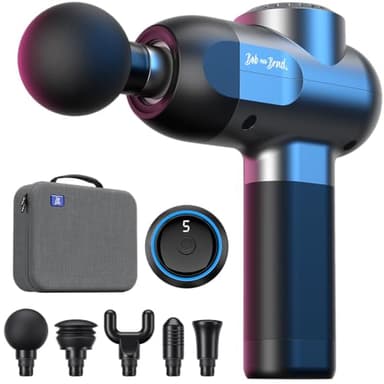
Bob and Brad C2 Massage Gun
The only gun in this roundup whose maker publishes all four numbers that decide whether it reaches the muscle — amplitude, stall force, speed range and noise — and the stall-force figure is higher than the premium units that hide theirs.
What it gets right
- Publishes amplitude, stall force, speed range and noise — the two market leaders publish none of the first three
- Published stall force of over 44 lb is higher than the figure Therabody publishes for the Prime
- 1.5 lb is light enough to hold overhead against your own shoulder without your arm giving out first
- FSA/HSA eligible, which quietly makes it cheaper again for a lot of buyers
What it does not
- 10 mm amplitude is genuinely shorter than a 16 mm premium stroke — that difference is real for glutes and thick back muscle
- No app, no pressure-feedback screen, no ecosystem
- Five fixed speeds rather than a continuous range
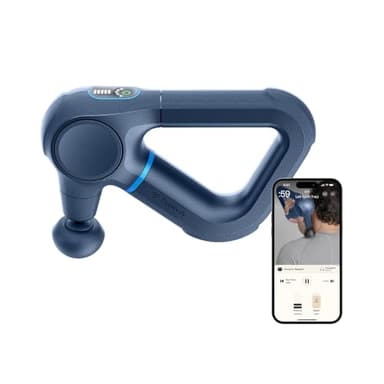
Therabody Theragun Prime (6th Gen)
The long-stroke option, and the build quality is not in question — but Therabody's current US product page publishes dimensions, weight, battery and warranty and does not publish amplitude, stall force, PPM or noise, so the numbers most buyers are shopping on are not on the page they are shopping from.
What it gets right
- The 16 mm stroke Therabody quotes is genuinely long, and stroke length is what determines depth
- Real-time pressure feedback stops the most common user error — leaning on it far too hard
- Rated by Therabody to survive drops from 10 feet, which matters more than it sounds for a thing you use on a hard floor
What it does not
- Amplitude, stall force, PPM and dB are absent from the current US product page — we checked
- Two attachments in the box, against five on guns costing a fifth as much
- 120 minutes of battery is quoted at the LOWEST speed setting, which is not the setting you will use
- One-year limited warranty on a device at this price
| Amplitude | Not published page we checked |
|---|---|
| Stall force | Not published page we checked |
| Speed range | Not published page we checked |
| Speed settings | 5 source |
| Weight | 2 lb source |
| Noise | Not published page we checked |
| Battery | 2 h source |
| Attachments | 2 source |
| Warranty | 1-year limited source |
| Dimensions | 238 × 153 × 61 mm source |
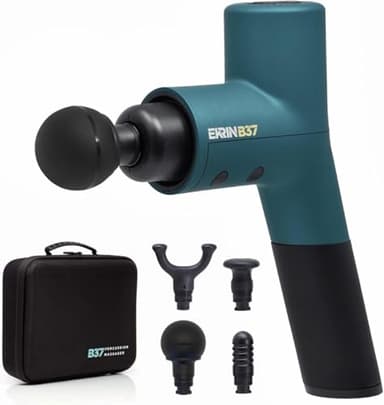
Ekrin Athletics B37v2 Massage Gun
The 15-degree angled handle is the one genuine ergonomic idea in this category — it is the difference between reaching your own mid-back and asking someone else to.
What it gets right
- Angled handle materially extends self-treatment reach
- Lifetime warranty is unusual at any price in this category
- Quieter than most mid-priced guns
What it does not
- Costs several times a fully-specified budget gun
- Heavier than the lightest premium handhelds
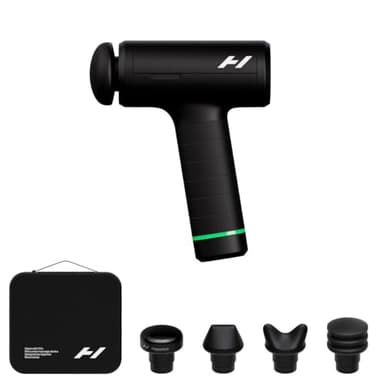
Hyperice Hypervolt 3 Pro
The one premium gun we rank that publishes both a speed range and a noise figure — 1,500–2,500 RPM at 51 dB — which is quiet for the power, though amplitude is still missing.
What it gets right
- 51 dB published is genuinely quiet; you can hold a conversation over it
- Published 1,500–2,500 RPM range, which almost nothing else at this price states
- Heated head attachment included, and heat before percussion is a sensible order of operations
What it does not
- Amplitude still not published
- 2.5 lb is heavy for overhead work on your own shoulder
- The most expensive handheld here by a wide margin
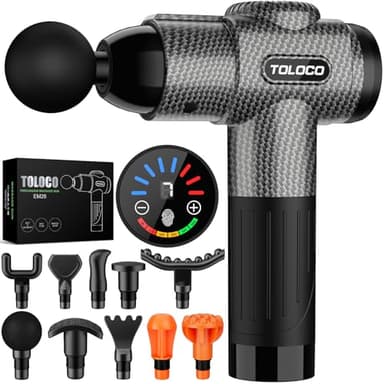
TOLOCO Massage Gun (EM26)
The cheapest gun worth owning, and the ten-attachment box is not the selling point the listing thinks it is — but if the alternative is not buying one at all, this is a real tool.
What it gets right
- Cheap enough that it is not a decision
- Ten attachments, of which you will use two
- Light enough for self-application
What it does not
- No published amplitude or stall force from the manufacturer
- Build quality is what the price implies — treat it as a two-year tool
- Loud relative to premium units
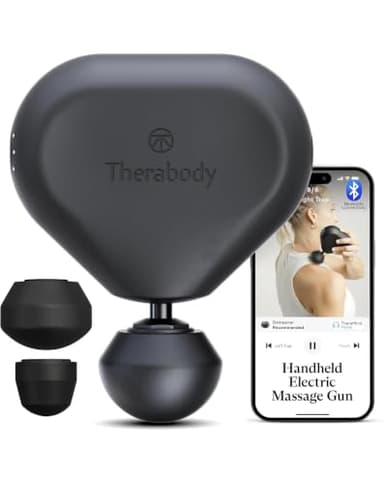
Therabody Theragun Mini (3rd Gen)
A genuinely pocketable gun that survives being thrown in a bag — the trade is that a short body has to give up stroke somewhere, and Therabody does not say where.
What it gets right
- Small enough to actually carry, which is the only spec that matters for a travel gun
- Simple three-speed operation
What it does not
- No published amplitude or stall force
- Priced like a full-size premium gun
- Short handle means you cannot reach your own mid-back with it
| Amplitude | Not published page we checked |
|---|---|
| Stall force | Not published page we checked |
| Speed range | 1,750–2,400 PPM source |
| Speed settings | 3 source |
| Weight | 0.9 lb source |
| Noise | Not published page we checked |
| Battery | 2.5 h source |
| Attachments | 3 source |
| Warranty | 1-year limited source |
| Dimensions | 116 × 135 × 96 mm source |
Common questions
What is the best massage gun for legs?
The Bob and Brad C2, and the reason is unusually concrete: it is the only gun we rank whose maker publishes amplitude, stall force, speed range and noise, and the first two are the specs that decide whether a head reaches through a quad or a hamstring. It is also the lightest full-size gun here at 1.5 lb, which matters when you are holding it behind your own thigh. Pay more only for a specific reason — the Ekrin B37v2 if you cannot reach the back of your own leg, the Theragun Prime if you want the longest stroke available, the Hypervolt 3 Pro if you need it quiet for long sessions.
Do you need an expensive massage gun for legs?
No, and legs are the clearest case of that on this site. Expensive guns mostly buy quieter motors, nicer materials, app ecosystems and handle geometry for hard-to-reach places. A quad, a hamstring and a calf are none of those problems: they are large, accessible muscle bellies with nothing delicate nearby. The two specs that actually matter on them are published by a budget brand and withheld by both market leaders. Spend more if you cannot reach the back of your own leg, or if you need a unit quiet enough to use in a shared room for twenty minutes at a time.
How long should you use a massage gun on your legs?
Sixty to ninety seconds per muscle belly, which for both legs front and back comes to around ten minutes. The range-of-motion benefit measured in the trials arrives quickly and does not keep growing the longer you hold the head on; past a couple of minutes on one spot you are mostly just making the skin sore. Keep the muscle slack, keep moving the head rather than parking it, and let the device float rather than pressing hard enough to stall it.
Where should you not use a massage gun on your legs?
Off the crease behind the knee and off the groin crease — both carry major vessels and nerves close to the surface — and off the bony front edge of the shin, the kneecap and the Achilles tendon. Do not use it over a fresh strain or suspected tear, over varicose veins, or over any numb area. And if one calf is swollen, warm and painful to squeeze, do not percuss it at all: that pattern can indicate a clot, and it needs same-day medical assessment rather than a tool.
Is a massage gun or a roller stick better for calves?
For calves specifically, the stick is the better buy for most people. You can apply as much pressure as your arms will produce, it never needs charging, it fits in any bag and it costs a small fraction of what the cheapest gun here costs. The gun earns its place on quads and hamstrings, where it lets you treat a completely slack muscle while sitting still — which is hard with a stick and impossible on the floor. If you are buying one tool for legs and money is tight, buy the stick first.
Does a massage gun help legs recover faster?
It helps them feel and move better, which is not the same thing. A randomized trial on squat-induced soreness found percussion better than static stretching for recovering jump height and range of motion at 48 hours, and a study on eccentric muscle damage found it restored range of motion faster than rest — but without changing strength or speeding the underlying tissue repair. A warm-up study in trained athletes found no performance benefit from using one beforehand. So: real, immediate, repeatable symptom relief; no evidence that it rebuilds muscle any faster.
Sources
- 1.Bob and Brad — C2 massage gun product page — the only product page in this roundup publishing amplitude (10 mm), stall force (44+ lb), a PPM range and a decibel figure
- 2.Therabody — Theragun Prime product page — checked for amplitude, stall force, PPM and dB; the current US page publishes dimensions, weight, battery, warranty and attachment count and none of the four depth specs
- 3.Hyperice — Hypervolt 3 Pro product page — published 1,500-2,500 RPM and 51 dB - the only premium unit here stating either; amplitude still absent
- 4.Percussion massage therapy and recovery from delayed onset muscle soreness — randomized controlled trial (PMC11979224) — squat-induced soreness; percussion beat static stretching for jump height and range of motion at 48 hours
- 5.Effects of Percussive Massage Treatments on Symptoms Associated with Eccentric Exercise-Induced Muscle Damage (PMC10915620) — range of motion restored faster than rest, with no change in strength and no acceleration of underlying repair
- 6.Foam Rolling or Percussive Massage for Muscle Recovery: Insights into DOMS (PMC12286022) — direct foam rolling versus percussive massage comparison for DOMS - closer together than the price gap implies
- 7.Does Massage Gun or Foam Roller Use During a Warm-Up Improve Performance in Trained Athletes? (PMC12473898) — no meaningful performance gain from gun or roller use during a warm-up in trained athletes
- 8.The Effect of Percussive Therapy on Musculoskeletal Performance and Experiences of Pain: A Systematic Literature Review (PubMed 37020441) — systematic review of percussive therapy on musculoskeletal performance and pain - a small, uneven literature
- 9.Therabody — Product Safety & Precautions — the manufacturer contraindication list quoted above, verbatim