Recovery Tech
Wireless vs Wired TENS Units
A wireless TENS unit is not a stronger TENS unit. It is the same current delivered from a pod stuck to your skin instead of through a lead wire, and it costs several times as much. There is exactly one situation where that is money well spent, and it is worth knowing whether you are in it before you buy.
By Stephen V.Published
Disclosure:Grip & Gait earns a commission when you buy through links on this page, at no extra cost to you. It never changes what we recommend or the order we rank things in — here is exactly how we’re funded.
Quick picks
Ranked on published manufacturer specs and what they mean for the job, not on testing we have not done. Tap a row for the full reasoning. How we score.
| # | Product | Best for | Score | Price |
|---|---|---|---|---|
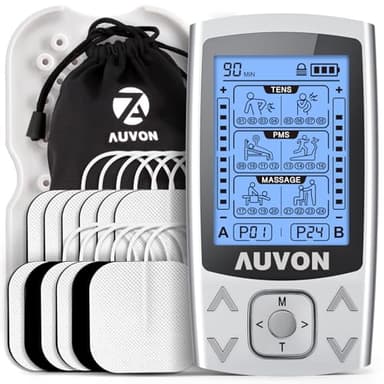
| 1 |  AUVON Dual Channel TENS Unit Wired, two independent channels, rechargeable, and cheap enough that trying TENS costs less than one appointment. This is the default unless you have a specific reason to go wireless. | Best for most people | 8.5 | $35.99 · View on Amazon Price as of October 21, 2026. #ad How we’re funded |
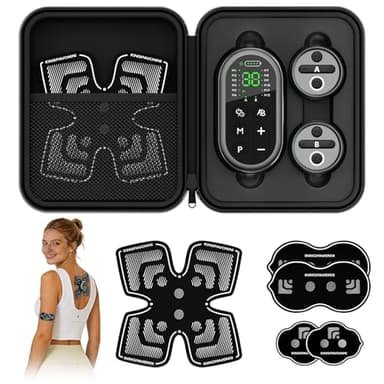
| 2 |  KingPavonini Wireless TENS + EMS Muscle Stimulator Two pods with no lead wires, independently controlled, published 20 hours per pod over USB-C. The only format that makes a two-hour daily session through a working day realistic. | Wearing it under clothes while you move | 8.1 | |
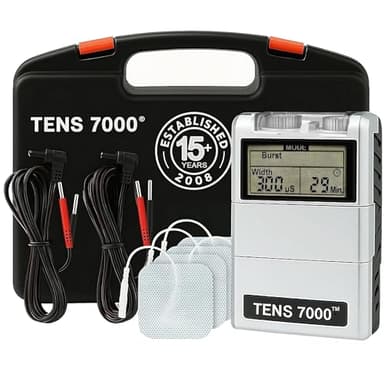
| 3 |  TENS 7000 Digital TENS Unit The clinic-style box: manual pulse width and rate instead of numbered presets, and pads you can buy anywhere. The cheapest unit here and the most adjustable. | Wired, with manual parameter control | 8.3 | $38.88 · View on Amazon Price as of October 21, 2026. #ad How we’re funded |
The short answer
Buy wired unless you specifically need to use TENS while moving about or under clothing. The electricity is the same: both formats deliver pulsed current between two electrodes on your skin, and nothing in the clinical literature distinguishes them because every trial worth citing was run on wired units. What wireless buys is format— no lead wires snaking out of a waistband — and that is genuinely decisive for one group of people: anyone running the long daily sessions that the fibromyalgia protocol calls for, or anyone who needs the unit on at work. For everybody else, the wired AUVON does the same job for a fraction of the price, and the TENS 7000 does it with more control.
What “wireless” actually means
A wired unit is a handheld controller with two or four lead wires running to sticky electrode pads. A wireless unit moves the electronics into the pod itself: you stick a pod with built-in electrodes onto the muscle, and a small remote (or a phone) sets the mode and intensity. There is no cable between you and a box in your pocket, which is the entire selling point.
Two consequences follow, and neither is advertised. First, the pads become part of the device: a wireless pod takes the maker’s own pad shapes rather than the universal 2 by 2 in electrodes any wired unit accepts, so your consumable is whatever that brand sells. Second, you now have two pods and a remote to keep charged rather than one unit with a battery. The KingPavonini pods publish 20 hours per pod on a 1040 mAh cell charged over USB-C, which is about ten two-hour sessions, and three pad sizes including a 4.3 in butterfly pad — good numbers, and still three objects to not lose.
| What you want to do | Which format | Why |
|---|---|---|
| Twenty minutes on a sore back on the sofa | Wired | You are sitting still next to the thing anyway. The cable costs you nothing and saves you most of the money. |
| Two hours a day while you get on with your life | Wireless | This is the one case that justifies the price. Lead wires are what stop a long daily habit surviving a real day - and long daily use is what the fibromyalgia trials actually tested. |
| Wear it at work, under a shirt | Wireless | A pod under clothing is invisible. A controller clipped to a waistband with wires to your shoulder is not. |
| Treat two regions at different intensities | Either - check the spec | Any dual-channel wired unit does this with separate intensity per channel; the wireless pods do it independently per pod. One channel means alternating. |
| Dial in a specific pulse width and rate | Wired (TENS 7000) | Manual parameter control is a wired-unit feature. Wireless units are preset-driven, and a mode count is not a specification. |
| Spend as little as possible to find out if TENS helps you | Wired | A wired dual-channel unit plus a pack of generic pads is the cheapest honest test of whether this works for you at all. |
| Keep running costs down over years | Wired | Universal 2 by 2 in pads are cheap and sold everywhere. Proprietary wireless pads are reusable but priced as part of a system. |
The evidence is wired, and that is worth saying plainly
When TENS is studied, it is studied on wired clinic units. The 2026 FM-TIPS trial applied TENS to the upper and lower back at a modulated 2 to 125 Hz for two hours a day and reported movement-evoked pain 1.2 points lower on a 0-10 scale at day 60. The Cochrane review of TENS for knee osteoarthritis and the meta-analysis of TENS for neuropathic pain describe the same kind of hardware. None of that evidence transfers betterto a wireless pod, and none of it transfers worse either — it is the same current. What it means is simple: no one has shown that paying for wireless makes TENS work better. They have shown that TENS works at a dose that is hard to reach with a cable attached to you.
That is the whole honest case for wireless, and it is a real one. A device you use for two hours a day beats a cheaper device you use for twenty minutes when you remember.
Who should buy which
- Buy wired if: your pain is in one region, you treat it sitting or lying down, you want to spend the least to find out whether TENS helps, or you want manual control over the parameters. The AUVON for simplicity, the TENS 7000 for control.
- Buy wireless if: you are running long daily sessions, you need it on during work or chores, you cannot manage small connectors and fiddly leads, or wires have already been the reason a unit ended up in a drawer.
- Do not buy wireless for: more power, deeper penetration, or a bigger mode count. Intensity is set by you and limited by what your skin tolerates, in both formats, and forty-eight modes is a marketing number in either.
Where to go from here
If you have not decided whether TENS is the right class of device at all, start at the TENS overview or massage gun vs TENS. If you want the two cheap wired units compared head-to-head, that is TENS 7000 vs AUVON, and AUVON vs Belifu covers the budget end. If you are buying for a specific region, the roundups are aimed better than this page is: back, neck and shoulder, sciatica and knee. And if you want muscle contraction rather than pain relief, you want EMS, which is a different machine: TENS vs EMS.
Every pick, in full
Specs below are the manufacturer’s own published figures, each linked to the page it came from. Where a maker does not publish a number, the table says so and names the page we checked — that absence is information too.
Price as of October 21, 2026. #ad How we’re funded
AUVON Dual Channel TENS Unit
Two independent channels so you can treat both sides of a problem at once, at a price where trying TENS costs less than one session of anything else.
What it gets right
- Two independent channels with separate intensity control
- Rechargeable rather than eating 9 V batteries
- Cheap enough to find out whether TENS does anything for you
What it does not
- Pad adhesive life is the real running cost, not the unit
- Interface is fiddly with cold hands
KingPavonini Wireless TENS + EMS Muscle Stimulator
TENS and EMS from two pods you stick on and wear, with no lead wires anywhere — which is the whole reason to pay this much, because it is the only version of the device you can use under a shirt and still move around in. The 48-mode count is marketing; the dual-zone independent control underneath it is not.
What it gets right
- Wireless pods rather than lead wires, so it works under clothing and while moving
- Two pods run independently — separate mode and intensity each, so a shoulder and a leg can run different settings at once
- Published 20 hours per pod on the 1040 mAh cell, charged over USB-C rather than off a disposable battery
- Ships with three pad sizes including a 4.3 in butterfly pad, which is the one that actually covers a lower back
What it does not
- Forty-eight modes is a mode count, not a specification — the same marketing this site flags on every cheap unit
- Several times the price of a wired dual-channel unit that treats a back just as well
- Two pods and a remote are three things to keep charged and not lose
- Listed only in December 2025 and rated 4.1 across 69 reviews, so there is very little ownership history behind it
Price as of October 21, 2026. #ad How we’re funded
TENS 7000 Digital TENS Unit
The unit clinics hand out, with manual control over pulse width and rate rather than a menu of preset programs — which is what you want once you know what setting helps.
What it gets right
- Manual pulse-width and rate control instead of fixed presets
- The long-standing clinic default, so accessories are everywhere
What it does not
- Runs on a 9 V battery
- Manual control is only an advantage if you know what you are adjusting
Common questions
Is a wireless TENS unit better than a wired one?
Not electrically. Both deliver pulsed current between electrodes on the skin, and every clinical trial of TENS worth citing was run on wired units. Wireless is better at one thing: letting you use the device for long stretches while moving about or under clothing. If that is your situation it is worth the premium, because a dose you actually take beats a cheaper device you do not. If you treat yourself sitting down, wired is the same therapy for much less money.
Do wireless TENS pods use special pads?
Usually yes, and it is the hidden cost. A wireless pod carries its electrodes in the maker’s own pad shapes, so your consumable is whatever that brand sells; the KingPavonini ships three sizes, including a 4.3 in butterfly pad, described as reusable around fifty times. Wired units take universal 2 by 2 in electrodes sold by every pharmacy and a dozen brands, which keeps the long-term running cost down.
Is a wireless TENS unit more powerful?
No. In both formats you turn the intensity up to a strong but comfortable buzz, and the ceiling is what your skin tolerates rather than what the device can produce. Mode counts — twenty-four, forty-eight — are marketing in either format. The specifications that change the therapy are channel independence, adjustable pulse width and rate, and pad size.
Can you wear a TENS unit all day?
The studied dose is two hours a day, which is where the wireless format earns its price. Going well beyond that is not supported by the trial evidence and increases the main nuisance effect, which is skin irritation under the electrodes — about 30% of participants in the 2026 fibromyalgia trial reported minor adverse events over six months. Move the pads slightly between sessions, keep the skin clean and dry, and take it off to shower.
Sources
- 1.Transcutaneous Electrical Nerve Stimulation and Pain With Movement in People With Fibromyalgia: A Cluster Randomized Clinical Trial (FM-TIPS) - JAMA Network Open 2026 (PMC13032160) — the two-hour daily protocol that makes the wireless format worth paying for
- 2.Transcutaneous electrostimulation for osteoarthritis of the knee - Cochrane Database of Systematic Reviews (PubMed 19821296) — the Cochrane position on TENS, collected on wired clinic units
- 3.Neuropathic Pain Relief Through Transcutaneous Electrical Neuromuscular Stimulation: Insights From a Systematic Review and Meta-Analysis of Clinical Evidence - BioMed Research International 2025 (PMC12543013) — TENS for neuropathic pain - same hardware class again
- 4.camelcamelcamel — AUVON TENS price history — price history for the wired default