Feet & Gait
The Best Muscle Scraping Tools
The 2019 review that supports scraping also found that the different tools produced similar effect sizes, which is the most useful buying advice in this whole category: the tool is not the variable. What changes is whether the edge fits the body part you are treating. Here is the ranking on that basis - and the 2023 update that argues the technique itself may not do much.
By Stephen V.Published
Disclosure:Grip & Gait earns a commission when you buy through links on this page, at no extra cost to you. It never changes what we recommend or the order we rank things in — here is exactly how we’re funded.
Quick picks
Ranked on published manufacturer specs and what they mean for the job, not on testing we have not done. Tap a row for the full reasoning. How we score.
| # | Product | Best for | Score | Price |
|---|---|---|---|---|
| 1 |  BYYDDIY 3-in-1 Stainless Steel Muscle Scraper Set Three edge shapes cover a calf, a forearm and a foot properly, which is the only thing that actually changes what a scraper can reach. Non-magnetic 304 stainless. | Best overall for several body parts | 8.2 | |
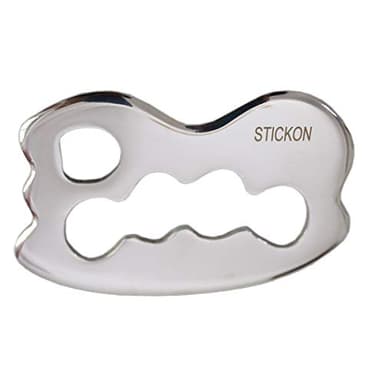
| 2 |  STICKON Stainless Steel Gua Sha Scraping Tool Several working radii on one piece, which is the shape clinics use. Nothing to lose from a set, and enough mass that you stop gripping it hard - which is what keeps the angle shallow. | Best single tool | 7.9 | $27.99 · View on Amazon Price as of October 21, 2026. #ad How we’re funded |
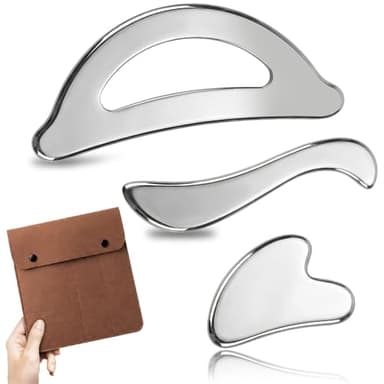
| 3 |  Rena Chris Gua Sha & Muscle Scraper Tool Several radii at the lowest price for a set, and the only one here that includes a face-sized piece. If the jaw and neck are part of why you are buying, this is the set. | Body and face in one set | 7.6 | $14.99 · View on Amazon Price as of October 21, 2026. #ad How we’re funded |
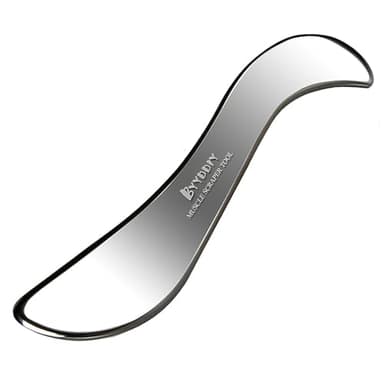
| 4 |  BYYDDIY 304 Stainless Steel Muscle Scraper One edge profile and no handle shaping, at a price where discovering that scraping does nothing for you costs less than lunch. On this page, that matters more than usual. | Cheapest way to find out | 7.2 | $7.99 · View on Amazon Price as of October 21, 2026. #ad How we’re funded |
| ✕ |  Silicone Cupping Set (4 cups) Suction lifts tissue; scraping shears along it. People buy them interchangeably as myofascial tools and they are not the same claim, the same technique or the same marks. Skip this | The one to skip here | 6.0 |
The short version
If you want one purchase, buy the BYYDDIY 3-in-1 set: three edge shapes means the tool fits a calf, a forearm and a foot instead of forcing one profile onto all three. If you would rather have a single object than a set, the STICKON tool carries several radii on one piece. If the face and jaw are part of why you are looking, the Rena Chris set is the cheapest set that includes a face-sized piece. And if you simply want to know whether scraping does anything for you, the BYYDDIY single scraper answers that for less than the price of a coffee, which is the honest entry point given what the evidence below says.
The thing we will not do is pretend the brand matters. The review that supports this technique tested several different products and found they performed alike. Pay for the edge shapes you need and nothing else.
The evidence, both halves of it
Instrument-assisted soft tissue mobilization — IASTM, the clinical name for scraping — has two systematic reviews that reach different conclusions, and anyone selling you a scraper will quote only the first.
The 2019 systematic review and effect-size analysis in the Journal of Athletic Training searched ten databases for randomized trials from 1997 to 2016, included 13 articles and ran effect sizes on 12. Average study quality was middling: a PEDro score of 5.83 for trials in uninjured participants and 5.86 for injured ones. It found large effect sizes for range of motion in uninjured participants, and for pain and patient-reported function in injured ones. Its own buying-relevant finding is the one nobody quotes: the different IASTM tools used in those studies revealed similar effect sizes across the various outcomes. The reviewers closed by asking for more high-quality research across a larger variety of patients and products.
Then the 2023 update in Disability and Rehabilitation searched four databases from 1999 to 2022 and found 46 eligible randomized trials — three and a half times the evidence base of the earlier review. Pooled against other active treatment, IASTM added to other treatment produced effects on function (SMD −0.28, 95% CI −0.66 to 0.09) and pain intensity (SMD −0.05, 95% CI −0.53 to 0.43) that were neither statistically significant nor clinically meaningful at up to one-year follow-up, and no clinically meaningful improvement in range of motion. The authors rated the certainty of the evidence very low, noted that the included trials had a high risk of bias, observed that only 10 of 46 trials assessed and reported IASTM-related adverse events at all, and remarked that publication of IASTM trials in suspected predatory journals is increasing. Their recommendation to clinicians was to consider other evidence-based strategies — physical activity and exercise — instead.
We sell scrapers and we are telling you that. Read the two together and the position is: scraping is cheap, feels like something is happening, has a plausible short-term effect on range of motion, and does not have a body of high-quality evidence showing it beats doing the exercise. Buy accordingly — which mostly means buy cheaply, and buy the shape that fits the part of you that hurts.
How we ranked these
No testing. We have no lab, no owned units and no clinician on staff, and we are not going to invent a torque figure for a piece of bent steel. What we can do is rank on the properties that change what the tool reaches, in the order those properties matter:
- Edge shapes, first and by a distance. A long straight edge works a calf or a hamstring. A deep concave curve wraps a forearm or an Achilles. A small contoured piece gets into a plantar fascia or around an elbow. A tool with one profile does one of those three jobs well.
- Material, which is simpler than the marketing suggests. Non-magnetic 304 stainless holds a consistent edge radius and can be cleaned properly. Stone chips, and a chipped edge is a scratched skin. Coated zinc alloy wears through. Every tool on this page is stainless for that reason.
- Whether you can hold it at a shallow angle without gripping hard. This is the technique variable disguised as a product feature. A tool with some mass sits against the skin on its own; a light, thin one gets squeezed, and a squeezed tool gets steeper, and a steeper tool bruises.
- Size against the target. A big body tool on a jaw is comedy; a face-sized piece on a calf takes twenty minutes. Match the piece to the structure.
- Cleanability. You are dragging it through an emollient, over skin, then putting it in a drawer. Smooth stainless with no seams wins, and every one of these needs drying rather than leaving wet.
What we deliberately ignore: bevel counts, “surgical grade” claims (a meaningless phrase in consumer goods), and any suggestion that one brand’s steel breaks up scar tissue better than another’s. The 2019 review already answered that question by finding the tools performed alike.
| What you are treating | The tool | Why that one |
|---|---|---|
| Calf, hamstring, quad | BYYDDIY 3-in-1 set (long straight edge) | Big flat-ish muscle wants the longest edge you have, held shallow and drawn along the fiber direction. A small piece just takes four times as long. |
| Forearm and lateral elbow | BYYDDIY 3-in-1 set or STICKON (curved edge) | A forearm is a cylinder, so a concave edge keeps contact around it. This is the tennis-elbow use case, and the loading work on our elbow page is the part that changes the tendon. |
| Plantar fascia and the arch | STICKON, or the small piece in a set | A small contoured edge follows the arch. For most people a contoured foot roller is easier to control and much harder to overdo on a sore heel. |
| Achilles and the back of the ankle | Curved edge, lightly | Thin tissue over bone with a tendon you must not scrape directly. Work the calf above it, and read the Achilles page before you touch the tendon itself. |
| Jaw, neck and face | Rena Chris set (face piece) | The only set here with a piece the right size. Light pressure only, and never on the front or sides of the neck. |
| Between the shoulder blades | A ball against a wall, not a scraper | You cannot reach your own mid-back at a shallow angle, and the angle is the technique. Pressure beats shear here. |
| Any hot, swollen or freshly injured area | Nothing on this page | Shearing an irritated area is how a cheap tool becomes an expensive mistake. Cold, relative rest, and an assessment if it is not settling. |
Which tool for which buyer, in one line each
- You want one purchase that covers your whole body:the BYYDDIY 3-in-1 set. Three shapes, non-magnetic 304 stainless, mid-bracket price. The honest cons: three things to keep dry, and a set does not make the technique work better than a single tool — the review found the tools performed alike.
- You would rather own one object than three: the STICKON tool. Several radii on one piece and enough mass to stay shallow. The cons: it costs more than two single-edge tools, and one piece cannot be the ideal fit for both a calf and a finger.
- The jaw and neck are part of why you are here: the Rena Chris set. Several radii including a face-sized piece, cheapest set on the page. The cons: the body pieces are smaller than a dedicated body tool, so a big muscle takes longer.
- You want to find out whether this does anything for you: the BYYDDIY single scraper. One profile, no handle shaping, lowest outlay in the category. The cons are the same list: one shape fits some structures badly, and nothing about the object is better than the technique it delivers.
- Skip the cupping set if scraping is what you want.Suction lifts tissue upward; scraping shears along it. They are marketed together as “myofascial tools”, they leave different marks, and they make different claims. Massage gun vs cupping covers the suction side if that is actually your question.
Stainless, stone or coated: the material question settled
Three materials turn up in this category and only one of them is worth your money. Non-magnetic 304 stainless is what every tool on this page is made from. It holds a consistent edge radius, it does not corrode if you dry it, and it can be cleaned with soap and water or an alcohol wipe between people. Stone— jade, rose quartz, bian stone — is the traditional gua sha material, and it has one genuine advantage (it feels warmer against skin) and one disqualifying flaw for body work: it chips. A chipped edge is a scratch waiting to happen, and you will not always see the chip before you feel it. Coated zinc alloy is what the cheapest no-name tools are, and the coating wears through at the working edge first, which is the worst place for it.
Two things the listings advertise that do not matter: “surgical grade”, which is not a defined standard in consumer goods and means nothing on a product you can buy for eight dollars; and mirror polish, which looks good in photographs and changes nothing once there is balm between the steel and the skin. What does matter is that the edge is a smooth radius rather than a sharp angle. Run a fingernail along it before first use — if it catches, return it.
Set or single: who actually needs three pieces
A set earns its extra cost in one situation: you are treating structures of genuinely different sizes. If your list is calves and hamstrings, a single long-edged tool is all you will use and the other two pieces will live in a drawer. If your list is a calf, a forearm and a plantar fascia — which is the common pattern for runners and desk workers who also lift — the three shapes are each doing something the others cannot do comfortably.
The reverse case is just as real. A set is three objects to find, dry and store, and the practical outcome for a lot of people is that two of them go missing within a season. If you know you want one thing in your gym bag, buy the single multi-radius tool and accept that it is a compromise on the smallest and largest structures.
Technique, because it is the part that goes wrong
A scraper does nothing on dry skin except abrade it. Oil or balm first, every time. Hold the tool at a shallow angle— think 30 to 45 degrees, not perpendicular — and draw it along the muscle with light to moderate pressure for 30 to 60 seconds per area, then move on. You are looking for a mild warmth and a faint pinkness, not a lattice of broken capillaries. Petechiae mean you went too hard, and the 2023 review’s note that only 10 of 46 trials even recorded adverse events is a reason to be conservative rather than a reason to assume there are none.
Then do the thing that has the evidence. Scrape the calf, then do the heel raises. Scrape the forearm, then do the loading work on our tennis elbow page. The tool buys you a window where the area feels more willing to move; what changes the tissue is what you do in it.
Cleaning and care, in thirty seconds
Wash it with soap and warm water after every session, dry it properly, and store it somewhere it is not rattling against other metal. Balm residue left on stainless goes tacky and then attracts everything in the bag. If more than one person uses the tool, wipe it with alcohol between users — this is a device that works by shearing skin, and skin-to-skin equipment hygiene is not an optional nicety. Do not run any of these through a dishwasher: the detergent is harsh on the finish and the heat is not doing anything useful.
Where a scraper is the wrong purchase
If what you want is deep pressure rather than shear, a ball is cheaper, better evidenced and easier to aim: the massage ball roundupis the page. If you want to cover whole muscle groups quickly, that is a roller’s job — the beginner foam roller roundup or a massage stick. If you want the class-level argument about whether scraping is worth doing at all, that is our scrapers and gua sha explainer, which is the page this roundup sits under. And if the real target is a specific problem, the symptom pages route it properly: plantar fasciitis, Achilles and heel pain, tennis elbow and tight calves and shin pain.
One more honest note on price brackets. Every tool here sits in the cheap end of the recovery aisle, and the gap between the most and least expensive is a few tens of dollars. Given a 46-trial review that found no clinically meaningful effect, spending at the top of that range on branded “clinical” steel is the least defensible upgrade on this site. Buy the shapes, skip the story.
Every pick, in full
Specs below are the manufacturer’s own published figures, each linked to the page it came from. Where a maker does not publish a number, the table says so and names the page we checked — that absence is information too.
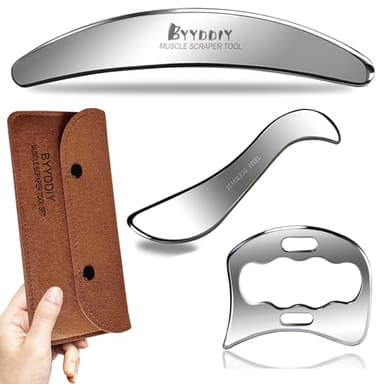
BYYDDIY 3-in-1 Stainless Steel Muscle Scraper Set
Three shapes rather than one, which is the only specification that changes what a scraper can reach: a long straight edge for a calf, a curved edge for a forearm, and a small contoured piece for a foot or an elbow.
What it gets right
- Three edge shapes, so the tool fits the limb instead of the limb fitting the tool
- Non-magnetic 304 stainless, which holds an edge profile where stone chips
- Costs less than one physiotherapy session that would use the same technique
What it does not
- Three objects to store and keep dry, and stainless spots if you leave it wet
- A set does not make the technique work better - the review evidence is the same for every tool shape
- No published hardness, radius or weight figures; the listing is marketing copy, not a spec sheet
Price as of October 21, 2026. #ad How we’re funded
STICKON Stainless Steel Gua Sha Scraping Tool
One object with several working edges, which is the shape most clinics actually use - easier to keep track of than a set and easier to hold at a shallow angle, which is the angle that matters.
What it gets right
- Multiple radii on a single piece, so you are not swapping tools mid-session
- Enough mass to do the work without being gripped hard, which is what keeps the angle shallow
- Nothing to lose from a set
What it does not
- Costs more than two single-edge tools that do most of the same work
- A single piece cannot be the perfect fit for both a calf and a finger
- No published specifications; brand is an Amazon-native label with no spec page to cite
Price as of October 21, 2026. #ad How we’re funded
Rena Chris Gua Sha & Muscle Scraper Tool
Stainless rather than the jade sold for facial use — the edge profile is the whole product, and a stone tool will not hold one against a plantar fascia.
What it gets right
- Stainless holds a consistent edge profile; stone chips
- Multiple edge radii for different structures
- Wipes clean
What it does not
- Very easy to bruise yourself with — this needs emollient and a light hand
- The evidence base for scraping is thin and we say so on the page
Price as of October 21, 2026. #ad How we’re funded
BYYDDIY 304 Stainless Steel Muscle Scraper
The cheapest honest way to find out whether scraping does anything for you, which matters more here than on any other page - the updated review evidence says the technique may do nothing at all.
What it gets right
- The lowest outlay in the category by a distance
- Non-magnetic 304 stainless rather than coated zinc alloy
- Small enough to keep in a gym bag
What it does not
- One edge profile, so it fits some structures well and others badly
- No handle shaping worth the name - you hold the tool itself
- Nothing about it is better than the technique it delivers, which is the real question
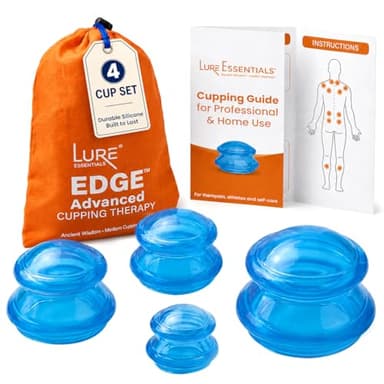
Silicone Cupping Set (4 cups)
Squeeze-and-release silicone rather than a hand pump, which is the version that works one-handed on your own leg. The honest reason to buy it is that percussion does not suit everyone, not any claim about toxins.
What it gets right
- Silicone cups apply and release by hand, so you can use them on yourself
- Slide easily over an emollient for moving cupping rather than static marks
- Cheap enough to find out whether the sensation suits you
What it does not
- The evidence base for cupping is thin and we say so on the comparison page
- It marks, and the marks last days — plan around anything you have to show up to
- Suction over broken skin, varicose veins or while on blood thinners is a clinician question first
Common questions
Do muscle scraping tools actually work?
The evidence is genuinely split and the more recent half is unflattering. The 2019 systematic review and effect-size analysis in the Journal of Athletic Training pooled 13 randomized trials and found large effect sizes for range of motion in uninjured people and for pain and function in injured ones. The 2023 update in Disability and Rehabilitation pooled 46 randomized trials and found that IASTM added to other treatment produced no statistically significant or clinically meaningful effect on function (SMD −0.28) or pain (SMD −0.05), and no clinically meaningful change in range of motion, on very low-certainty evidence with a high risk of bias. Treat scraping as a cheap comfort and mobility tool, not as a treatment.
Does the brand of scraping tool matter?
On the available evidence, no. The 2019 effect-size analysis specifically examined the influence of the product used and reported that the different IASTM tools in those studies revealed similar effect sizes across outcomes. What changes the session is the edge shape against the body part, the angle you hold it at, and whether you used an emollient. Buy the shapes you need at the lowest price you can.
What is the best scraping tool for plantar fasciitis?
A small contoured edge that follows the arch — the STICKON tool or the small piece in a 3-in-1 set — used with balm, shallow, for 30 to 60 seconds, and never directly on the point of the heel. Honestly though, for most people a contoured foot roller is the better buy for this: same pressure-and-shear idea, far more control, much harder to overdo on a painful heel. The stretch and loading work on our plantar fasciitis page is still the part with the trial evidence.
How hard should you press a muscle scraper?
Light to moderate, at a shallow 30 to 45 degree angle, for 30 to 60 seconds per area. You are after mild warmth and faint pinkness. Widespread petechiae — the speckled bruising people post as proof it worked — mean you pressed too hard, and only 10 of the 46 trials in the 2023 review even recorded adverse events, so nobody can tell you that bruising is harmless. Stop if you feel sharp or radiating pain.
Can you use a muscle scraper every day?
You can use it on a given area every other day, which gives skin and capillaries time to recover, and rotating body parts daily is fine. There is no dose-response evidence here to cite — the trials used clinic protocols of one to two sessions a week alongside exercise, which is a reasonable template. If an area is still tender from the last session, that is the answer for today.
Sources
- 1.Instrument-Assisted Soft Tissue Mobilization: A Systematic Review and Effect-Size Analysis - Journal of Athletic Training 2019 (PubMed 31322903) — 13 RCTs, PEDro ~5.8; large effect sizes for ROM (uninjured), pain and function (injured); different tools showed similar effect sizes
- 2.Effectiveness of instrument-assisted soft tissue mobilization for the management of upper body, lower body, and spinal conditions: an updated systematic review with meta-analysis - Disability and Rehabilitation 2023 (PubMed 35611579) — 46 RCTs; function SMD -0.28, pain SMD -0.05, no clinically meaningful ROM change; very low certainty, high risk of bias, 10 of 46 reported adverse events
- 3.Comparing the Role of Different Treatment Modalities for Plantar Fasciitis: A Double Blind Randomized Controlled Trial (PubMed 32257015) — the plantar fasciitis modality evidence behind the foot recommendation
- 4.Therabody — Product Safety & Precautions — manufacturer precautions naming blood-thinning medication - the same caution applies to shear tools