Feet & Gait
The Best Insoles for Flat Feet
Buy the PowerStep Pinnacle Maxx if your arch flattens under load: it is the one insole here that its maker sells for flat feet and overpronation specifically, and the angled heel addresses the rolling-in rather than just padding the arch. The budget pick is Dr. Scholl's Flat Feet Support at a drugstore price. Before you spend anything, read the evidence section - the best-measured result in this literature came from an exercise program, not an insole.
By Stephen V.Published
Disclosure:Grip & Gait earns a commission when you buy through links on this page, at no extra cost to you. It never changes what we recommend or the order we rank things in — here is exactly how we’re funded.
Quick picks
Ranked on published manufacturer specs and what they mean for the job, not on testing we have not done. Tap a row for the full reasoning. How we score.
| # | Product | Best for | Score | Price |
|---|---|---|---|---|
| 1 |  PowerStep Pinnacle Maxx Orthotic Insoles The only pick here that PowerStep sells for flat feet and overpronation rather than for a painful fascia: the same semi-rigid shell as the standard Pinnacle with an angled heel platform on top of it, in real shoe sizes. | Best overall for a collapsing arch | 8.7 | |
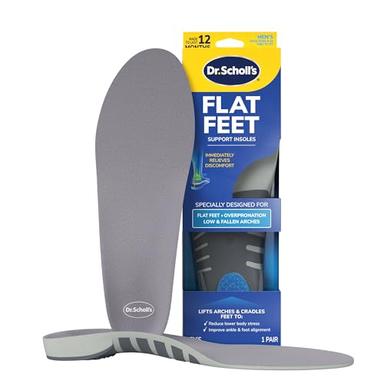
| 2 |  Dr. Scholl's Flat Feet Support Insoles Drugstore money for an insole marketed at overpronation and fallen arches rather than at fascia pain. Foam gives way sooner than a shell, which is the trade - but the shape is right and you can buy a pair for every shoe. | Budget pick - the right shape, cheap | 8.0 | $14.97 · View on Amazon Price as of November 22, 2026. #ad How we’re funded |
| 3 |  WalkHero Heavy Duty Arch Support Insoles Rated for higher body weight, which almost nobody publishes and which is exactly the variable that flattens a soft insole in a month. Deep heel cup. Firm from the first day and bulky in a dress shoe. | Heavier body weight | 8.2 | |
| 4 |  PowerStep Pinnacle Orthotic Insoles The lower-volume sibling: the same semi-rigid shell without the angled heel platform, so it goes into shoes the Maxx cannot. Less correction for the rolling-in, more shoes you can actually wear it in. | If the Maxx will not fit your shoes | 8.1 | |
| ✕ |  Dr. Scholl's Plantar Fasciitis Relief Orthotic Insoles A good insole aimed at a different foot - it is built and sold for plantar fascia pain, and it is trim-to-fit, so the support may not land under your arch. If heel pain rather than arch collapse is your complaint, it belongs on a different page. Skip this | The one to skip for this problem | 6.6 |
The short version
Buy the PowerStep Pinnacle Maxx. Almost everything sold as an “arch support insole” is designed and marketed for plantar fasciitis, which is a different problem with a different shape; the Maxx is the one pick here that its maker sells for flat feet and overpronation, and it adds an angled heel platform to the semi-rigid shell to address the way a flat foot rolls inward rather than simply filling the space under the arch. It is sized in real shoe sizes, so the support lands where your arch actually is.
If that is more than you want to spend on a first attempt, Dr. Scholl’s Flat Feet Supportis the cheapest insole we have found that is sold for this foot rather than for a sore fascia — drugstore money for the correct shape, which is the best way to find out whether support helps you at all. If you are a heavier adult, the WalkHero is the one with a published body-weight rating.
And one thing no insole page usually tells you: in the best-controlled trial we could find on flexible flat feet, a six-week exercise program improved foot posture more than insoles did. The honest recommendation is both, and the exercises are free.
What “flat feet” actually means for an insole
The clinical description is the useful one. A 2021 systematic review of foot orthoses for adults with flatfoot characterizes it as the falling of the medial longitudinal arch, eversion of the hindfoot and abduction of the loaded forefoot. Three things, not one — and only the first is the arch itself. That is why an insole that merely pushes up under the arch often disappoints: the heel is rolling inward at the same time, and nothing is holding it.
It also matters whether your flat foot is flexible or rigid. The simple home check: stand up and look at the inside of your foot, then rise onto your toes. If an arch appears when you tiptoe, the foot is flexible, which is the type almost every insole on the market is designed for and the type studied in the trials below. If there is no arch in either position, that is a rigid flat foot, and it is a conversation with a podiatrist rather than a shopping decision.
The same review notes the reason people end up on a page like this one in the first place: flatfoot is associated with musculoskeletal symptoms further up the chain, including knee and hip pain. If your complaint is actually knee pain or tight hips, an insole is a plausible part of the answer rather than the whole of it.
Does an insole actually help? The honest version
Three findings, and they do not all point the same way. We would rather print the disagreement than pick the flattering one.
The adult evidence is thin. The 2021 systematic review found twelve studies in adults, mostly of low methodological quality, measuring stance and plantar pressure rather than whether people felt better. Its own conclusion is blunt: given how weak the available evidence is, the frequency with which foot orthoses are prescribed is somewhat surprising. Anyone telling you insoles are proven for adult flat feet has not read this.
The pooled trial evidence on pain is positive. A 2026 systematic review and network meta-analysis of eight randomized trials in 369 participants reported significant pain reduction for insoles alone and larger reductions for insoles plus exercise, along with improvements in center-of-pressure displacement and some radiographic angles. The caveat is the population: mean ages in the included trials ran from about 7 to 27 years, so this is strongest evidence for children and young adults rather than for a fifty-year-old on their feet all day.
Exercise did more for the foot itself. In a 2024 randomized controlled trial of 45 people with flexible flatfoot, six weeks of tibialis posterior strengthening and short foot exercises improved foot posture more than customized arch support insoles did, and limits of stability improved in the exercise and exercise-plus-insole groups rather than in the insole-only group. Static balance improved in all three. The authors’ conclusion is that management should be tailored to the individual assessment, which is a careful way of saying there is no single right purchase.
For completeness, the pediatric question has its own Cochrane review of foot orthoses for treating paediatric flat feet. If you are buying for a child, read that rather than this page, and ask a clinician whether anything is needed at all — a flexible flat foot in a child who is not in pain is usually left alone.
What all of this adds up to, practically: an insole is a reasonable, cheap thing to try for a symptomatic flat foot, it is more likely to change how your day feels than to change your foot, and the thing with the better-measured effect on the foot costs nothing and takes ten minutes a day.
What to look for, in order
| What to check | What you want | Why it matters for a flat foot |
|---|---|---|
| What the maker sells it for | Flat feet, low arch or overpronation | Most 'arch support' insoles are plantar fasciitis products. The shapes differ: a fascia insole fills the arch, a flat-foot insole also controls the heel. |
| Heel geometry | A deep cup or an angled platform | The hindfoot everts - rolls inward - as the arch falls. A flat heel area lets that continue no matter how much support sits under the arch. |
| Shell stiffness | Semi-rigid, not foam alone | Press hard into the arch with your thumb. If it collapses easily under your thumb it will collapse under your bodyweight, which is the whole mechanism you are trying to resist. |
| Sized or trim-to-fit | Sized, if you can | A trim-to-fit insole puts the arch where the template says, not where your arch is. For a foot that is already poorly aligned, that margin of error matters. |
| Volume versus your shoes | Measure before you buy | A maximum-support insole is thick. In a snug running shoe or a dress shoe it changes the fit, and an insole in a shoe you stop wearing does nothing. |
| Body-weight rating | Published, if you are heavier | Almost nobody states one. It is the variable that decides whether an insole is still doing its job in three months. |
The picks, and who each one is for
PowerStep Pinnacle Maxx — the one to buy first. Two things earn it the top spot. It is sold by its maker for flat feet and overpronation, which sounds like marketing until you compare it with the standard Pinnacle and see that the heel is built differently; and it is sized rather than trimmed, so the arch support lands under your arch rather than wherever a cutting guide suggests. It is also the most expensive insole on this site and takes the most room in a shoe. If it does not fit the shoes you actually wear, it is the wrong purchase at any price.
Dr. Scholl’s Flat Feet Support — the budget pick. The reason to start here is not that it is better. It is that this category has a high rate of people buying a $45 orthotic, finding it uncomfortable in week one, and giving up. A drugstore-priced insole built for the right foot shape tells you cheaply whether support helps you, and if it does, you can upgrade knowing the answer. Foam compresses faster than a shell, and it is sold in broad size bands rather than exact sizes.
WalkHero — for a heavier adult. It publishes a body-weight rating, which is rare enough that we mention it on every page where it appears, and it has a deep heel cup, which is the feature that matters most for an everting hindfoot. It is firm from day one and bulky in anything smart.
PowerStep Pinnacle — the shoe-fit compromise. The same semi-rigid shell as the Maxx in a lower-volume package without the angled heel. You give up some of the correction and gain the ability to wear it in a shoe that is already snug. For a mild flexible flat foot with no pain further up the chain, this is often enough.
Dr. Scholl’s Plantar Fasciitis Relief — the skip row here. We recommend it elsewhere and will keep recommending it: on our general insoles and arch support page it is the cheapest real support you can buy in a pharmacy. It is the skip on this page because it is built and sold for fascia pain and it is trim-to-fit, which are the two things a flat foot specifically does not want.
The free half: the exercises the trial used
The 2024 trial used two exercises, three days a week, for six weeks: tibialis posterior strengthening and the short foot exercise. The tibialis posterior is the muscle whose tendon holds the arch up, and the short foot exercise trains the small muscles inside the foot to do the same job. Neither needs equipment. We are not going to print a rehabilitation program from a page that sells insoles — ask a physical therapist to teach you both properly, because the short foot exercise in particular is easy to do wrong by curling your toes instead.
What the trial result means for your money is simple: if you buy an insole and do nothing else, you have bought the intervention that performed worse on foot posture. The combination was the best performer on pain and on limits of stability. Buy the insole and learn the exercises.
Flat feet and the rest of the chain
Because the arch falls and the heel rolls in, the effects travel. The 2021 review names knee and hip pain among the associated symptoms, and in practice the complaints we see most often alongside a flat foot are plantar fasciitis, achilles and heel pain, calf and shin tightness and shin splints. An insole changes the load on all of them a little; it treats none of them directly.
If you stand for a living, the insole matters more than any treatment tool you own, and the ranked tools for that case are in the best foot tools for standing all day. If what hurts is the first few steps in the morning, that is a fascia pattern rather than an arch-collapse pattern, and rolling the plantar fascia is the page to read first.
How we ranked these
- Is it built for this foot? Weighted first. An insole sold for plantar fasciitis is a different shape, and that single distinction moved the rankings more than anything else on this page.
- Does it control the heel, not just fill the arch? A deep cup or an angled platform, because hindfoot eversion is half of what a flat foot does.
- Does the support survive your bodyweight? Semi-rigid beats foam for resisting collapse; a published body-weight rating beats a silent one.
- Will it fit the shoes you wear? The best insole in a shoe you abandon is worth nothing, which is why the lower-volume Pinnacle keeps a place in this list.
- What does the evidence support?Pain relief, modestly, in mostly younger populations — and less than exercise does for the foot itself. We rank on that rather than on correction claims nobody has demonstrated.
Where an insole is the wrong purchase
If your feet are flat and nothing hurts, you do not need to buy anything — a flexible flat foot without symptoms is a foot shape, not a condition, and the evidence above does not support treating it preventively. If the pain is specifically in the heel first thing in the morning, read the plantar fasciitis page and insoles and arch support, which rank the fascia-shaped products instead. If what you want is relief at the end of a shift rather than support through it, a machine does more than an insole can: the best foot massagers ranks those. And if your shoes are worn out, replace those first — a new pair of supportive shoes changes more than any insole you put inside an old pair.
Every pick, in full
Specs below are the manufacturer’s own published figures, each linked to the page it came from. Where a maker does not publish a number, the table says so and names the page we checked — that absence is information too.
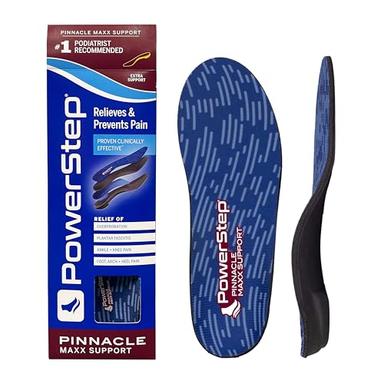
PowerStep Pinnacle Maxx Orthotic Insoles
The maximum-support version of the Pinnacle, and the one PowerStep sells for flat feet and overpronation rather than for a sore fascia - an angled heel platform on top of the same semi-rigid shell.
What it gets right
- Sold by the maker specifically for flat feet and overpronation, not as a general arch insole
- Angled heel platform addresses the rolling-in the arch collapse causes
- Sized rather than trim-to-fit, so the support lands where your arch is
What it does not
- The most expensive insole on the site, several times a drugstore pair
- Takes real volume - it will not go in a dress shoe or a snug running shoe
- Firm and angled from day one, so the first week is an adjustment
Price as of November 22, 2026. #ad How we’re funded
Dr. Scholl's Flat Feet Support Insoles
The cheapest insole we have found that is sold for flat feet specifically rather than for plantar fasciitis - a drugstore price for the right shape is the best first purchase in this category.
What it gets right
- Drugstore price, so you can buy a pair for every shoe you actually wear
- Marketed for overpronation and low or fallen arches rather than fascia pain
- Widely stocked, which makes replacing a flattened pair trivial
What it does not
- Foam construction gives less resistance to arch collapse than a semi-rigid shell
- Sold in gendered size bands rather than by exact shoe size
- Will need replacing well before a shelled orthotic would
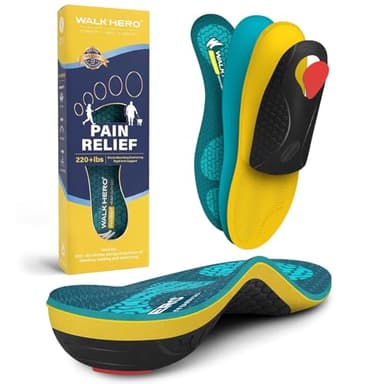
WalkHero Heavy Duty Arch Support Insoles
Rated for heavier body weights, which is a specification almost nobody publishes and which is exactly the variable that flattens a soft insole in a month.
What it gets right
- Explicitly rated for higher body weight — a spec that is usually silent
- Deep heel cup
- Priced between drugstore foam and semi-rigid orthotics
What it does not
- Firm from day one
- Bulky in dress shoes
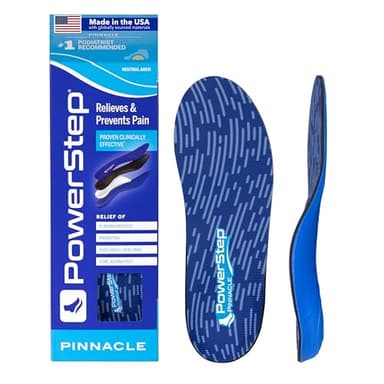
PowerStep Pinnacle Orthotic Insoles
A semi-rigid shell under a cushioned top, sized rather than trimmed — the closest thing to a dispensed orthotic you can buy without an appointment.
What it gets right
- Semi-rigid shell actually resists arch collapse rather than just padding it
- Sold in real shoe sizes rather than trim-to-fit
- Holds its shape far longer than foam
What it does not
- Three times the drugstore price
- Takes up volume — may not fit a snug shoe
- Needs a break-in period that some people give up during
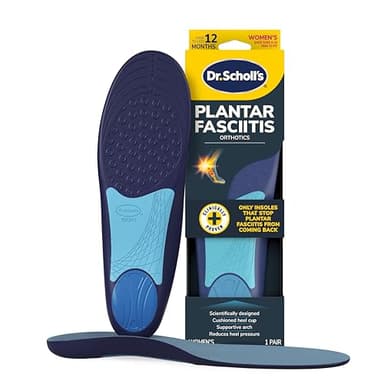
Dr. Scholl's Plantar Fasciitis Relief Orthotic Insoles
Drugstore-priced and widely available, which matters more than it sounds: the insole you can replace in fifteen minutes is the one still in your shoe in six months.
What it gets right
- Cheap enough to buy a pair for every shoe you actually wear
- Available almost everywhere, so replacement is trivial
What it does not
- Trim-to-fit rather than sized, so the arch may not land under your arch
- Compresses faster than a rigid orthotic
Common questions
What kind of insole is best for flat feet?
One built for a collapsing arch rather than for a sore fascia, which in practice means three features: a deep heel cup or an angled heel platform to limit the heel rolling inward, a semi-rigid shell that does not flatten under your bodyweight, and a real shoe size rather than a trim-to-fit template. Our top pick is the PowerStep Pinnacle Maxx, which its maker sells specifically for flat feet and overpronation; the cheap way to test whether support helps you at all is Dr. Scholl’s Flat Feet Support at drugstore money.
Do insoles actually fix flat feet?
No, and anyone promising that is overselling. A 2021 systematic review of foot orthoses for adults with flatfoot found only twelve studies, mostly of low quality, and concluded that the evidence is weak relative to how often orthoses are prescribed. A 2026 network meta-analysis of eight randomized trials did find significant pain reduction from insoles, and more from insoles plus exercise — but in a population whose mean ages ran from about 7 to 27. The realistic expectation is a foot that hurts less during the day, not an arch that comes back.
Are plantar fasciitis insoles the same as flat feet insoles?
They overlap but they are not the same shape, and this is the single most useful thing on this page. A plantar fasciitis insole is built to support and offload a painful fascia, and many are trim-to-fit. A flat-foot insole has to do that and also control the heel, which everts as the arch falls — hence the deeper cups and angled heel platforms. If your complaint is morning heel pain, buy the fascia product; if it is an arch that flattens under load and legs that ache by evening, buy the flat-foot product.
Do I need custom orthotics, or will over-the-counter insoles do?
For a flexible, symptomatic flat foot, start over the counter. The 2021 review looked at both prefabricated and custom-made orthoses and did not produce evidence that custom wins for this presentation; what it produced was a call for better trials. Over-the-counter insoles sold in real shoe sizes cost a fraction of a dispensed pair, and you will know within a few weeks whether support helps you. Custom becomes the sensible conversation if a shelled over-the-counter insole in the right size does not help, if the foot is rigid, or if a clinician managing something specific recommends it.
Can exercises help flat feet, or do I just need support?
They can, and in the one randomized trial we found that compared them head to head, six weeks of tibialis posterior strengthening and short foot exercises improved foot posture more than customized arch support insoles did, with the combination performing best on limits of stability. That is the strongest argument on this page for doing both. Have a physical therapist teach you the short foot exercise rather than copying it from a video, because curling the toes instead of shortening the foot is the usual mistake.
How long do insoles for flat feet last?
It depends on construction and on your weight more than on the brand. Foam insoles flatten fastest, which is why we recommend them as a cheap test rather than a long-term solution, and a semi-rigid shell holds its shape far longer. The practical check is the thumb test: press hard into the arch, and if it gives way easily it is no longer resisting your bodyweight either. If you are a heavier adult, buy a product that publishes a body-weight rating, because that is the variable that decides this.
Sources
- 1.Evidence for foot orthoses for adults with flatfoot: a systematic review - Journal of Foot and Ankle Research 2021 (12 included studies; methodological quality mostly low) (PMC8628393) — the definition used on this page (arch fall, hindfoot eversion, forefoot abduction) and the honest verdict on adult evidence quality
- 2.Optimizing Flatfoot Management With Foot Orthoses: A Systematic Review and Network Meta-analysis - American Journal of Physical Medicine and Rehabilitation 2026 (8 RCTs, 369 participants, mean age 6.8-26.8 years) (PubMed 41065643) — pooled randomized evidence of pain reduction from insoles, and larger reduction from insoles plus exercise - in a mostly young population
- 3.Effects of foot exercises and customized arch support insoles on foot posture, plantar force distribution and balance in people with flexible flatfoot: a randomized controlled trial - Gait and Posture 2024 (45 randomized, 40 completed, six weeks) (PubMed 38865799) — exercise improved foot posture more than customized insoles over six weeks; the combination was best for limits of stability
- 4.Foot orthoses for treating paediatric flat feet - Cochrane Database of Systematic Reviews 2022 (PubMed 35080267) — the separate question of children's flat feet - read this instead of this page if you are buying for a child