Recovery Tech
The Best Heating Pads for Back Pain
Heat is the one passive thing with a Cochrane review behind it for acute low back pain, and the specification that decides whether you get that effect is embarrassingly simple: how much of your back the pad actually covers, and whether it stays in contact when you sit up. Ranked on area, contact and auto shutoff, which are the only three things a heating pad can be better or worse at.
By Stephen V.Published
Disclosure:Grip & Gait earns a commission when you buy through links on this page, at no extra cost to you. It never changes what we recommend or the order we rank things in — here is exactly how we’re funded.
Quick picks
Ranked on published manufacturer specs and what they mean for the job, not on testing we have not done. Tap a row for the full reasoning. How we score.
| # | Product | Best for | Score | Price |
|---|---|---|---|---|
| 1 |  Pure Enrichment PureRelief XL Heating Pad (12 × 24 in) For almost everyone treating a lumbar spine lying down. A 12 x 24 in footprint spans the whole low back, with auto shutoff and a washable cover and nothing clever to go wrong. | Best overall for a lower back | 8.7 | |
| 2 |  Boileau XXXL Electric Heating Pad (17 × 33 in) For anyone whose pain spreads across the low back and into one hip. 17 x 33 in covers the lumbar span and both sides of it, and it is the cheapest pad on this page. | Budget pick - and the largest pad here | 8.5 | |
| 3 |  Comfytemp Weighted Heating Pad (12 × 24 in) For desk workers and anyone who cannot lie down mid-day. The weight holds the pad against the lumbar curve instead of letting it tent away from it. | Best if you treat your back sitting up | 8.4 | |
| 4 |  GENIANI Electric Heating Pad For a specific painful patch rather than a whole back - a one-sided lumbar spasm or a spot beside the spine. Moist heat, auto shutoff, smaller footprint. | Best moist-heat option | 7.9 | |
| 5 |  Comfytemp Cordless Heating Pad with Massager For a back that hurts at work, in a car or on a job site where there is no outlet. Pay the premium only if the cord is the actual problem. | Heat you can walk around in | 7.5 | |
| ✕ |  Sunbeam Neck and Shoulder Heating Pad A genuinely good pad on the wrong body part. It is cut to sit over the traps, and that shape does nothing useful on a lumbar spine. Skip this | The one to skip for a back | 6.5 |
The short version
Buy the Pure Enrichment PureRelief XL. For a lower back the specification that changes the outcome is area, and 12 x 24 in is the size that spans a lumbar region rather than warming a patch in the middle of it — with auto shutoff, which is the one safety feature that matters on a device people fall asleep on. The budget pick is the Boileau XXXL, and it is the strangest result on this page: it is the cheapest pad here and also the biggest, at 17 x 33 in. If you treat your back sitting at a desk rather than lying on a bed, buy the Comfytemp Weightedinstead — weight is what keeps a pad in contact with a lumbar curve when you are upright.
What the evidence actually supports
Heat is unusual in this category: it is a passive modality with a Cochrane review behind it that says something concrete. The Cochrane review of superficial heat or cold for low back pain pooled 9 trials with 1,117 participants and found moderate evidence that a heat wrap reduced pain in acute low back pain — a weighted mean difference of 1.06 on a 0 to 5 scale at five days — with pain reduced further when exercise was added, and insufficient evidence to say anything useful about cold.
Read that carefully, because it contains the two instructions this page is built on. First, the trials used a wrap: a heat source held in sustained contact with the back, not a pad resting on top of one. Second, the effect got bigger when movement was added. Heat is what makes the first ten minutes of moving bearable; it is not the treatment on its own. A pad that slides off, or that you only use lying still in the evening, is a pad delivering less than the trials did.
The three specs that decide a back pad
| Spec | Does it matter | Why |
|---|---|---|
| Area | Decides it | A lower back is roughly 12 in across and the pain usually wraps toward one hip. A 12 x 15 in pad warms the middle and leaves the part that hurts cold. The two pads here at 12 x 24 in and 17 x 33 in are the ones that cover the actual problem. |
| Contact when upright | Decides it, if you sit | An unweighted pad tents away from a lumbar curve the moment you sit up straight, so the heat goes into the chair. Weight is the only thing that fixes that, which is the entire argument for the Comfytemp. |
| Auto shutoff | Safety, not comfort | People fall asleep on back pads more than on any other kind, because a sore back is treated lying down. Every pad we rank here has it; a pad without it does not belong on this list. |
| Moist versus dry | Real but small | Moist heat carries into tissue slightly better than dry, which is why the GENIANI's damp-cloth option is a genuine feature. It is a smaller difference than covering twice the area. |
| Number of heat settings | Mostly noise | Six settings instead of three changes nothing about the dose you actually use, which is the hottest one you can tolerate for twenty minutes. Do not pay for the dial. |
| Cordless | Only if the cord is the problem | A lower back is usually treated sitting or lying down near an outlet. Cordless costs more and adds a runtime limit; buy it for a car or a worksite, not for a sofa. |
The picks, and who each one is for
Pure Enrichment PureRelief XL — the default
This is the pad to buy if you have not got a specific reason to buy one of the others. It is for the person with ordinary mechanical low back pain who wants to lie down for twenty minutes and have the whole sore region warm. The 12 x 24 in footprint is the size that matches a lumbar spine, the auto shutoff means falling asleep on it is not an event, and the cover washes. There is nothing innovative about it and that is the recommendation: in a category where the extras are a dial with more numbers on it, the boring pad wins.
Boileau XXXL — the budget pick, and the biggest
This is for the reader whose pain does not sit in one tidy square: it runs across the whole low back, or across the back and into a glute, or up into the thoracolumbar junction. At 17 x 33 in it covers all of that at once, and it is the cheapest pad on this page, which is not how this category usually works. Name it the budget pick without apology — it is the cheapest thing here that does the job, and on the one spec that decides a back pad it does the job better than anything else listed. The trade is honest: it is bulky to store and it takes longer to come up to temperature than a small pad.
Comfytemp Weighted — for treating a back sitting up
This is for the office worker, the driver and anyone whose back hurts during the day rather than at the end of it. The weight is the whole product. An ordinary pad behind you in a chair bridges the lumbar curve and heats air; a weighted one settles into it. It is also listed as FSA and HSA eligible, which changes what it actually costs a lot of buyers. Some people dislike weight on a sore back, and that is a real reason to pick the PureRelief instead.
GENIANI Electric Heating Pad — for one painful patch
Smaller than the two XL pads, with a moist-heat option and auto shutoff. This is the pick for a one-sided lumbar spasm, a spot beside the spine, or a back that also needs a pad that can travel to a shoulder or a hip on other days. It is not the pick for a whole lower back, because area is the spec that matters and this one has less of it.
Comfytemp Cordless — buy only for a specific constraint
Battery heat plus vibration. Worth the premium only if your back hurts somewhere there is no outlet — standing at a counter, driving, on a site. Check the current listing’s stated runtime before buying it for a 20 to 30 minute session, because runtime is the limiting factor on every cordless pad and it is the number that varies most between production runs.
Sunbeam Neck and Shoulder — the skip, for this job only
We rank this pad highly on the neck and shoulder page, and it is the skip here for exactly the reason it wins there: it is cut to drape over the trapezius and down both sides, and that shape is useless flat against a lumbar spine. If your back pain is actually upper back and neck tension, buy that one and ignore this page.
What else is worth owning alongside it
Heat is a twenty-minute window, not a treatment. The two cheapest things below are what the evidence actually points at — the movement half — and both cost less than the pad.
How this page differs from the other heat pages here
The site runs a heat page per region because the right pad genuinely changes shape with the body part. The category page explains how heat works and what the settings do. This page ranks for a lumbar back, where area wins. Neck and shoulders is won by shape instead, and hip pain by whether the pad stays wrapped on a moving joint. If you are deciding between heat and electrical stimulation at all, heating pad versus TENS is the page for that question.
Every pick, in full
Specs below are the manufacturer’s own published figures, each linked to the page it came from. Where a maker does not publish a number, the table says so and names the page we checked — that absence is information too.
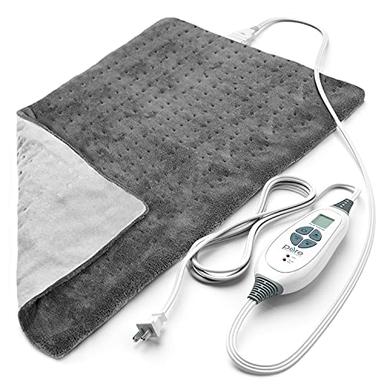
Pure Enrichment PureRelief XL Heating Pad (12 × 24 in)
The default answer in this category: standard 12 × 24 in footprint, multiple heat settings, auto shutoff, and a washable cover — nothing clever, everything you actually need for a back.
What it gets right
- 12 × 24 in is the size that spans a lower back rather than treating a patch of it
- Auto shutoff, which is the one feature that matters if you fall asleep on it
- Machine-washable microplush cover
What it does not
- Corded, so you are treating your back wherever the outlet is
- No weight to it, so it lifts away from the curve of your back when you sit upright
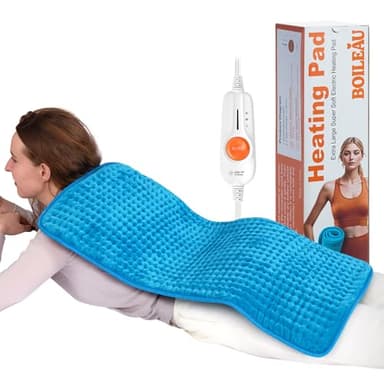
Boileau XXXL Electric Heating Pad (17 × 33 in)
Large enough to cover a whole lumbar region and both sides of it at once, which a standard pad cannot do — and area is the only heating-pad spec that changes the experience.
What it gets right
- 17 × 33 in covers the full lumbar span rather than a patch of it
- Multiple heat settings with auto shutoff
What it does not
- Bulky to store
- Takes longer to reach temperature
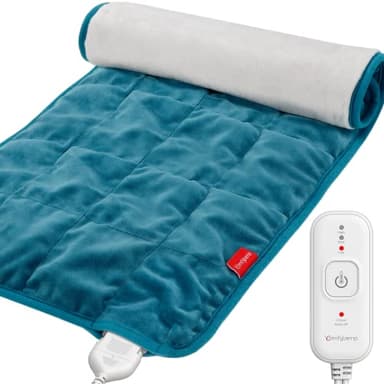
Comfytemp Weighted Heating Pad (12 × 24 in)
The weight is the whole point and it is not a gimmick: a weighted pad stays in contact with the curve of a lower back when you are sitting, which is exactly where an unweighted pad lifts off.
What it gets right
- Weighted, so it holds contact against a lumbar curve instead of tenting away from it
- Listed as FSA and HSA eligible, which changes the real price for a lot of buyers
- Auto shutoff and a washable cover
What it does not
- The weight is the reason to buy it and the reason some people dislike it on a sore back
- Heavier to hold in place anywhere other than a back
- Corded
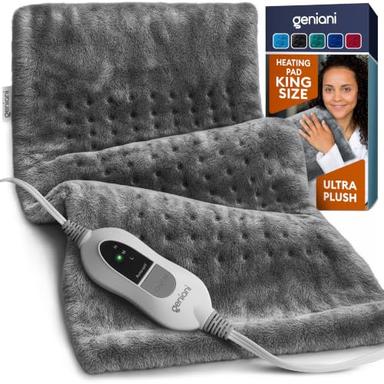
GENIANI Electric Heating Pad
Moist-heat capable with an auto-shutoff, which is the specification that decides whether a heating pad is safe to use lying down — and lying down is when you want it.
What it gets right
- Auto shutoff — the safety feature that matters if you fall asleep on it
- Moist-heat option penetrates better than dry
- Machine-washable cover
What it does not
- Corded, so your position is fixed
- Smaller than the XXL pads
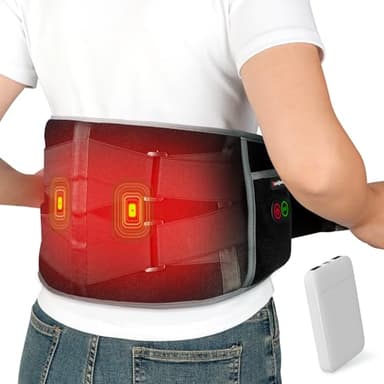
Comfytemp Cordless Heating Pad with Massager
Battery heat plus vibration, aimed at people who want to walk around while treating a back — which is the one thing a sore lower back is usually least interested in doing.
What it gets right
- No cord, so it works in a car, at a desk away from a socket, or standing at a counter
- Adds vibration on top of heat, which some people prefer to heat alone
- Listed as FSA and HSA eligible
What it does not
- Runtime per charge is the limiting factor for a 20-30 minute session; check the current listing figure before buying for that
- Costs more than a corded pad of the same size
- A lower back is usually treated sitting or lying down, which is where a cord is not a problem
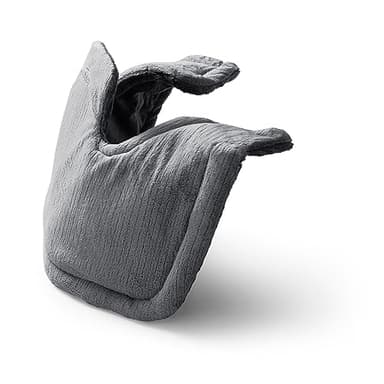
Sunbeam Neck and Shoulder Heating Pad
Cut to the shape of the problem: it sits over the trapezius and down both sides without being held there, which is the only thing a flat rectangle cannot do on a neck.
What it gets right
- Shaped for the neck and shoulders, so it stays put without a hand on it
- Moist-heat option as well as dry
- Auto shutoff — the feature that matters because people use this one in an armchair in the evening
What it does not
- The shape that makes it good on a neck makes it useless on a lower back
- Corded, so you are anchored to the outlet
- Covers less total area than a flat XL pad
Common questions
What is the best heating pad for back pain?
The Pure Enrichment PureRelief XL for most people, because 12 x 24 in is the footprint that spans a lower back rather than warming the middle of one, and it has the auto shutoff that matters on a device used lying down. Buy the Boileau XXXL instead if your pain spreads wider than that — it is 17 x 33 in and it is also the cheapest pad we rank. Buy the Comfytemp Weighted if you treat your back sitting up, because weight is the only thing that keeps a pad in contact with a lumbar curve in a chair.
Does a heating pad actually help back pain?
For acute low back pain, yes, modestly, and that is one of the better-supported claims on this site. The Cochrane review of superficial heat or cold pooled 9 trials with 1,117 participants and found moderate evidence that a heat wrap reduced pain, a weighted mean difference of 1.06 on a 0 to 5 scale at five days. Two caveats come with that number: the effect was larger when exercise was added, and the trials used wraps held in sustained contact rather than a pad resting loosely on a back.
How long should you use a heating pad on your back?
Fifteen to twenty minutes at a temperature you could hold your hand on comfortably, then off, and ideally move afterwards while the tissue is still warm. Longer is not better: past twenty minutes you are not getting more effect, you are getting more skin exposure, and prolonged low-grade heat is how people end up with the mottled skin pattern clinicians call erythema ab igne. Never sleep on a pad that does not shut itself off.
Is a bigger heating pad better for a back?
For a back, yes, and it is the only place on this site where we say that about size. Back pain rarely sits in one tidy square: it runs across the lumbar region and usually favours one side. A 12 x 15 in pad centred on the spine leaves the part that actually hurts cold. That is why a 12 x 24 in pad is the default pick here and a 17 x 33 in pad is a legitimate budget upgrade rather than overkill. Size costs you storage space and warm-up time, and nothing else.
Heat or ice for lower back pain?
Heat, for ordinary mechanical back pain and back spasm, and the Cochrane review is the reason: it found moderate evidence for heat wraps and explicitly said there was insufficient evidence to draw conclusions about cold. Ice has a place for a fresh, obviously swollen injury in the first day or two. For the common case — a back that has seized up and hurts to move — heat is the better-supported choice and the one that makes the movement part possible.
Is a weighted heating pad worth it for back pain?
It is worth it for one specific situation: treating your back while sitting upright. An unweighted pad bridges the curve of a lumbar spine in a chair and heats the chair rather than you. Weight closes that gap. If you treat your back lying down on a bed or a floor, gravity already does that job and the weight buys you nothing — buy the larger plain pad instead and put the money into area.
Sources
- 1.Superficial heat or cold for low back pain - Cochrane Database of Systematic Reviews 2006 (PubMed 16437495) — 9 trials, 1,117 participants; heat wrap WMD 1.06 on a 0-5 scale at five days in acute low back pain, larger with exercise added; insufficient evidence for cold
- 2.Effectiveness of Conservative Nonpharmacologic Therapies for Pain, Disability, Physical Capacity, and Physical Activity Behavior in Patients With Degenerative Lumbar Spinal Stenosis: A Systematic Review and Meta-analysis - Archives of Physical Medicine and Rehabilitation 2021 (PubMed 33933439) — the quantified gains in degenerative lumbar conditions come from movement-based care, which is why this page treats heat as the thing that makes movement possible rather than the treatment
- 3.Use of Heat for the Self-Management of Non-Specific Neck Pain: A Systematic Review - Journal of Pain Research 2026 (PMC13269032) — the parallel review for neck pain, cited here only to mark that the back evidence and the neck evidence are separate bodies of work