Recovery Tech
The Best TENS Units Under $50
Buy the TENS 7000. Under $50 you can have the unit most clinics hand out, with manual pulse-width and rate control, and it is the only one here whose maker publishes a reference manual stating the actual ranges. The budget pick is the Belifu at the bottom of the band. One thing nobody tells you first: over two years the pads cost more than any unit on this page.
By Stephen V.Published
Disclosure:Grip & Gait earns a commission when you buy through links on this page, at no extra cost to you. It never changes what we recommend or the order we rank things in — here is exactly how we’re funded.
Quick picks
Ranked on published manufacturer specs and what they mean for the job, not on testing we have not done. Tap a row for the full reasoning. How we score.
| # | Product | Best for | Score | Price |
|---|---|---|---|---|
| 1 |  TENS 7000 Digital TENS Unit For anyone who has tried a cheap unit and only felt tingling skin: manual pulse width and rate, and a published reference manual that states both ranges rather than a mode list. | Best overall under $50 | 8.7 | $38.88 · View on Amazon Price as of November 12, 2026. #ad How we’re funded |
| 2 |  AUVON Dual Channel TENS Unit For someone who wants to switch it on and have it work without reading anything. Two independent channels with separate intensity, rechargeable, and usable on day one. | Best presets, rechargeable | 8.4 | |
| 3 |  Belifu Dual Channel TENS EMS Unit For covering a large area on the smallest possible outlay. The twenty-four modes are marketing; the dual-channel hardware and the included pads are why it is here. | Budget pick - cheapest dual channel | 7.7 | |
| ✕ |  KingPavonini Wireless TENS + EMS Muscle Stimulator Twice this page's ceiling and genuinely the nicest to wear. Two cordless pods cannot bracket an area the way four wired pads can, and that is what you are giving up. Skip this | The one to skip in this band | 6.6 | $129.69 · View on Amazon Price as of November 12, 2026. #ad How we’re funded |
The short version
Buy the TENS 7000. Fifty dollars is a generous ceiling in this category — generous enough to buy the unit that clinics hand out, which means pads and leads are available everywhere and will still be in five years. More importantly, it is the one unit here with manual pulse-width and pulse-rate control, and its maker publishes a reference manual that states the ranges: pulse width 50–300 µs with 70–120 µs suggested, pulse rate 2–150 Hz with 70–120 Hz suggested, five named modes, two channels, a 1–60 minute or continuous timer, running on a 9 V battery. Nobody else in this band publishes a document like that.
If you would rather not read a manual at all, buy the AUVON dual channel: it is rechargeable, the presets are usable immediately, and it has two independent channels with separate intensity. If you want the lowest outlay that still gets you two channels, the Belifu is the budget pick. And skip the wireless pods at this ceiling — they cost twice the band and buy you cordlessness in exchange for the ability to bracket an area with four pads.
Under $50, the only spec that matters is pulse width
Every unit in this band is a two-channel surface stimulator with a plastic case and a set of sticky pads. The hardware does not vary much. What varies is whether you can turn the one dial that changes the character of the sensation.
| Control | What it changes | Worth it under $50? |
|---|---|---|
| Pulse width (µs) | Whether the sensation sits in the skin or spreads into muscle | This is the one. Manual width control is the single feature that separates a unit that works on a thick area from one that tickles. Only the TENS 7000 here gives you it. |
| Pulse rate (Hz) | Buzzy and fast against slow and thumping | Yes, and it is usually bundled with width. High frequency for immediate relief, low for a deeper, slower sensation - the two feel completely different. |
| Two independent channels | Four pads in two pairs, at different intensities | Yes, non-negotiable. All three picks here have it. A single-channel unit forces one placement, and the one you pick is rarely enough. |
| Rechargeable vs 9 V battery | Convenience, nothing else | Nice, not decisive. A 9 V battery lasts a long time in a device drawing this little, and it never dies permanently the way a sealed cell does. |
| Mode count (24, 48 modes...) | Nothing you can verify | No. Nobody publishes what each numbered program does. We rank this down everywhere on the site and this page is no exception. |
The running cost nobody mentions
A TENS unit is not the purchase. The pads are. Electrodes lose adhesion after somewhere between a handful and a couple of dozen applications depending on skin, hair and how carefully you store them, and a person treating a back twice a day will get through them faster than they expect. Over two years of real use the pads cost more than any unit on this page, which has three consequences for how you should buy:
- Buy a unit whose pads are commodity items. The TENS 7000 uses the standard 2 mm pin connector that generic 20-packs are made for, which is the reason it is cheap to own as well as cheap to buy.
- Count the pads in the box. A unit shipping with several sets is genuinely worth more than one shipping with one set, by the price of the difference.
- Do not buy a proprietary pod system on a budget. Cordless pods are pleasant and their replacement gels are not commodity parts.
What the evidence supports, and what it does not
We are not going to sell you a $40 device on a promise. The honest position is that TENS is cheap, low-risk and inconsistently effective, and the better trials are specific about where it helps. The Cochrane review of transcutaneous electrostimulation for knee osteoarthritis could not conclude that TENS reliably beats sham. The 2025 systematic review and meta-analysis of thirty studies in neuropathic pain found only a small reduction against placebo that did not reach clinical significance (SMD −0.35, 95% CI −0.90 to 0.10), with clear benefit confined to spinal cord injury.
The positive side is real and it is narrower than the box. The FAST trial and the FM-TIPS cluster randomized clinical trial in JAMA Network Open both found reductions in movement-evoked pain and fatigue in fibromyalgia, using defined settings rather than a numbered mode — which is the strongest practical argument on this page for buying the unit with manual control. And a Cochrane protocol for TENS in chronic neck pain is currently registered, meaning that question is being formally reviewed rather than settled.
The sane way to read all of that: at under $50 this is a cheap experiment on yourself with a short list of contraindications. It is not a treatment, and anyone presenting it as one is selling.
How we ranked these
- Published control ranges beat feature lists. The TENS 7000 wins this page because there is a manual stating what it does. The spec tables below name what each maker publishes and, where they publish nothing, where we looked.
- Two independent channels with separate intensity. A hard requirement, not a preference.
- Pad economics. Standard connectors and more pads in the box, both ranked up.
- Usable on day one. A unit that needs the manual to do anything at all loses points for a first-time buyer, which is why the AUVON sits so close to the top.
- Mode counts are ranked down, deliberately. Twenty-four or forty-eight numbered programs is a marketing specification. Two channels and a width dial is a real one.
Which one for which person, in one line each
- You have tried a cheap unit and it only tingled: the TENS 7000. Turn the pulse width up and the sensation stops being a surface thing.
- You want to switch it on and not think: the AUVON. Rechargeable, clear presets, two channels.
- You want the cheapest thing that is still two channels: the Belifu as the budget pick. Ignore the mode count and use the pads it comes with.
- You want to wear it under clothing while moving around: that is the wireless unit, it is twice this band, and it is our skip here rather than a recommendation at this price — see wireless vs wired TENS.
Where a sub-$50 TENS unit is the wrong purchase
If you want the category ranked without a price ceiling, that is the TENS unit roundup. If you are buying for a specific region, the body-part pages are more use than any price band: back, sciatica, knee and neck and shoulder. If the problem is a tight muscle you can press and reproduce rather than a nerve-flavoured ache, percussion or a ball does more for less — massage gun vs TENS is that argument. And if you want the head-to-head between the two units at the top of this page, TENS 7000 vs AUVON goes into it properly.
Every pick, in full
Specs below are the manufacturer’s own published figures, each linked to the page it came from. Where a maker does not publish a number, the table says so and names the page we checked — that absence is information too.
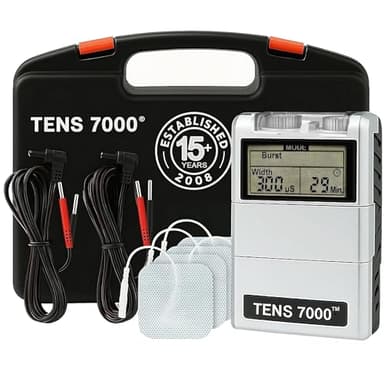
Price as of November 12, 2026. #ad How we’re funded
TENS 7000 Digital TENS Unit
The unit clinics hand out, with manual control over pulse width and rate rather than a menu of preset programs — which is what you want once you know what setting helps.
What it gets right
- Manual pulse-width and rate control instead of fixed presets
- The long-standing clinic default, so accessories are everywhere
What it does not
- Runs on a 9 V battery
- Manual control is only an advantage if you know what you are adjusting
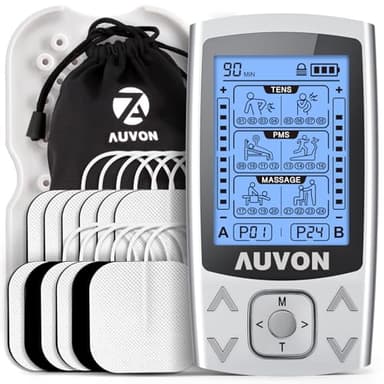
AUVON Dual Channel TENS Unit
Two independent channels so you can treat both sides of a problem at once, at a price where trying TENS costs less than one session of anything else.
What it gets right
- Two independent channels with separate intensity control
- Rechargeable rather than eating 9 V batteries
- Cheap enough to find out whether TENS does anything for you
What it does not
- Pad adhesive life is the real running cost, not the unit
- Interface is fiddly with cold hands
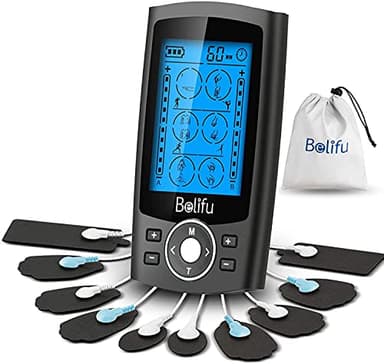
Belifu Dual Channel TENS EMS Unit
Twenty-four modes at the lowest price in the category, and the mode count is marketing — but the hardware underneath is a competent dual-channel stimulator.
What it gets right
- Cheapest dual-channel unit here
- Rechargeable
- Pads and leads included
What it does not
- Mode count is noise, not a feature
- Thin documentation of what each mode does
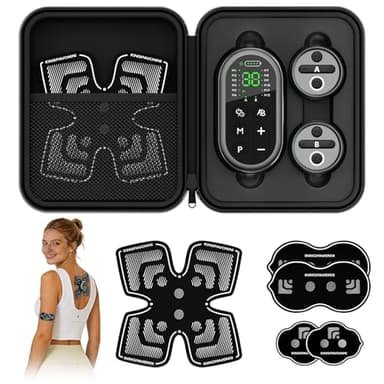
Price as of November 12, 2026. #ad How we’re funded
KingPavonini Wireless TENS + EMS Muscle Stimulator
TENS and EMS from two pods you stick on and wear, with no lead wires anywhere — which is the whole reason to pay this much, because it is the only version of the device you can use under a shirt and still move around in. The 48-mode count is marketing; the dual-zone independent control underneath it is not.
What it gets right
- Wireless pods rather than lead wires, so it works under clothing and while moving
- Two pods run independently — separate mode and intensity each, so a shoulder and a leg can run different settings at once
- Published 20 hours per pod on the 1040 mAh cell, charged over USB-C rather than off a disposable battery
- Ships with three pad sizes including a 4.3 in butterfly pad, which is the one that actually covers a lower back
What it does not
- Forty-eight modes is a mode count, not a specification — the same marketing this site flags on every cheap unit
- Several times the price of a wired dual-channel unit that treats a back just as well
- Two pods and a remote are three things to keep charged and not lose
- Listed only in December 2025 and rated 4.1 across 69 reviews, so there is very little ownership history behind it
Common questions
What is the best TENS unit under $50?
The TENS 7000, because at this ceiling you can have manual pulse-width and pulse-rate control and a maker who publishes the ranges. Its reference manual states a pulse width of 50–300 µs with 70–120 µs suggested, a pulse rate of 2–150 Hz with 70–120 Hz suggested, five named modes, two channels and a 1–60 minute or continuous timer. The AUVON is the close second if you want rechargeable presets instead of dials. Live prices for both sit beside their buy buttons with the date checked.
Are cheap TENS units any good?
The hardware, yes. A $30 dual-channel stimulator and a $300 one are doing the same physical thing, and the honest limiting factor is the evidence base rather than the build: the Cochrane review for knee osteoarthritis could not conclude TENS beats sham, and a 2025 meta-analysis in neuropathic pain found only a small, not clinically significant effect against placebo. What a cheap unit does buy you is a low-risk way to find out whether you are one of the people it helps, and the fibromyalgia trials that did find benefit used defined settings rather than expensive hardware.
How much do TENS pads cost to replace?
Enough that over a couple of years they outweigh the unit. Electrodes lose adhesion after somewhere between a handful and a couple of dozen applications depending on skin, hair and storage, so someone treating a back twice a day gets through them quickly. Buy a unit that takes standard 2 mm pin pads sold in 20-packs rather than a proprietary cordless gel, and store the pads on their plastic backing in the fridge in a sealed bag — that is the cheap trick that makes a set last.
Do you need more than two channels?
No, and you should not accept fewer. Two independent channels with separate intensity give you four pads in two pairs, which is what lets you bracket a sore area from both sides and run the tender side lower. Every pick on this page has two. Units advertising more than two channels at this price are generally counting pad sockets rather than independent circuits, which is not the same thing and is not something you can verify from a listing.
Sources
- 1.TENS 7000 — Reference Manual (pulse width 50-300 µs, suggested 70-120 µs; pulse rate 2-150 Hz, suggested 70-120 Hz; 5 modes; 1-60 minute or continuous timer; two channels; 9 V battery) — the published control ranges behind the top pick - the only such document in this band
- 2.Transcutaneous electrostimulation for osteoarthritis of the knee - Cochrane Database of Systematic Reviews (PubMed 19821296) — the reviewers could not conclude TENS reliably beats sham for knee osteoarthritis
- 3.Neuropathic Pain Relief Through Transcutaneous Electrical Neuromuscular Stimulation: Insights From a Systematic Review and Meta-Analysis of Clinical Evidence - BioMed Research International 2025 (PMC12543013) — SMD -0.35 vs placebo, not clinically significant outside spinal cord injury
- 4.Transcutaneous Electrical Nerve Stimulation Reduces Movement-Evoked Pain and Fatigue (FAST trial) - Arthritis & Rheumatology 2020 (PMC7188591) — reduced movement-evoked pain and fatigue using defined settings, not a numbered mode
- 5.Transcutaneous Electrical Nerve Stimulation and Pain With Movement in People With Fibromyalgia: A Cluster Randomized Clinical Trial (FM-TIPS) - JAMA Network Open 2026 (PMC13032160) — the 2026 cluster randomized trial replicating that finding
- 6.Transcutaneous electrical nerve stimulation (TENS) for chronic neck pain - Cochrane Database of Systematic Reviews 2026, PROTOCOL (PMC13501494) — registered protocol - the neck question is under formal review, not settled
- 7.camelcamelcamel — TENS 7000 price history — price history for the top pick
- 8.camelcamelcamel — AUVON TENS price history — price history for the preset pick