Recovery Tech
TENS 7000 Review
Almost every cheap TENS unit sells you a menu of named programs. This one sells you two dials and a manual. That is the whole review: the TENS 7000 is the unit that lets you set pulse width and pulse rate yourself, which is exactly right if a clinician has told you what setting helps and exactly wrong if nobody has. Here is what it publishes, what the evidence says TENS can and cannot do, and when a preset unit is the better buy.
By Stephen V.Published
Disclosure:Grip & Gait earns a commission when you buy through links on this page, at no extra cost to you. It never changes what we recommend or the order we rank things in — here is exactly how we’re funded.
Quick picks
Ranked on published manufacturer specs and what they mean for the job, not on testing we have not done. Tap a row for the full reasoning. How we score.
| # | Product | Best for | Score | Price |
|---|---|---|---|---|
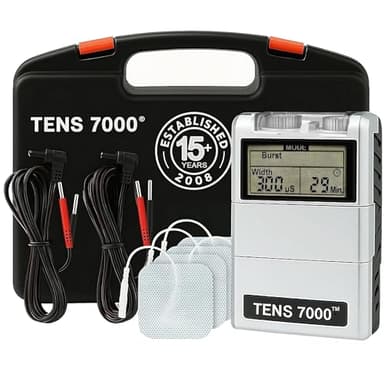
| 1 |  TENS 7000 Digital TENS Unit Manual pulse width (50-300 µs) and manual pulse rate (2-150 Hz) from the maker's own manual, five modes, two channels, a 1-60 minute timer. The parameters are yours to set, which is the point and also the catch. | The unit this review is about | 8.4 | $38.88 · View on Amazon Price as of November 12, 2026. #ad How we’re funded |
| 2 |  AUVON Dual Channel TENS Unit Twenty-four preset modes and a rechargeable battery instead of a 9 V cell. You give up parameter control and gain a unit you can use correctly on day one without reading anything. | If you want presets instead of dials | 8.2 | |
| 3 |  Belifu Dual Channel TENS EMS Unit Adds muscle-stimulation modes alongside the pain-relief ones. Two different jobs in one unit, and worth understanding the difference before you buy either. | If you want TENS and EMS in one box | 7.6 | |
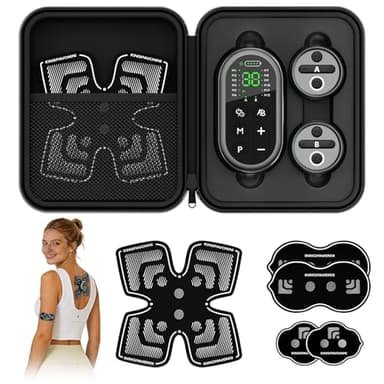
| ✕ |  KingPavonini Wireless TENS + EMS Muscle Stimulator Wireless pads solve a real problem - lead wires under clothing - at several times the price, with no manual parameter control at all. Buy it for the form factor, never for the therapy. Skip this | Skip unless you need no wires | 6.9 | $129.69 · View on Amazon Price as of November 12, 2026. #ad How we’re funded |
The verdict in one paragraph
Buy the TENS 7000if someone who examined you has told you what to set, or if you are willing to read a manual and work through the settings methodically. It is the unit that hands you the two parameters that actually define a TENS dose — how wide each pulse is and how fast the pulses arrive — and it publishes both ranges in its own documentation, which most units in this bracket do not. The honest limitation is the flip side of the same thing: a device with two dials and no guidance is worse than a device with a sensible preset if you have no idea what you are adjusting. If that is you, the preset alternatives below are the better purchase, and this review will tell you so twice.
What the maker actually publishes
This site scores devices on what the manufacturer puts in writing, because we do not run a lab. On that test the TENS 7000 does unusually well, and not because its marketing is better. Its reference manual states the full adjustable range of both dose parameters, the mode list, the timer range and the power source. Read on 31 October 2026, it publishes:
- Pulse width adjustable from 50 µs to 300 µs, with the manual adding that “unless otherwise instructed a setting of 70-120 µs is suggested”.
- Pulse rate adjustable from 2 Hz to 150 Hz, with the same form of guidance: 70-120 Hz unless you have been told otherwise.
- Five modes— Burst, Normal, Modulation, SD1 and SD2.
- Two channels, so four pads, which is what you need to bracket a painful area from both sides rather than from one.
- A treatment timer adjustable from 1 to 60 minutes, or continuous.
- A 9 V battery, with a low-battery indicator, and the manual’s own instruction to replace it “when stimulation feels weaker”.
- Sixty stored operation recordsand a running total treatment time up to 999 hours — a clinic feature, and genuinely useful if you are trying to work out whether you are actually using the thing.
That last group is why this unit turns up in physiotherapy rooms. The record log exists so a practitioner can see what a patient did. You inherit it whether you want it or not.
Why pulse width and pulse rate are the review
Pulse width is how long each electrical pulse lasts. Pulse rate is how many arrive each second. Together they decide what the current recruits: short, fast pulses bias toward the large sensory fibers that carry the “buzzing” sensation, while longer, slower pulses reach deeper and recruit motor fibers, which is when you start to see a twitch. Those two numbers are the dose. Everything else on a TENS unit — the mode names, the body diagrams, the carry case — is interface.
This matters commercially because the market almost entirely hides them. A typical budget unit offers “24 modes” with names like knee, shoulder and massage, each of which is a fixed pair of those two numbers that the maker chose and does not disclose. There is nothing dishonest about that; for most buyers it is the right design. But it means that if a physiotherapist tells you to try 100 Hz at 100 µs, a preset unit cannot comply and the TENS 7000 can.
| Unit | Dose parameters you can set | What you give up |
|---|---|---|
| TENS 7000 | Pulse width 50-300 µs and pulse rate 2-150 Hz, set by hand, plus five modes and a 1-60 minute timer | A 9 V battery rather than a rechargeable cell, and no hand-holding whatsoever |
| AUVON Dual Channel | Preset modes only - intensity is yours, the dose is the maker's | Parameter control, in exchange for a unit that is correct out of the box |
| Belifu Dual Channel TENS EMS | Preset modes across both TENS and EMS functions | Parameter control, and some clarity about which of two different jobs you are doing |
| KingPavonini wireless | Preset modes, no lead wires | Parameter control and a lot of money, for a convenience gain |
Who manual control actually helps
Three groups, in our reading, and it is worth being honest that they are not everyone:
- Anyone who has been given a setting by a clinician. This is the clearest case. A number you have been told to use is worthless on a device that cannot be set to it.
- People who have already tried a preset unit and got nothing. A preset that does nothing for you tells you almost nothing, because you do not know what it was doing. Being able to sweep the rate from 2 Hz to 150 Hz turns one failed experiment into a dozen real ones.
- People treating two different problems. With two channels and manual parameters you can genuinely run a different dose for a neck and a knee rather than picking a body-part preset and hoping.
And who it does not help: a first-time buyer with undiagnosed pain and no guidance. For that reader the AUVON’s presets are not a compromise, they are the correct product, and we would rather say so on the review page of the unit we rank first than bury it.
What the evidence says TENS does
No amount of parameter control changes the size of the effect available. The honest summary across conditions is “modest, short-term, and better evidenced in some conditions than others”, and the literature is worth reading before you form expectations:
- The Cochrane review of TENS for knee osteoarthritis is the one most people have heard of, and its conclusion is a caution about study quality rather than a green light.
- For nerve pain, the meta-analysis of TENS for neuropathic pain is the relevant evidence, and it is the cluster where the case is strongest.
- For neck pain, Cochrane has a 2026 review in protocol stage — which is to say the systematic answer does not exist yet, and anyone who tells you it does is guessing.
- In fibromyalgia the FAST trial is the most useful single study we found, because it specifies a settingrather than a product — which is precisely the kind of instruction only a unit like this one can follow. We go through it on the fibromyalgia TENS page.
Put plainly: buy this expecting a tool that can make an hour more bearable, not a treatment. If the pain has a cause that has not been identified, the device is the wrong purchase at any price.
The 9 V battery, and whether it matters
It is the most common complaint about this unit and the one we think is most overstated. A 9 V cell is a real inconvenience next to a rechargeable unit, and the manual’s advice to replace the battery “when stimulation feels weaker” is a reminder that a fading cell quietly changes your dose. Against that: a replaceable battery means a flat unit is fixed in thirty seconds rather than being tethered to a charging cable, and it is the reason this design has stayed on sale long enough to become the default. If rechargeable matters more to you than parameter control, that preference is a legitimate reason to buy the AUVON instead, and it is the main one.
How to use the parameter control instead of being defeated by it
The objection to this unit is always the same: two dials and no guidance is intimidating. It is a fair objection, and the answer is to treat the ranges as an experiment you run once rather than a setting you have to get right first time. The manual’s own suggested starting point — 70-120 µs and 70-120 Hz — is a sensible middle of both ranges, and it exists precisely because the maker knows most buyers arrive without instructions.
A methodical approach, for a reader who has no clinician-given setting to follow:
- Start in the middle of both ranges and change one thing at a time. Set pulse width around 100 µs and rate around 100 Hz, then leave the width alone for several sessions while you try the rate higher and lower. Changing both at once tells you nothing, which is the mistake that makes people conclude TENS does not work for them.
- Set the intensity by sensation, not by number.A strong but comfortable tingling with no muscle twitch is the conventional target for pain relief. If the muscle is visibly jumping, you have drifted into stimulation rather than analgesia — a different job, which is what the EMS half of a combined unit is for.
- Use the timer rather than the clock. The 1-60 minute range exists so you can stop at a planned point instead of at the point you remember. Thirty minutes is a common session length; there is no prize for longer.
- Bracket the painful area with both channels. Four pads, two either side of what hurts, is the arrangement that puts current through the target rather than past it. It is the main practical advantage of two channels over one and most single-channel owners never discover what they are missing.
- Write down what you used. Unglamorous and the single highest-value habit with this unit. The record log on the device tells you how long you ran it, not what you set, and the parameters are the only part worth remembering.
We go through electrode placement and session structure in more detail on how to use a TENS unit, which applies to any unit rather than just this one.
Pads are the real running cost
Electrodes lose their tack. That is the consumable, it is cheap, and buying a unit without buying spares is how people conclude a TENS unit “stopped working”. Pads that no longer sit flat deliver current unevenly, which feels like a hot spot rather than a treatment. The one accessory decision worth making at the same time as the unit:
Safety, in the maker’s own framing
TENS has a short list of situations where it is not appropriate regardless of how useful it might be, and the list is about electricity rather than about pain. Do not place pads over the front of the neck, across the chest, over broken or inflamed skin, or on areas with reduced sensation where you cannot feel whether the intensity is too high. Anyone with an implanted cardiac device, anyone pregnant, and anyone with epilepsy should ask a clinician before using one at all. Those are standing rules for the modality, not quirks of this model, and we treat them the same way on every TENS page on this site.
Where this unit sits against the alternatives
We cover the direct comparison in detail on TENS 7000 vs AUVON, which is the decision most people are actually making. The short version: the AUVON is the better first unit and the TENS 7000 is the better second one. If you want the format question instead — wires versus wireless pads — that is wireless vs wired TENS units. And if you are not yet sure TENS is the right class of tool at all, start at what a TENS unit does and work forward from the problem rather than from the product.
Our read
The TENS 7000 is the most legible TENS unit in its bracket. It tells you what it can do in a document you can read before buying, which is rarer than it should be in a category full of mode counts and body diagrams. That legibility is worth something real to a buyer who has a setting to follow or a reason to experiment carefully, and worth almost nothing to a buyer who just wants the pain to be quieter this evening. Both of those buyers exist, this page is for the first, and the second should scroll back up to the alternatives.
Every pick, in full
Specs below are the manufacturer’s own published figures, each linked to the page it came from. Where a maker does not publish a number, the table says so and names the page we checked — that absence is information too.
Price as of November 12, 2026. #ad How we’re funded
TENS 7000 Digital TENS Unit
The unit clinics hand out, with manual control over pulse width and rate rather than a menu of preset programs — which is what you want once you know what setting helps.
What it gets right
- Manual pulse-width and rate control instead of fixed presets
- The long-standing clinic default, so accessories are everywhere
What it does not
- Runs on a 9 V battery
- Manual control is only an advantage if you know what you are adjusting
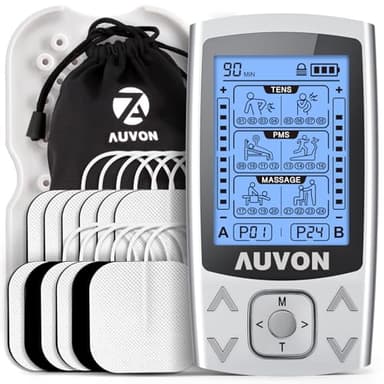
AUVON Dual Channel TENS Unit
Two independent channels so you can treat both sides of a problem at once, at a price where trying TENS costs less than one session of anything else.
What it gets right
- Two independent channels with separate intensity control
- Rechargeable rather than eating 9 V batteries
- Cheap enough to find out whether TENS does anything for you
What it does not
- Pad adhesive life is the real running cost, not the unit
- Interface is fiddly with cold hands
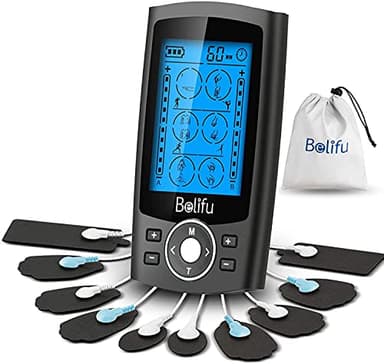
Belifu Dual Channel TENS EMS Unit
Twenty-four modes at the lowest price in the category, and the mode count is marketing — but the hardware underneath is a competent dual-channel stimulator.
What it gets right
- Cheapest dual-channel unit here
- Rechargeable
- Pads and leads included
What it does not
- Mode count is noise, not a feature
- Thin documentation of what each mode does
Price as of November 12, 2026. #ad How we’re funded
KingPavonini Wireless TENS + EMS Muscle Stimulator
TENS and EMS from two pods you stick on and wear, with no lead wires anywhere — which is the whole reason to pay this much, because it is the only version of the device you can use under a shirt and still move around in. The 48-mode count is marketing; the dual-zone independent control underneath it is not.
What it gets right
- Wireless pods rather than lead wires, so it works under clothing and while moving
- Two pods run independently — separate mode and intensity each, so a shoulder and a leg can run different settings at once
- Published 20 hours per pod on the 1040 mAh cell, charged over USB-C rather than off a disposable battery
- Ships with three pad sizes including a 4.3 in butterfly pad, which is the one that actually covers a lower back
What it does not
- Forty-eight modes is a mode count, not a specification — the same marketing this site flags on every cheap unit
- Several times the price of a wired dual-channel unit that treats a back just as well
- Two pods and a remote are three things to keep charged and not lose
- Listed only in December 2025 and rated 4.1 across 69 reviews, so there is very little ownership history behind it
Common questions
What pulse width and pulse rate does the TENS 7000 use?
Both are adjustable by hand. Its reference manual states a pulse width range of 50 to 300 microseconds and a pulse rate range of 2 to 150 Hz, and suggests 70-120 µs and 70-120 Hz unless a clinician has told you otherwise. That manual control is the single feature that separates this unit from the preset-driven units at similar money.
Is the TENS 7000 worth it?
If you have been given a setting to use, or you have already tried a preset unit and want to experiment properly, yes — it is the cheapest route to real parameter control and its ranges are published. If this is your first TENS unit and nobody has told you what to set, a preset unit like the AUVON is the better purchase, because two dials and no guidance is not an advantage. The therapy is identical either way; what differs is whether you or the manufacturer chooses the dose.
How many modes does the TENS 7000 have?
Five, named in the manual as Burst, Normal, Modulation, SD1 and SD2. That is far fewer than the twenty-plus a budget preset unit advertises, and it is not a shortfall: on this unit the mode sets the pulse pattern while you set the width and rate yourself, so five patterns times a continuous parameter range is a much larger space than twenty fixed programs.
Does the TENS 7000 need a 9 V battery?
Yes. The manual specifies a 9 V battery with a low-battery indicator and tells you to replace it when stimulation feels weaker, which is worth knowing because a fading cell changes your dose without telling you. It is the unit’s main inconvenience against a rechargeable competitor, and also the reason a flat unit is working again in thirty seconds.
Did you test the TENS 7000 yourselves?
No, and the site says so on every page. There is no lab, no owned units and no clinician on staff. This review is built from the manufacturer’s own reference manual, linked above, plus the peer-reviewed literature on what TENS does. Our method and its limits are set out at how we research.
Sources
- 1.TENS 7000 — Reference Manual (pulse width 50-300 µs, suggested 70-120 µs; pulse rate 2-150 Hz, suggested 70-120 Hz; 5 modes; 1-60 minute or continuous timer; two channels; 9 V battery) — every figure quoted in this review - pulse width, pulse rate, modes, channels, timer, battery, record log - read from this document on 2026-10-31
- 2.Transcutaneous electrostimulation for osteoarthritis of the knee - Cochrane Database of Systematic Reviews (PubMed 19821296)
- 3.Neuropathic Pain Relief Through Transcutaneous Electrical Neuromuscular Stimulation: Insights From a Systematic Review and Meta-Analysis of Clinical Evidence - BioMed Research International 2025 (PMC12543013)
- 4.Transcutaneous electrical nerve stimulation (TENS) for chronic neck pain - Cochrane Database of Systematic Reviews 2026, PROTOCOL (PMC13501494) — protocol stage - the systematic answer for neck pain does not exist yet
- 5.Transcutaneous Electrical Nerve Stimulation Reduces Movement-Evoked Pain and Fatigue (FAST trial) - Arthritis & Rheumatology 2020 (PMC7188591)
- 6.Transcutaneous Electrical Nerve Stimulation and Pain With Movement in People With Fibromyalgia: A Cluster Randomized Clinical Trial (FM-TIPS) - JAMA Network Open 2026 (PMC13032160)
- 7.camelcamelcamel — TENS 7000 price history — price history, for judging whether a given day's price is a deal