Feet & Gait
The Best Insoles for Work Boots
Buy the PowerStep Pinnacle Maxx: a work boot has the depth to take a maximum-volume orthotic that a running shoe does not, and the Maxx is the one here sold for a collapsing arch and overpronation rather than for a sore fascia. The budget pick is Dr. Scholl's Flat Feet Support at drugstore money. If you are a heavier adult on concrete, the WalkHero is the only pick that publishes a body-weight rating at all.
By Stephen V.Published
Disclosure:Grip & Gait earns a commission when you buy through links on this page, at no extra cost to you. It never changes what we recommend or the order we rank things in — here is exactly how we’re funded.
Quick picks
Ranked on published manufacturer specs and what they mean for the job, not on testing we have not done. Tap a row for the full reasoning. How we score.
| # | Product | Best for | Score | Price |
|---|---|---|---|---|
| 1 |  PowerStep Pinnacle Maxx Orthotic Insoles Maximum support version of the Pinnacle, with an angled heel platform on a semi-rigid shell, sold by PowerStep for flat feet and overpronation. Too thick for most dress shoes, which is precisely why it belongs in a boot. | Best overall - a boot can take the volume | 8.7 | |
| 2 |  WalkHero Heavy Duty Arch Support Insoles The only insole here with a published body-weight rating (220+ lb) and a deep heel cup, at roughly a third of the price of the shelled orthotics. Firm from the first hour, which some people never get used to. | Heavier bodies and long shifts | 8.4 | |
| 3 |  PowerStep Pinnacle Orthotic Insoles The lower-volume sibling: the same semi-rigid shell without the angled heel platform, so it fits boots the Maxx will not - including a composite or steel toe with a shallow toe box. | Safety-toe boots and tighter lasts | 8.2 | |
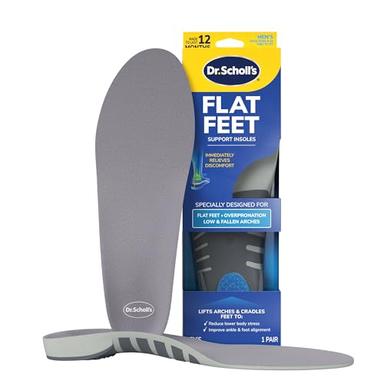
| 4 |  Dr. Scholl's Flat Feet Support Insoles Drugstore money for an insole marketed at overpronation and fallen arches, which makes it the cheap way to find out whether support changes your shift at all. Foam gives way sooner than a shell does. | Budget pick - the right shape, cheap | 7.9 | $14.97 · View on Amazon Price as of November 28, 2026. #ad How we’re funded |
| ✕ |  Dr. Scholl's Plantar Fasciitis Relief Orthotic Insoles A good insole aimed at a different problem and a different shoe: it is built for plantar fascia pain, it is trim-to-fit so the arch lands wherever you cut it, and gel-and-foam is the construction that flattens fastest under a full shift on concrete. Skip this | The one to skip for boots | 6.5 |
The short version
A work boot is the easiest shoe in your rack to fit an insole to, and almost every buying guide gets that backwards. Boots come with a thick, removable factory insole and a deep heel pocket, which means you can pull out a half-inch of foam and put a real orthotic in its place. Volume, the constraint that rules out a maximum-support insole in a dress shoe or a snug trainer, mostly stops being a constraint here.
So buy the PowerStep Pinnacle Maxx: a semi-rigid shell with an angled heel platform on top of it, sized in real shoe sizes rather than trimmed, and sold by its maker for flat feet and overpronation instead of for a painful fascia. If your boots are safety-toe with a shallow toe box, the standard PowerStep Pinnacle is the same shell in a lower-volume package and is the one that will actually fit.
If you are a heavier adult standing on concrete, read the WalkHero row carefully: it is the only pick on this page that publishes a body-weight rating, and body weight is the variable that decides whether an insole is still doing its job in three months. The budget pickis Dr. Scholl’s Flat Feet Support at drugstore money — the cheap way to find out whether support helps you before you spend orthotic money.
Why a boot is a different fitting problem
Three differences change the purchase, and none of them are about the insole itself.
You can remove what is already in there. Pull the factory insole out before you measure anything. If it comes out in one piece, you have its full thickness of room to play with and a maximum-volume orthotic is on the table. If it is glued down, you are fitting on top of it and you want the slimmest shell you can get, not the thickest.
A safety toe shortens your usable height at the front. A composite or steel cap is a fixed ceiling over the toes. An insole that adds height under the forefoot can press your toes into it, which is a blister by lunchtime. Support belongs under the arch and heel, where a boot has depth, rather than under the ball of the foot, where it does not.
The floor is harder than any shoe. A warehouse or a job site is concrete, and the shock you are managing arrives through a stiff sole with very little give. That is the one place where cushioning has real occupational evidence behind it, which is the next section.
What the occupational evidence actually says
This is the part most insole pages skip, and the findings do not all flatter the product.
Cushioning does reduce discomfort for people who stand to work. A 2018 systematic review in Applied Ergonomics looked specifically at softer flooring and cushioned shoe insoles for workers required to stand for prolonged periods. Across ten studies it found a moderate level of evidence supporting cushioned materials for reducing discomfort and fatigue, and only a limitedlevel of evidence favoring insoles over anti-fatigue mats. Its own closing note is that larger workplace trials are needed before firm industry recommendations are possible. Read that as support for the category and a caution against anyone who tells you the research is settled — and note that if your employer will put a mat at your station, that is at least as well evidenced as anything you can buy.
Insoles are not a back-pain treatment. The 2014 systematic review and meta-analysis in BMC Musculoskeletal Disorders pooled eleven randomized trials — five on treating low back pain and six on preventing it, the latter in 2,379 participants — and found no significant effect either way. If your back hurts at the end of a shift, buy insoles for your feet and treat the back as its own problem; the trials do not support buying them to fix a back. Our back pages are the better destination for that: lower back pain and the best heating pad for back pain.
Comfort improves even when the pressure map does not. In a randomized clinical trial of two insole types among assembly-line workers who stand to work, both groups reported increased foot comfort over five weeks, while the added pressure-targeted strip did not significantly change plantar pressure distribution or other symptoms. The useful lesson for a buyer: the comfort gain is real and does not depend on exotic customization. A correctly shaped, correctly sized off-the-shelf insole is doing most of the available work.
And the arch-support evidence has limits worth knowing. A 2021 systematic review of foot orthoses for adults with flatfoot found twelve studies, mostly of low methodological quality, and said plainly that the frequency with which orthoses are prescribed is surprising given how weak the evidence is. That review is also the source of the three-part description we use throughout the site: the arch falls, the hindfoot rolls inward, the loaded forefoot splays. Only the first is the arch.
What to look for, in order
| What to check | What you want | Why it matters in a work boot |
|---|---|---|
| Does the factory insole come out? | Check before you buy | If it lifts out whole you have its full thickness of room, and a maximum-volume orthotic fits. If it is glued in, buy the lower-volume shell instead. |
| Sized or trim-to-fit | Sized, wherever possible | A trim-to-fit insole puts the arch where the cutting guide says. A boot is long and deep enough that you can buy a real size and have the support land under your own arch. |
| Shell stiffness | Semi-rigid, not foam alone | Press hard into the arch with your thumb. If it collapses under your thumb it will collapse under your bodyweight at hour nine, which is exactly the hour you bought it for. |
| Heel cup depth | Deep, or angled | Boots have heel room and a deep cup holds the heel from rolling inward. That is half of what a flat foot does under load, and nothing under the arch alone addresses it. |
| Published body-weight rating | Stated, if you are heavier | Almost nobody publishes one. It is the single variable that decides whether an insole is still supporting anything after three months on concrete. |
| Forefoot height under a safety toe | As little as possible | A steel or composite cap is a fixed ceiling. Height under the ball of the foot pushes your toes into it; height under the arch and heel does not. |
The picks, and who each one is for
PowerStep Pinnacle Maxx — the one to buy first.It is the maximum-support version of PowerStep’s Pinnacle: the same semi-rigid shell with an angled heel platform added, sized rather than trimmed, and sold by the maker for flat feet and overpronation rather than as a general arch pad. On every other page on this site its bulk is the catch. In a boot, with the factory insole pulled out, the bulk is the point — you have the depth, so take the support. The honest cons stand: it is the most expensive insole on the site by several times a drugstore pair, it will not go into a dress shoe or a snug running shoe, and it is firm and angled from day one, so the first week is an adjustment rather than instant relief.
WalkHero Heavy Duty — for heavier bodies and the longest shifts.It publishes a body-weight rating, which is rare enough that we mention it everywhere it appears, and it has a deep heel cup. It sits between drugstore foam and the shelled orthotics on price, which makes it the best-value serious option here. Cons: firm from day one, and bulky in anything smart — neither of which is a problem in a work boot, which is why it ranks second here and lower on our dress-shoe-friendly pages.
PowerStep Pinnacle — for a safety toe or a tight last. The lower-volume sibling: the same semi-rigid shell, no angled heel platform, less total height. You give up some of the heel control and gain the ability to fit boots the Maxx cannot, including a composite-toe boot with a shallow toe box or any boot whose factory insole is glued down. Cons: three times the drugstore price, it still takes volume, and it needs a break-in period that some people give up during.
Dr. Scholl’s Flat Feet Support — the budget pick.Not because it is better, but because of how this category actually fails: people buy the most expensive orthotic on the shelf, find it uncomfortable in week one, and abandon it. A drugstore-priced insole built for overpronation and low or fallen arches tells you cheaply whether support changes your day, and if it does you can upgrade knowing the answer. Cons: foam resists collapse far less than a shell, it is sold in broad gendered size bands rather than exact sizes, and it will need replacing well before a shelled orthotic would — on concrete, sooner still.
Dr. Scholl’s Plantar Fasciitis Relief — the skip row here. We recommend it elsewhere and will keep recommending it: on our insoles and arch support page it is the cheapest real support available in a pharmacy. It is the skip in a work boot for two specific reasons. It is trim-to-fit, and a boot is exactly the shoe where you do not need to compromise on arch position. And gel-and-foam construction is the fastest to flatten under a full shift of standing, which turns a cheap insole into a cheap insole you buy several times a year. If morning heel pain rather than a tired arch is your actual complaint, read the plantar fasciitis page instead — this page is not aimed at that problem.
Fitting them without wasting a pair
Pull the factory insole out and lay it on top of the new one. If the new insole is longer, trim only the toe end, only to the old insole’s outline, and only if the product is designed to be trimmed — never cut into a shell. Put the new insole in, lace the boot the way you actually lace it, and stand up. The arch support should sit under your arch, not in front of it. If your toes feel closer to the cap, you have added height at the front and the lower-volume option is the right call.
Then give it a week. A semi-rigid shell is uncomfortable at first because it is resisting something that has not been resisted before, and the most common way this purchase fails is abandonment on day two. Start with half a shift if you can. If it still hurts in a new place after a week, the insole is wrong for your foot rather than for your boot — and if your arch flattens under load specifically, the shape-first argument is on the best insoles for flat feet.
What an insole will not fix
It will not fix worn-out boots. A sole with the tread gone and a compressed midsole changes more than any insert you put inside it, and replacing boots you have had for three years is the better first purchase. It will not fix a back — see the meta-analysis above. And it will not fix a knee, although a collapsing arch does load one: if the knee is the loudest complaint, our ranked tools for that are on the knee pain page and the gun-specific selection is the best massage gun for knee pain.
How we ranked these
- Does the boot have room for it? Weighted first, and it is the whole reason this page ranks differently from our other insole pages: in a boot you can take the maximum-support option, so the thickest shell goes to the top rather than the slimmest.
- Will the support survive your bodyweight on concrete? Semi-rigid beats foam; a published weight rating beats a silent one.
- Does it control the heel? A deep cup or an angled platform, because the hindfoot rolling inward is half of what happens as an arch gives way.
- Sized or trimmed? Sized wins, and a boot is long enough that you never have to settle for trimmed.
- What does the occupational evidence support? Moderate evidence for cushioning reducing discomfort and fatigue in standing workers; no evidence for insoles as a back treatment. We rank on that, which is why the cheap pick keeps a place and no row on this page claims to fix anything above the ankle.
Where a different purchase does more
If what you want is relief after the shift rather than support through it, a machine does more than any insert: the best foot massagers ranks those, and the best foot tools for standing all day is the tool mix we recommend for nurses, retail and the trades. If the arch itself is the complaint, rolling the plantar fascia is free and takes five minutes. And if your feet are fine but your calves and shins are not by the end of the day, that is calf and shin tightness, a different problem with different tools.
Every pick, in full
Specs below are the manufacturer’s own published figures, each linked to the page it came from. Where a maker does not publish a number, the table says so and names the page we checked — that absence is information too.
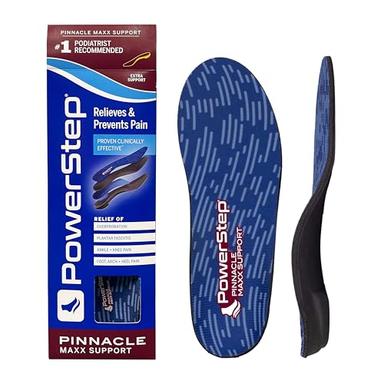
PowerStep Pinnacle Maxx Orthotic Insoles
The maximum-support version of the Pinnacle, and the one PowerStep sells for flat feet and overpronation rather than for a sore fascia - an angled heel platform on top of the same semi-rigid shell.
What it gets right
- Sold by the maker specifically for flat feet and overpronation, not as a general arch insole
- Angled heel platform addresses the rolling-in the arch collapse causes
- Sized rather than trim-to-fit, so the support lands where your arch is
What it does not
- The most expensive insole on the site, several times a drugstore pair
- Takes real volume - it will not go in a dress shoe or a snug running shoe
- Firm and angled from day one, so the first week is an adjustment
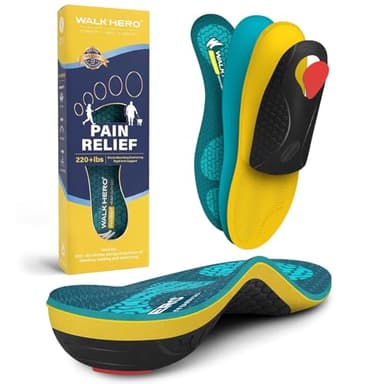
WalkHero Heavy Duty Arch Support Insoles
Rated for heavier body weights, which is a specification almost nobody publishes and which is exactly the variable that flattens a soft insole in a month.
What it gets right
- Explicitly rated for higher body weight — a spec that is usually silent
- Deep heel cup
- Priced between drugstore foam and semi-rigid orthotics
What it does not
- Firm from day one
- Bulky in dress shoes
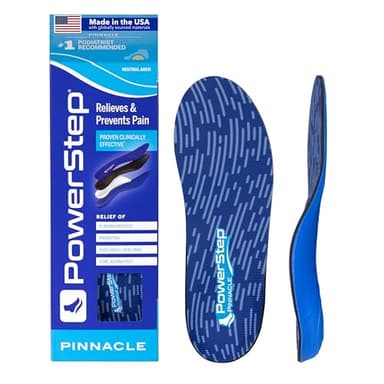
PowerStep Pinnacle Orthotic Insoles
A semi-rigid shell under a cushioned top, sized rather than trimmed — the closest thing to a dispensed orthotic you can buy without an appointment.
What it gets right
- Semi-rigid shell actually resists arch collapse rather than just padding it
- Sold in real shoe sizes rather than trim-to-fit
- Holds its shape far longer than foam
What it does not
- Three times the drugstore price
- Takes up volume — may not fit a snug shoe
- Needs a break-in period that some people give up during
Price as of November 28, 2026. #ad How we’re funded
Dr. Scholl's Flat Feet Support Insoles
The cheapest insole we have found that is sold for flat feet specifically rather than for plantar fasciitis - a drugstore price for the right shape is the best first purchase in this category.
What it gets right
- Drugstore price, so you can buy a pair for every shoe you actually wear
- Marketed for overpronation and low or fallen arches rather than fascia pain
- Widely stocked, which makes replacing a flattened pair trivial
What it does not
- Foam construction gives less resistance to arch collapse than a semi-rigid shell
- Sold in gendered size bands rather than by exact shoe size
- Will need replacing well before a shelled orthotic would
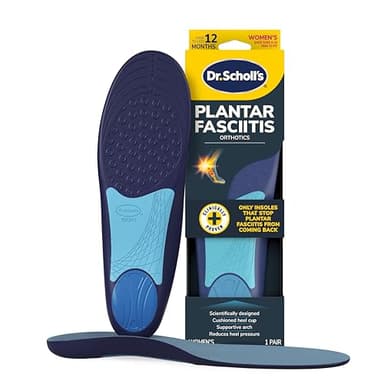
Dr. Scholl's Plantar Fasciitis Relief Orthotic Insoles
Drugstore-priced and widely available, which matters more than it sounds: the insole you can replace in fifteen minutes is the one still in your shoe in six months.
What it gets right
- Cheap enough to buy a pair for every shoe you actually wear
- Available almost everywhere, so replacement is trivial
What it does not
- Trim-to-fit rather than sized, so the arch may not land under your arch
- Compresses faster than a rigid orthotic
Common questions
What are the best insoles for work boots?
The PowerStep Pinnacle Maxx, because a work boot is the one shoe with enough depth to take a maximum-support orthotic: pull the factory insole out and you have room for a semi-rigid shell with an angled heel platform, sized rather than trimmed. If your boots are safety-toe with a shallow toe box, the standard Pinnacle is the same shell in less volume. If you are a heavier adult on concrete, the WalkHero is the only pick here that publishes a body-weight rating. The cheap way to test whether support helps you at all is Dr. Scholl’s Flat Feet Support.
Do I need to remove the insole that came with my boots?
Yes, if it lifts out. Stacking a new orthotic on top of the factory foam raises your foot, tightens the fit over the instep and pushes your toes toward a safety cap, and it wastes the depth you paid for when you bought boots. Lay the old insole on the new one as a length and width guide. If the factory insole is glued down, buy the lower-volume option instead — that is the situation the standard Pinnacle is for.
Do insoles help if you stand on concrete all day?
The evidence is reasonable but narrower than the marketing. A 2018 systematic review in Applied Ergonomics found a moderate level of evidence that cushioned materials reduce discomfort and fatigue among workers who stand for prolonged periods, and only a limited level of evidence favoring insoles over anti-fatigue mats. In a randomized trial of assembly-line workers who stand to work, comfort improved over five weeks even where plantar pressure distribution did not change. So: expect your feet to feel better; do not expect a measurable change in how load is distributed, and take the mat if your employer offers one.
Will work boot insoles help my lower back?
Probably not on their own, and we would rather say so. A 2014 systematic review and meta-analysis of eleven randomized trials — five on treating low back pain, six on preventing it in 2,379 participants — found no significant effect for insoles or foot orthoses either way. Buy insoles because your feet and legs ache; treat a back as its own problem. Plenty of people report both improving together, and the trial evidence does not support selling insoles on that promise.
Can I use plantar fasciitis insoles in work boots?
You can, and for morning heel pain specifically they are the right shape. They are just not what we would choose for a shift on concrete: most are trim-to-fit, which puts the arch wherever you cut it when a boot gives you room to buy a real size, and gel-and-foam constructions flatten faster than a shell under eight to twelve hours of standing. If heel pain in the first few steps of the morning is your main complaint, buy the fascia product and read our plantar fasciitis pages. If a tired, aching arch by mid-afternoon is the complaint, buy the shell.
How often should I replace insoles I wear for work?
Sooner than the box suggests, and it depends on construction and your weight more than on brand. Foam flattens fastest, which is why we frame the drugstore pick as a cheap test rather than a long-term solution; a semi-rigid shell holds its shape far longer. The practical check takes five seconds: press hard into the arch with your thumb, and if it gives way easily it is no longer resisting your bodyweight either. If you are a heavier adult, buy the product that publishes a weight rating, because that is the variable that decides this.
Sources
- 1.The effect of cushioning materials on musculoskeletal discomfort and fatigue during prolonged standing at work: a systematic review - Applied Ergonomics 2018 (10 studies; moderate evidence for cushioned materials, limited evidence favouring insoles over anti-fatigue mats) (PubMed 29866322) — the occupational case for this category: moderate evidence for cushioned materials reducing discomfort and fatigue in standing workers, limited evidence favoring insoles over anti-fatigue mats
- 2.The effectiveness of shoe insoles for the prevention and treatment of low back pain: a systematic review and meta-analysis of randomised controlled trials - BMC Musculoskeletal Disorders 2014 (11 trials; no significant effect for treatment or prevention) (PubMed 24775807) — no significant effect for insoles in treating or preventing low back pain across eleven randomized trials - the claim this page deliberately does not make
- 3.Comparison of Two Types of Insoles on Musculoskeletal Symptoms and Plantar Pressure Distribution in a Work Environment: A Randomized Clinical Trial - Clinical Medicine and Research 2016 (29 female assembly-line workers who stand to work, five weeks) (PubMed 27231116) — comfort improved over five weeks in workers who stand, while the pressure-targeted modification did not change plantar pressure distribution
- 4.Evidence for foot orthoses for adults with flatfoot: a systematic review - Journal of Foot and Ankle Research 2021 (12 included studies; methodological quality mostly low) (PMC8628393) — the three-part description of what a flat foot does under load, and the honest verdict on adult orthosis evidence quality