Massage Guns
Best Massage Gun for Tennis Elbow
You will be holding this gun in your other hand, reaching across your body, onto a forearm beside a tendon that is already irritable. That makes weight and head shape the specs that decide the purchase, and amplitude almost irrelevant - which is the opposite of how massage guns are sold. Here are the picks on that basis, the head to use, and an honest account of what percussion will and will not do for a tendon.
By Stephen V.Published
Disclosure:Grip & Gait earns a commission when you buy through links on this page, at no extra cost to you. It never changes what we recommend or the order we rank things in — here is exactly how we’re funded.
Quick picks
Ranked on published manufacturer specs and what they mean for the job, not on testing we have not done. Tap a row for the full reasoning. How we score.
| # | Product | Best for | Score | Price |
|---|---|---|---|---|
| 1 |  Bob and Brad C2 Massage Gun At a published 1.5 lb it is the lightest full-size gun here, which is what decides whether you can hold it steady across your body for two minutes. Five speeds means a genuinely low setting exists, and that matters more than its 10 mm stroke on a muscle this size. | Best overall for a forearm | 8.7 | |
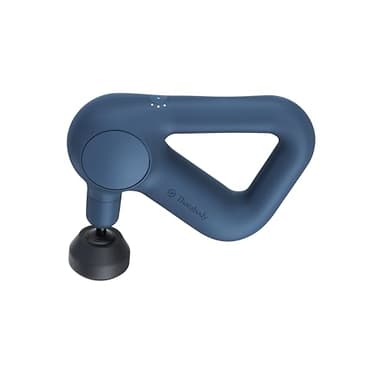
| 2 |  Therabody Theragun Relief Deliberately less aggressive than the rest of Therabody's line, which is a feature rather than a compromise next to a sore tendon. Three speeds and no pressure screen; you are buying restraint. | When the area is irritable | 8.2 | $159.99 · View on Amazon Price as of November 12, 2026. #ad How we’re funded |
| 3 |  Bob and Brad Q2 Mini Massage Gun Pocket-sized, so your working hand is doing almost no holding and all of the aiming. The trade is a smaller battery and less headroom if you also want to use it on a quad. | Easiest one-handed reach | 8.1 | |
| 4 |  RENPHO Active Massage Gun The cheapest gun on this site we would still recommend, and for a forearm its lighter duty is barely a limitation. Publishes the least of any pick here, which is the honest reason it is not higher. | Lowest outlay | 7.6 | |
| ✕ |  Therabody Theragun Prime (6th Gen) A premium gun marketed on a 16 mm stroke, aimed at thick muscle, at a published 2.0 lb and with two heads in the box. Everything that makes it good on a glute makes it wrong on a forearm, and it is the heaviest thing here to hold across your own body. Skip this | Skip this for tennis elbow | 6.4 | $329.99 · View on Amazon Price as of November 12, 2026. #ad How we’re funded |
Start here: a massage gun is not the treatment
How we ranked these, and why amplitude is not on the list
Most massage gun rankings lead with amplitude — stroke length — because it is the spec that decides how deep a percussion device reaches into thick muscle. For this job it is close to irrelevant. The wrist extensor group on the outside of your forearm is a thin sheet of muscle lying over bone, a few centimetres from an inflamed tendon attachment. Nothing about that target rewards a longer stroke, and a long stroke makes it harder to stay off the bone.
Here is what we ranked on instead, in order:
- Published weight. The dominant constraint, and the one almost nobody mentions. You cannot treat your own forearm with the hand attached to it. You will be holding the gun in your opposite hand, arm crossed over your body, wrist at an awkward angle, for a minute or two at a time. Every ounce is leverage against you. A published 1.5 lb and a published 2.0 lb are different tools in that position.
- Whether a genuinely low speed exists. Five speeds is not a better spec sheet than three for its own sake; it means the bottom of the range is lower. Beside an irritable tendon you want the gentlest setting the device offers, and a gun whose slowest speed is still brisk is the wrong gun.
- Head shape, and whether the right one is in the box. The flat and dampener heads are what you want here. A bullet head on a tendon attachment is the single most common self-inflicted injury in this category. More on this below, because it is what people are actually searching for.
- Size for one-handed control. Related to weight but not identical: a short body is easier to aim precisely at a target the width of two fingers.
- What the maker publishes at all.The standing rule on this site. We score what manufacturers put in writing and record the absences by name — see cheap vs expensive massage guns for the full table of who publishes what.
The attachment question, which is the real question
Live search for this topic asks about heads almost as often as guns: “best massage gun head for tennis elbow” and “best massage gun attachment for tennis elbow” are both standard completions. That instinct is correct, because head shape changes where the force goes far more than gun choice does.
| Head | Use it here? | Why |
|---|---|---|
| Flat head | Yes - the default | Spreads force over the widest area of any head, which is exactly what you want on a thin muscle sheet lying over bone. Start here and stay here unless you have a reason not to. |
| Dampener (soft, flat-faced) | Yes - the gentler default | The softest option most guns ship with. The right first head if the forearm is tender to touch, and the right head for working close to the bony point without hammering it. |
| Standard ball | Usable, with care | Fine on the thicker belly of the forearm two-thirds of the way toward the wrist. Concentrates force more than the flat head, so keep it away from the elbow end. |
| Bullet / cone | No | Designed to drive force into a small point. On a tendon attachment that is how a sore elbow becomes a much sorer elbow. There is no version of this page that recommends it here. |
| Fork / spine head | No | Shaped to straddle the spine. It has no application on a forearm and its prongs sit either side of whatever you aim at. |
The practical consequence for the picks: the Theragun Prime ships with two heads, a dampener and a standard ball, and no flat head. The Bob and Brad C2 ships five. If your gun did not come with a flat or dampener head, that is a cheap thing to fix and it matters more than which gun you own.
Where to put the gun, and where not to
The pain is at the bony point on the outside of the elbow. The muscle pulling on it runs from just below that point down the back of the forearm toward the wrist. You work the muscle, not the point.
- Target:the meat of the forearm extensors, roughly a hand’s width below the elbow and continuing toward the wrist. Palm down, forearm relaxed and supported on a table, gun in the other hand, slow passes along the muscle.
- Avoid entirely: the bony prominence itself, and the groove just behind it on the inner side of the elbow where the ulnar nerve sits close to the surface. Percussion over a superficial nerve produces exactly the pins-and-needles you would expect, and it is a reason to stop rather than a sign it is working.
- Dose: a minute or two per pass at the lowest useful speed, light contact pressure, then load the tendon. The gun is the warm-up, not the session.
The picks in detail
Bob and Brad C2 — best overall for a forearm
At a published 1.5 lb this is the lightest full-size gun on this site, and in the reach-across-your-body position that is the difference between finishing a pass and giving up on it. It is also the only gun here whose maker publishes all four depth-relevant figures — a 10 mm amplitude, over 44 lb of stall force, a 2,000-3,200 PPM range and under 60 dB — which we re-read off its product page. Five speeds means a real low setting, and five heads means the flat and dampener you want are in the box. Its cons are honest: 10 mm is genuinely shorter than the stroke premium guns are marketed on, there is no app or pressure screen, and the five speeds are fixed steps rather than a continuous range. None of those three matter on a forearm. Full write-up: our C2 review.
Theragun Relief — when the area is irritable
Therabody built the Relief to be gentler than the rest of its range, and for most of this site’s pages that is a limitation. Here it is the point. A tendon attachment that hurts when you press it does not need the most capable percussion device available; it needs the least aggressive one that still does something. Three speeds, no pressure feedback, no ecosystem. The cons: you are paying a premium brand price for deliberate restraint, and Therabody’s own page does not publish amplitude or stall force, so you cannot compare its reach with anything. If gentleness is what you want, that absence costs you less than usual.
Bob and Brad Q2 Mini — easiest one-handed reach
A pocket-sized gun removes the holding problem almost entirely: your opposite hand is aiming rather than supporting, and precision on a target the width of two fingers improves accordingly. If the forearm is the only thing you intend to treat, this is arguably the mostusable pick on the page. The cons are real if your needs grow: a smaller battery, less headroom on a quad or a glute, and a short body that is less comfortable on large muscle. We compare it against the obvious alternative on Theragun Mini vs Bob and Brad Q2.
RENPHO Active — lowest outlay
The cheapest gun on this site we would still recommend, and for a forearm its lighter duty is barely a constraint — you are not asking it to stall against a glute. The honest reason it sits fourth rather than higher is documentation: RENPHO publishes less about this unit than any other pick here, so there is nothing to check it against. It is a real percussion device rather than a vibrating toy, which is a lower bar than it sounds in this price bracket. See RENPHO Active vs Bob and Brad C2 for the direct comparison.
Theragun Prime — the one to skip here
Not a bad gun; a badly matched one. Everything that earns the Prime its place on the deep-tissue roundup works against it on a forearm: the long stroke Therabody markets it on is aimed at thick muscle, the published 2.0 lb makes it the heaviest thing here to hold across your own body, and its current US product page ships two attachments, neither of which is a flat head. If you already own one, use the dampener, run it slow, and stay well clear of the bony point. If you are buying for this specifically, buy lighter.
What percussion is actually doing here
Worth keeping in proportion. The review of percussive therapy finds short-term range-of-motion and pain-perception effects rather than structural change, and the hamstring range-of-motion study points the same way. For a tendinopathy that is a modest and temporary benefit, which is exactly why the loading callout sits at the top of this page rather than the bottom. If you want the other end of the intervention spectrum, the 2026 network meta-analysis of shockwave therapy in tendinopathy covers a clinic treatment people often confuse with a massage gun; we explain why they are not the same device on massage gun vs shockwave therapy.
Percussion is also not the only symptom-management route here. A TENS unit works on the pain signal rather than on the tissue, and for an elbow protocol handed to you by a clinician the thing that matters is whether the device can be set to the numbers you were given — which is the argument of our TENS 7000 review. Neither route replaces loading the tendon; both can make loading it tolerable.
A fortnight that uses the gun for what it is good at
The failure mode with a massage gun and a tendon is using it instead of the thing that works, usually because percussion feels like treatment and loading feels like exercise. Here is the shape of a two-week block that puts the gun where it belongs. It is a structure rather than a prescription, and anyone who has been given a protocol should follow that one instead.
- Days 1-4, settle it down.Gun on the forearm extensors at the lowest useful speed with the dampener head, a minute or two, once or twice a day. Then light isometric holds — gripping something without moving the wrist — which is the loading style the 2026 isometric review describes as tolerable and short-term analgesic rather than curative. Tolerable is the point this week.
- Days 5-10, start loading. Same warm-up, then controlled eccentric work with the lightest resistance bar: twist with the good hand, let the bad side resist slowly on the way back. Slowly is the whole exercise. The Medicina trial ran 18 supervised sessions across six weeks before measuring, which is a useful calibration for how long this takes.
- Days 11-14, add grip. Once the slow eccentrics are not provoking next-day soreness, grip work goes back in. This is also the point to look at what caused it: a racket grip that is too small, a tool handle you squeeze too hard, a mouse that keeps your wrist extended all day.
Two honest notes on dose. Expect soreness during the loading phase and judge it the next morning rather than during the set; pain that is worse 24 hours later means you went too far. And if two weeks of this produces nothing at all, the answer is an examination rather than a different attachment head — lateral elbow pain has several causes that no amount of percussion will touch.
Is it tennis elbow or golfer’s elbow?
Worth thirty seconds before you buy anything, because it changes which side of the forearm you work. Pain on the outsideof the elbow, worse when you extend the wrist or grip something, is lateral — tennis elbow. Pain on the inside, worse when you flex the wrist, is medial — golfer’s elbow. The gun and head advice above transfers directly; the target moves to the other side of the forearm. We have a separate page for the medial version at tools for golfer’s elbow, and the nerve caution matters more on that side because the ulnar nerve runs behind the inner bony point.
Our read
If you want one sentence: buy the lightest gun with a flat or dampener head and a genuinely slow bottom speed, use it to make the forearm workable, and spend the rest of your money on something that loads the tendon. The C2 is the pick because it is light, documented and ships the right heads. The Relief is the pick if touching the area already hurts. And the honest hierarchy on this page puts a cheap resistance bar above every gun on it — which is an odd thing for a page about massage guns to say, and the reason we think it is worth saying.
Every pick, in full
Specs below are the manufacturer’s own published figures, each linked to the page it came from. Where a maker does not publish a number, the table says so and names the page we checked — that absence is information too.
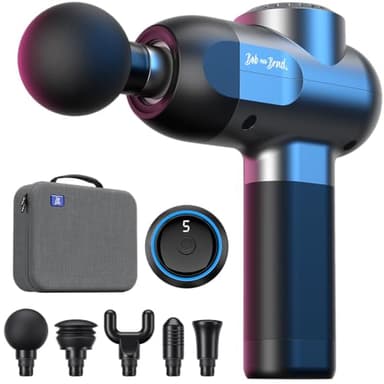
Bob and Brad C2 Massage Gun
The only gun in this roundup whose maker publishes all four numbers that decide whether it reaches the muscle — amplitude, stall force, speed range and noise — and the stall-force figure is higher than the premium units that hide theirs.
What it gets right
- Publishes amplitude, stall force, speed range and noise — the two market leaders publish none of the first three
- Published stall force of over 44 lb is higher than the figure Therabody publishes for the Prime
- 1.5 lb is light enough to hold overhead against your own shoulder without your arm giving out first
- FSA/HSA eligible, which quietly makes it cheaper again for a lot of buyers
What it does not
- 10 mm amplitude is genuinely shorter than a 16 mm premium stroke — that difference is real for glutes and thick back muscle
- No app, no pressure-feedback screen, no ecosystem
- Five fixed speeds rather than a continuous range
Price as of November 12, 2026. #ad How we’re funded
Therabody Theragun Relief
Therabody's deliberately gentle model — lighter, simpler and less aggressive than the Prime, which is the right direction for stiff hands and thin skin rather than a compromise.
What it gets right
- Simple controls with no app required — a real advantage if the buyer is not going to pair anything to a phone
- Lighter and less aggressive than the Prime, which is the point rather than a limitation
- Therabody's ergonomic handle geometry makes it easier to hold with a weak grip
What it does not
- Same missing-spec problem as the rest of the Therabody range
- Not the tool for dense glute or thick paraspinal muscle
- Costs more than fully-specified budget guns that hit harder
| Amplitude | Not published page we checked |
|---|---|
| Stall force | Not published page we checked |
| Speed range | Not published page we checked |
| Weight | 1.37 lb source |
| Noise | Not published page we checked |
| Battery | 2 h source |
| Attachments | 3 source |
| Warranty | 1-year source |
| Dimensions | 9.66 × 2.58 × 1.37 in source |
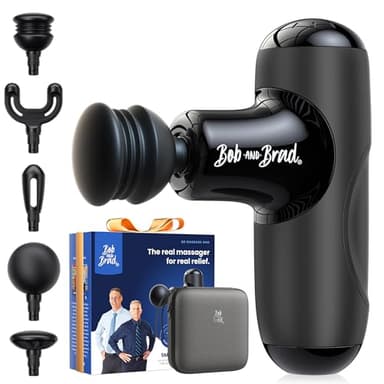
Bob and Brad Q2 Mini Massage Gun
Pocket-sized from the one brand in this category with a habit of publishing its numbers — the honest travel option at a third of what the premium minis cost.
What it gets right
- Genuinely pocketable
- From a brand whose full-size model publishes complete specs
- FSA/HSA eligible
What it does not
- A short body cannot deliver a long stroke — physics, not a flaw
- Not the tool for glutes or thick back muscle
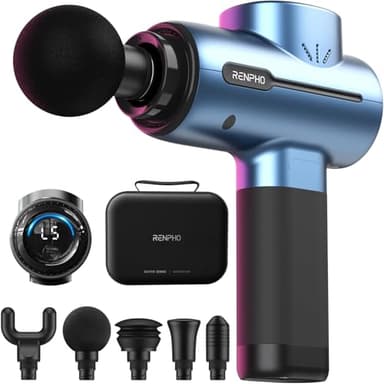
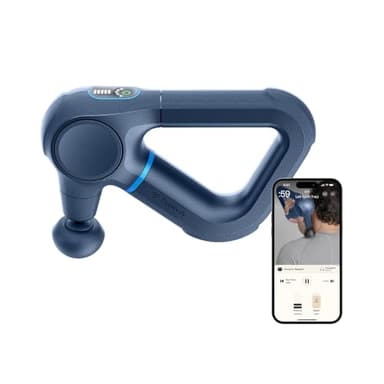
RENPHO Active Massage Gun
A competent mid-budget gun with FSA eligibility, sitting in the awkward space between the cheap gun that does the job and the specified one that does it better.
What it gets right
- FSA eligible, which changes the real price for a lot of buyers
- Quiet for the money
- Comfortable handle angle
What it does not
- Amplitude and stall force not published
- Costs close to the fully-specified C2 without matching its published numbers
Price as of November 12, 2026. #ad How we’re funded
Therabody Theragun Prime (6th Gen)
The long-stroke option, and the build quality is not in question — but Therabody's current US product page publishes dimensions, weight, battery and warranty and does not publish amplitude, stall force, PPM or noise, so the numbers most buyers are shopping on are not on the page they are shopping from.
What it gets right
- The 16 mm stroke Therabody quotes is genuinely long, and stroke length is what determines depth
- Real-time pressure feedback stops the most common user error — leaning on it far too hard
- Rated by Therabody to survive drops from 10 feet, which matters more than it sounds for a thing you use on a hard floor
What it does not
- Amplitude, stall force, PPM and dB are absent from the current US product page — we checked
- Two attachments in the box, against five on guns costing a fifth as much
- 120 minutes of battery is quoted at the LOWEST speed setting, which is not the setting you will use
- One-year limited warranty on a device at this price
| Amplitude | Not published page we checked |
|---|---|
| Stall force | Not published page we checked |
| Speed range | Not published page we checked |
| Speed settings | 5 source |
| Weight | 2 lb source |
| Noise | Not published page we checked |
| Battery | 2 h source |
| Attachments | 2 source |
| Warranty | 1-year limited source |
| Dimensions | 238 × 153 × 61 mm source |
Common questions
Can a massage gun help tennis elbow?
It can make the forearm feel workable and warm the tissue before you load it, which is a real but modest and temporary benefit — the percussive therapy review finds short-term range-of-motion and pain-perception effects rather than structural change. What changes a tendon is progressive loading: the 2026 Medicina trial found eccentric strengthening beat passive motion by an adjusted 3.21 push-up repetitions and 0.35 m of explosive power over six weeks. Use the gun as the warm-up, not the treatment.
Which massage gun attachment is best for tennis elbow?
The flat head, or the dampener if the area is tender to touch. Both spread force over a wide area, which is what a thin muscle sheet lying over bone needs. Avoid the bullet or cone head entirely — it is built to drive force into a small point, and a tendon attachment is the worst possible target for that. The fork head has no application on a forearm. If your gun shipped without a flat or dampener head, that is cheap to fix and matters more than which gun you own.
Where do you use a massage gun for tennis elbow?
On the muscle, not the sore point. Work the forearm extensors from roughly a hand’s width below the elbow down toward the wrist, palm down and forearm supported on a table. Stay off the bony prominence on the outside of the elbow entirely, and off the groove behind the inner side where the ulnar nerve is superficial. A minute or two per pass at the lowest useful speed with light contact pressure, then load the tendon.
Should I buy a massage gun or a FlexBar for tennis elbow?
If you can only buy one, the resistance bar. It is the cheaper item and it does the job the loading research actually tested, where the gun manages a symptom around it. Start at a light resistance — an irritated tendon is where you begin, not where you finish — and progress from there. The honest caveat is that even the loading literature is mixed: the 2026 isometric review found significant pain and function improvement in only 3 of 13 trials, with 10 rated poor quality. Modest expectations, consistent work.
Is a heavier, more powerful massage gun better for tennis elbow?
No, and it is the clearest case on this site of a bigger spec being the wrong spec. The target is a thin muscle sheet over bone next to an irritable tendon, so a longer stroke buys nothing and makes it harder to stay off the bone. Meanwhile you have to hold the thing in your opposite hand with your arm crossed over your body, where every ounce works against you. Light, slow and flat-headed beats powerful here.
Sources
- 1.Eccentric Isokinetic Rehabilitation for Chronic Lateral Epicondylitis in Female Swimmers: A Randomized Controlled Trial of Bilateral Neuromuscular Adaptations and Functional Performance - Medicina 2026 (PMC13027445) — 25 swimmers, 18 sessions over 6 weeks; eccentric training beat passive motion by an adjusted 3.21 push-up reps and 0.35 m explosive power; range of motion unchanged
- 2.Isometric Exercises for Tendinopathies: A Systematic Literature Review - Clinical Therapeutics 2026 (PubMed 42203537) — 13 RCTs, 336 participants, 2 at the lateral elbow; significant pain and function improvement in only 3 studies, 10 of 13 rated poor quality
- 3.The Effect of Percussive Therapy on Musculoskeletal Performance and Experiences of Pain: A Systematic Literature Review (PubMed 37020441) — what percussion does: acute range-of-motion and pain-perception effects, not structural change
- 4.Acute Effects of Theragun Percussive Therapy on Viscoelastic Tissue Dynamics and Hamstring Range of Motion (PMC10499144)
- 5.The Effect of Extracorporeal Shockwave Therapy in Tendinopathy: A Systematic Review and Network Meta-Analysis of Randomized Controlled Trials - Orthopaedic Surgery 2026 (PMC13572833) — the clinic treatment people confuse with a massage gun
- 6.Bob and Brad — C2 massage gun product page — 10 mm amplitude, 44+ lb stall force, 2,000-3,200 PPM, 5 speeds, 1.5 lb, under 60 dB - re-read 2026-10-31
- 7.Therabody — Theragun Prime product page — 2.0 lb and two attachments published; no flat head in the box, and no amplitude, stall force, PPM or dB
- 8.Therabody — Theragun Relief product page
- 9.Therabody — Product Safety & Precautions — the manufacturer's own precautions list, quoted verbatim on the tennis elbow symptom page