Massage Guns
Bob and Brad C2 Review
This is the gun the rest of this site is measured against, and not because we love the brand. It is the only unit in its class whose maker publishes all four numbers that decide whether a percussion device reaches muscle - amplitude, stall force, speed range and noise - and its published stall force is higher than the figure Therabody publishes for a gun costing several times more. Here is what it does, what 10 mm of stroke cannot do, and who should buy something else.
By Stephen V.Published
Disclosure:Grip & Gait earns a commission when you buy through links on this page, at no extra cost to you. It never changes what we recommend or the order we rank things in — here is exactly how we’re funded.
Quick picks
Ranked on published manufacturer specs and what they mean for the job, not on testing we have not done. Tap a row for the full reasoning. How we score.
| # | Product | Best for | Score | Price |
|---|---|---|---|---|
| 1 |  Bob and Brad C2 Massage Gun Published 10 mm amplitude, over 44 lb stall force, 2,000-3,200 PPM, five speeds, 1.5 lb and 60 dB - the only unit in its bracket where all four depth-relevant numbers are on the maker's own page. | The gun this review is about | 8.7 | |
| 2 |  Therabody Theragun Prime (6th Gen) Therabody's marketing cites a 16 mm stroke and stroke length is what sets depth, but the current US product page publishes no amplitude, stall force, PPM or noise figure at all. You are paying several times more and shopping with fewer numbers. | If you want the long stroke | 7.5 | $329.99 · View on Amazon Price as of October 24, 2026. #ad How we’re funded |
| 3 |  RENPHO Active Massage Gun The cheapest gun on this site that we would still recommend. Lighter duty than the C2 and far less documented, but it is a real percussion device rather than a vibrating toy. | If the C2 is still too much money | 7.8 |
The verdict in one paragraph
Buy the Bob and Brad C2if you want one massage gun, you want to know what you are buying, and you are treating ordinary sore muscle — calves, quads, hamstrings, traps, forearms. It is light enough to hold against your own shoulder, it publishes every number that matters, and its published stall force is higher than the figure the market leader publishes for a far more expensive gun. The honest limitation is stroke: at a published 10 mm of amplitude, it does not reach as deep as the 16 mm that premium guns are marketed on, and on thick glute and lumbar muscle you can feel that difference. If the depth is what you are buying, read the alternatives at the bottom. If documentation and value are what you are buying, this is the reference point.
Why this gun is the reference point on this site
We score percussion devices on published manufacturer specifications, because we do not test products and will not pretend to. That method has an uncomfortable finding built into it, and the C2 is where it shows up most clearly: the cheap gun documents itself and the expensive ones do not.
Bob and Brad’s own product page for the C2 publishes a 10 mm amplitude, a stall force of over 44 lb, a 2,000-3,200 PPM range, five speeds, a 1.5 lb weight and a figure under 60 dB. That is four of the four numbers that determine how a percussion device behaves against tissue. For comparison, Therabody’s current US page for the Theragun Prime publishes dimensions, weight, battery life, warranty and attachment count, and does not publish amplitude, stall force, PPM or noise. Hyperice’s Hypervolt 2 page publishes weight, dimensions, motor wattage, speeds and battery, and no amplitude either. We record those absences in the product registry as absences, naming the page we checked, because the absence is itself the finding.
| Specification | Bob and Brad C2 | The premium pages we checked |
|---|---|---|
| Amplitude (stroke length) | 10 mm, published | Not published for the Theragun Prime or the Hypervolt 2. This is the number that sets how deep percussion reaches. |
| Stall force | Over 44 lb, published | Not published on either premium page. The C2's figure is higher than the stall force Therabody publishes for the Prime - because Therabody publishes none. |
| Percussions per minute | 2,000-3,200 PPM, published | Not published for the Prime; the Hypervolt 2 lists speeds without a range, so 'three speeds' is a count of buttons rather than a description of behavior. |
| Noise | Under 60 dB, published | Not published for the Prime. The Hypervolt 3 Pro publishes 51 dB and the Hypervolt Go 3 publishes 55 dB, so the figure exists inside that range - just not for the model most people buy. |
| Weight | 1.5 lb, published | Published by everyone. It is also the spec that decides whether you can hold a gun against your own shoulder for three minutes. |
| Attachments in the box | Check the current listing | Therabody publishes two for the Prime. We do not quote a figure for the C2 because its page does not give one we can cite. |
What the 10 mm actually means, in both directions
Amplitude is how far the head travels on each stroke, and it is the specification that decides depth. A 10 mm stroke with 44 lb behind it at 2,000-3,200 strokes a minute is a genuinely capable tool on everything close to the surface: calves, quads, hamstrings, forearms, traps, the muscle beside a shoulder blade. For the overwhelming majority of what people buy a massage gun for, that is the whole job.
Where you will feel the ceiling is thick muscle under a layer of other tissue — glutes especially, and lumbar muscle on a larger person. A 16 mm stroke moves tissue further per hit and that difference is real, not marketing. We would rather say that plainly than sell a budget gun as equivalent to a premium one. If your reason for buying is deep glute work, the C2 is not the tool with the longest reach on this site.
Two counterweights, though. First, the research on percussive therapy does not reward depth the way the marketing implies: the systematic review of percussive therapy found short-term effects on range of motion and pain perception rather than structural change, and the comparison of foam rolling against percussive massage for delayed onset soreness found no decisive winner between mechanical approaches at all. Second, stall force is the spec that stops a gun bogging down when you lean in, and on that one the cheap gun publishes a better number than the expensive one publishes at all.
Living with it: the things specs do not tell you
- Weight is the spec you feel most. At a published 1.5 lb you can hold it up to your own trap or rear shoulder with the opposite arm without that arm giving out first. That sounds trivial until you try a 2.5 lb gun on your own shoulder.
- Five fixed speeds, not a dial. Fewer options than a continuous range, and in practice most people use two of them. A stepped selector is easier to operate with cold hands than a touch ring.
- Under 60 dB is “conversation-possible”, not silent. It is louder than the 51 dB Hyperice publishes for its flagship. If you share a room with someone watching television, they will hear it.
- FSA and HSA eligibility is on the listing, which for a lot of US buyers changes the real price more than any sale does. Check the current listing before assuming it still applies to your plan.
- No app, no pressure screen, no ecosystem.Therabody’s pressure feedback genuinely does stop the commonest user error, which is leaning on the thing far too hard. The C2 gives you no such guardrail, so read how to use a massage gun and set the habit yourself: keep it moving, a minute or two per muscle, firm not fierce.
What 44 lb of stall force actually means
Stall force is the amount of pressure you can push into the muscle before the motor stops driving the head and the gun starts buzzing uselessly against your skin. It is the spec that decides whether a device works on someone with a lot of muscle or a lot of soft tissue, and it is the one most people have never heard of — partly because the premium brands do not print it.
Over 44 lb is a lot in context: it is more pressure than most people apply deliberately, and crucially more than you can apply one-handed to your own shoulder. In practice it means the C2 will not bog down in normal use, which is the only question that matters. The caveat is that stall force and amplitude are not interchangeable. A gun can resist pressure well and still move tissue a short distance per stroke, which is exactly the C2's profile: press as hard as you like, the head still travels 10 mm.
Who it is for, in one line each
- First-time buyer who wants one gun: this is the default recommendation on this site, and the reason is documentation plus weight rather than brand.
- Runner or cyclist treating calves, quads and hamstrings: all three are surface-adjacent muscle where 10 mm is plenty, and 1.5 lb means you can hold it on a calf without the session becoming an arm workout.
- Desk worker treating traps and the muscle beside a shoulder blade: light enough to hold at head height with the opposite arm, which is the spec that decides whether a gun gets used on a shoulder at all.
- Anyone who wants the numbers before they buy: the only unit in this bracket whose maker publishes all four.
- Not for deep glute work as a priority: that is the 16 mm argument, and the C2 does not claim it.
Who should not buy the C2
Anyone whose problem is a joint or a tendon.No gun reaches a rotator cuff tendon under bone or an arthritic joint surface, and percussion over either is a way to aggravate the thing that already hurts — see rotator cuff pain and arthritis tools. Anyone on blood thinners or with a clotting disorder, who should ask a clinician before using any percussion device at all. Anyone who wants maximum depth and has the budget: the long stroke is the premium argument and it is a real one. Anyone who mainly wants comfort rather than targeted work— heat or a kneading massager is a better fit, which massage gun vs handheld massager sets out. And anyone who has not yet tried a ball or a roller: they cost a tenth as much and the evidence base is no worse.
What to check on the listing before you order
Three things change between listings and we cannot pin them for you. What ships in the box— attachment counts vary by bundle, and head shape changes what a stroke does more than most spec differences do. Which model you are looking at— Bob and Brad sell a C2 alongside a C2 Pro and other variants, and the published figures on this page are the C2's. FSA and HSA eligibility, which the current listing states and which depends on your plan administrator rather than on the product.
How we assessed it, and what we did not do
We have not tested this gun. There is no lab here, no owned units, no clinician on staff, and we are not going to invent a decibel reading or a “weeks of testing” narrative that would be indistinguishable from fiction. What we did instead is the work that is actually checkable: compile the published figures from each manufacturer’s own page, link every one to the document it came from, record the absences by name, and read the trial literature on what percussion does. On a category where the two best-known brands will not publish the headline number, that comparison is worth more than another set of unverifiable impressions.
Prices on this page come from the live price layer and carry the date they were checked. We quote price bracketsin prose — budget, mid, premium — because a number typed into a sentence is stale the week after it is written.
The alternatives, honestly
If the C2 is still more than you want to spend, the RENPHO Activeis the cheapest gun here we would still recommend — less documented and lighter duty, but a real percussion device; the head-to-head is RENPHO Active vs Bob and Brad C2. If you want the long stroke and the ecosystem, the Theragun Prime is the premium option, with the documentation caveat above: Bob and Brad vs Theragun compares them directly and Theragun Prime vs Pro covers the step above that. If you are deciding whether to buy a gun at all, are massage guns worth it argues the other side, and the budget roundup ranks this whole bracket.
Every pick, in full
Specs below are the manufacturer’s own published figures, each linked to the page it came from. Where a maker does not publish a number, the table says so and names the page we checked — that absence is information too.
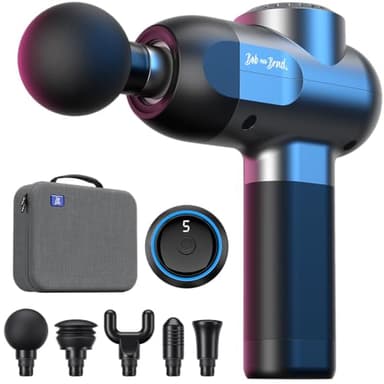
Bob and Brad C2 Massage Gun
The only gun in this roundup whose maker publishes all four numbers that decide whether it reaches the muscle — amplitude, stall force, speed range and noise — and the stall-force figure is higher than the premium units that hide theirs.
What it gets right
- Publishes amplitude, stall force, speed range and noise — the two market leaders publish none of the first three
- Published stall force of over 44 lb is higher than the figure Therabody publishes for the Prime
- 1.5 lb is light enough to hold overhead against your own shoulder without your arm giving out first
- FSA/HSA eligible, which quietly makes it cheaper again for a lot of buyers
What it does not
- 10 mm amplitude is genuinely shorter than a 16 mm premium stroke — that difference is real for glutes and thick back muscle
- No app, no pressure-feedback screen, no ecosystem
- Five fixed speeds rather than a continuous range
Price as of October 24, 2026. #ad How we’re funded
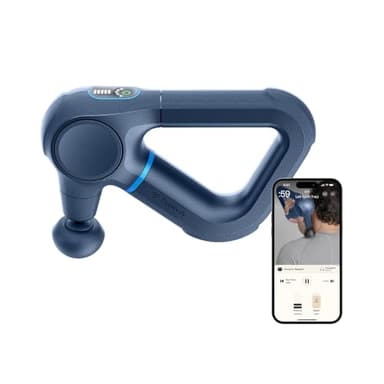
Therabody Theragun Prime (6th Gen)
The long-stroke option, and the build quality is not in question — but Therabody's current US product page publishes dimensions, weight, battery and warranty and does not publish amplitude, stall force, PPM or noise, so the numbers most buyers are shopping on are not on the page they are shopping from.
What it gets right
- The 16 mm stroke Therabody quotes is genuinely long, and stroke length is what determines depth
- Real-time pressure feedback stops the most common user error — leaning on it far too hard
- Rated by Therabody to survive drops from 10 feet, which matters more than it sounds for a thing you use on a hard floor
What it does not
- Amplitude, stall force, PPM and dB are absent from the current US product page — we checked
- Two attachments in the box, against five on guns costing a fifth as much
- 120 minutes of battery is quoted at the LOWEST speed setting, which is not the setting you will use
- One-year limited warranty on a device at this price
| Amplitude | Not published page we checked |
|---|---|
| Stall force | Not published page we checked |
| Speed range | Not published page we checked |
| Speed settings | 5 source |
| Weight | 2 lb source |
| Noise | Not published page we checked |
| Battery | 2 h source |
| Attachments | 2 source |
| Warranty | 1-year limited source |
| Dimensions | 238 × 153 × 61 mm source |
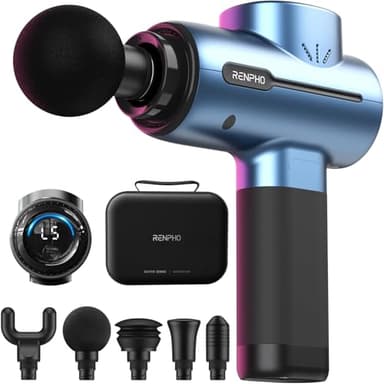
RENPHO Active Massage Gun
A competent mid-budget gun with FSA eligibility, sitting in the awkward space between the cheap gun that does the job and the specified one that does it better.
What it gets right
- FSA eligible, which changes the real price for a lot of buyers
- Quiet for the money
- Comfortable handle angle
What it does not
- Amplitude and stall force not published
- Costs close to the fully-specified C2 without matching its published numbers
Common questions
Is the Bob and Brad C2 worth it?
For most people buying a first massage gun, yes. It is the only unit in its price bracket whose maker publishes all four depth-relevant numbers — a 10 mm amplitude, over 44 lb of stall force, a 2,000-3,200 PPM range and under 60 dB — and at a published 1.5 lb it is light enough to use on your own shoulder. The limitation is stroke length: 10 mm is genuinely shorter than the 16 mm premium guns are marketed on, and on thick glute or lumbar muscle that difference is real.
How does the C2 compare to a Theragun?
On documentation, the C2 wins outright: Therabody’s current US page for the Theragun Prime publishes dimensions, weight, battery, warranty and attachments, and does not publish amplitude, stall force, PPM or noise. On stroke length, Therabody’s marketing cites 16 mm against the C2’s published 10 mm, and longer strokes do reach deeper. On price the gap is several-fold. Our read: the Theragun is the better tool for thick muscle, the C2 is the better purchase for almost everyone else.
Is 10 mm amplitude enough?
For calves, quads, hamstrings, forearms, traps and the muscle beside a shoulder blade, yes — that is most of what people treat. For glutes and thick lumbar muscle, a longer stroke does more per pass. Worth keeping in proportion: the percussive therapy review found short-term range-of-motion and pain-perception effects rather than structural change, so the realistic gap between 10 mm and 16 mm is how a session feels, not whether tissue is remodeled.
Is the Bob and Brad C2 FSA or HSA eligible?
The current Amazon listing states FSA eligibility and HSA approval, which for a lot of US buyers changes the effective price more than any discount does. Eligibility depends on your plan administrator rather than on the product alone, so confirm on the listing and with your plan before counting on it. We do not quote prices in prose for the same reason we do not quote stale specs — the live price and the date it was checked are in the table above.
Did you test the C2 yourselves?
No, and we say so on every page. There is no lab, no owned units and no clinician on staff. What this review is built from is each manufacturer’s own published figures, linked to the page they came from, with the absences recorded by name, plus the peer-reviewed literature on what percussive therapy does. Our method and its limits are set out at how we research.
Sources
- 1.Bob and Brad — C2 massage gun product page — published 10 mm amplitude, 44+ lb stall force, 2,000-3,200 PPM, 5 speeds, 1.5 lb, under 60 dB
- 2.Therabody — Theragun Prime product page — dimensions, weight, battery, warranty and attachments published; amplitude, stall force, PPM and noise absent - checked
- 3.Hyperice — Hypervolt 2 product page — weight, dimensions, motor wattage, speeds and battery published; no amplitude
- 4.The Effect of Percussive Therapy on Musculoskeletal Performance and Experiences of Pain: A Systematic Literature Review (PubMed 37020441) — what percussive therapy does: acute range-of-motion and pain-perception effects
- 5.Foam Rolling or Percussive Massage for Muscle Recovery: Insights into DOMS (PMC12286022) — no decisive winner between foam rolling and percussion for DOMS
- 6.camelcamelcamel — Bob and Brad C2 price history — price history, for judging whether a given day's price is a deal