Recovery Tech
Alternatives to the TENS 7000
The unit we would buy instead is the AUVON Dual Channel: the same two-channel stimulation, rechargeable rather than running on a 9 V battery, and the cheapest unit here that does the job. One thing we will not fudge - if you wanted the TENS 7000 because it lets you set pulse width and pulse rate by hand, no alternative on this page gives you that, and the maker's own manual is the reason we can say so precisely.
By Stephen V.Published
Disclosure:Grip & Gait earns a commission when you buy through links on this page, at no extra cost to you. It never changes what we recommend or the order we rank things in — here is exactly how we’re funded.
Quick picks
Ranked on published manufacturer specs and what they mean for the job, not on testing we have not done. Tap a row for the full reasoning. How we score.
| # | Product | Best for | Score | Price |
|---|---|---|---|---|
| 1 |  AUVON Dual Channel TENS Unit For almost everyone replacing a TENS 7000. Two independent channels with separate intensity control, rechargeable instead of a 9 V battery, and the cheapest unit here that does the job. | Best overall alternative - and the budget pick | 8.5 | |
| 2 |  Belifu Dual Channel TENS EMS Unit For someone treating a sore back and a weak calf with one device. A competent dual-channel stimulator with EMS modes; the twenty-four-mode count is marketing and we say so. | If you want EMS as well as TENS | 8.0 | |
| 3 |  KingPavonini Wireless TENS + EMS Muscle Stimulator For treating a back or shoulder under a shirt while moving around. Two wireless pods with independent dual-zone control, a published 20 hours per pod and USB-C charging. | If the lead wires are the problem | 7.7 | |
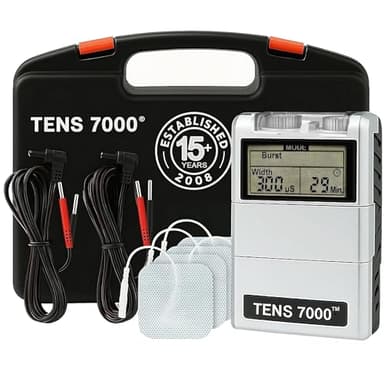
| ✕ |  TENS 7000 Digital TENS Unit Manual pulse width of 50-300 microseconds and pulse rate of 2-150 Hz, five modes, two channels and a 1-60 minute timer, all published in its own reference manual. Nothing here matches that control. Skip this | The original - when it is still the answer | 8.4 | $38.88 · View on Amazon Price as of November 22, 2026. #ad How we’re funded |
The short version
Buy the AUVON Dual Channel TENS Unit. For the large majority of people looking for a TENS 7000 alternative, what they actually want is two channels, reliable output and pads that stick — and the AUVON delivers that while recharging over a cable instead of eating 9 V batteries. It is also the cheapest unit on this page that does the job. Buy the Belifu if you want EMS modes alongside TENS, and the KingPavonini Wireless if the lead wires are the specific thing in your way.
And the caveat that belongs at the top rather than buried: if you chose the TENS 7000 because it lets you dial pulse width and pulse rate yourself, none of the alternatives here does. They are preset-driven units where your only lever is intensity. That is a real difference and for some readers it is the whole decision.
What a TENS 7000 is known for
Three things, and separating them is what makes this page useful, because different alternatives answer different ones.
- Manual parameter control. The maker’s own reference manual publishes a pulse width range of 50 to 300 microseconds with a suggested 70 to 120, and a pulse rate range of 2 to 150 Hz with the same suggested band, plus five named modes, two channels and a 1 to 60 minute timer. Almost nothing else in this category publishes those numbers, let alone lets you set them.
- Being the clinic default. It has been handed out by physical therapy practices for years, which means pads, leads and accessories are everywhere and cheap.
- Simplicity in the ugly sense. No app, no modes you have to decode, a 9 V battery and physical controls. People either love that or replace it within a month.
What each alternative matches, and what it gives up
| If you wanted the TENS 7000 for... | Buy instead | What you give up |
|---|---|---|
| Two channels and dependable output | AUVON Dual Channel | Manual pulse width and rate. You get presets plus an intensity dial, and for most users that is enough - but it is less control, not the same control in a nicer box. |
| Not buying 9 V batteries | AUVON or Belifu | Nothing meaningful. Both recharge, and a rechargeable cell is the single most common reason people replace a TENS 7000. |
| EMS as well as pain relief | Belifu Dual Channel TENS EMS | Clarity. The mode count is a listing feature and the documentation of what each mode does is thin - which is exactly what manual control on the TENS 7000 exists to avoid. |
| Treating a back while moving around | KingPavonini Wireless | Price and simplicity. Several times the cost of a wired dual-channel unit, and two pods plus a remote are three things to charge and not lose. |
| Cheap, universally available pads | Any of them, with care | Connector type. The 2 mm pin style the TENS 7000 and AUVON use is not the 3.5 mm snap some units take - check before you buy a pack. |
| Setting pulse width and rate by hand | The TENS 7000 | Nothing here matches it. If you have found a setting that works for you, stay on the unit that lets you keep it. |
The alternatives in detail
AUVON Dual Channel — the one we would buy
For the reader whose actual complaint about the TENS 7000 is the battery drawer and the dated interface rather than the parameter control. Two independent channels with separate intensity means you can run one pair of pads either side of a lumbar spine and another on a calf, at different strengths. It recharges. It is the cheapest unit on this page that does the job. The fiddly interface with cold hands is a genuine complaint and the pad adhesive is the real running cost of owning any of these.
Belifu Dual Channel TENS EMS — for two jobs in one box
For the reader who wants pain relief on one channel and muscle stimulation on the other — a sore lower back and a quad that has not fired properly since a knee problem, say. It is a competent dual-channel stimulator at the lowest price in the category, with pads and leads included. Twenty-four modes is noise rather than a feature, and the documentation of what each mode actually does is thin. We would rather tell you that than count the modes back at you.
KingPavonini Wireless — for the wires specifically
For someone treating a back or a shoulder under clothing during a working day. Two pods you stick on and wear with no leads anywhere, running independently so a shoulder and a leg can be on different modes and intensities at once, with a published 20 hours per pod on a 1,040 mAh cell over USB-C and three pad sizes including a 4.3 in butterfly that actually covers a lower back. It was listed only in December 2025 and has a thin ownership history behind it, and forty-eight modes is the same marketing we flag everywhere else. The full format comparison is on wireless vs wired TENS units.
When the TENS 7000 is still the right answer
If you already know the setting that helps you, keep the unit that lets you set it. Manual pulse width and rate is a real capability, it is published in the maker’s own manual rather than inferred, and nothing on this page replaces it. The honest reasons to leave it are the 9 V battery and the fact that manual control is only an advantage if you know what you are adjusting. Our long-form take is in the TENS 7000 review.
If the real answer is not another TENS unit
Plenty of people reach this page because the TENS 7000 did not help, not because it broke. Two cheaper things are worth trying before another stimulator.
Where this sits in the TENS coverage
TENS units, explained is the category page, and how to use a TENS unit covers pad placement and settings. For the one-to-one comparisons, see AUVON vs Belifu. If you are choosing between electrical stimulation and heat at all, heating pad vs TENS is the page for that.
Every pick, in full
Specs below are the manufacturer’s own published figures, each linked to the page it came from. Where a maker does not publish a number, the table says so and names the page we checked — that absence is information too.
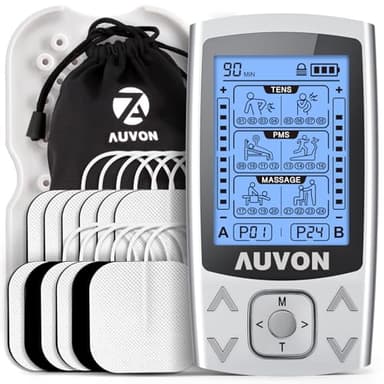
AUVON Dual Channel TENS Unit
Two independent channels so you can treat both sides of a problem at once, at a price where trying TENS costs less than one session of anything else.
What it gets right
- Two independent channels with separate intensity control
- Rechargeable rather than eating 9 V batteries
- Cheap enough to find out whether TENS does anything for you
What it does not
- Pad adhesive life is the real running cost, not the unit
- Interface is fiddly with cold hands
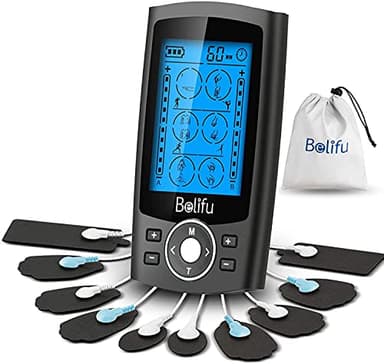
Belifu Dual Channel TENS EMS Unit
Twenty-four modes at the lowest price in the category, and the mode count is marketing — but the hardware underneath is a competent dual-channel stimulator.
What it gets right
- Cheapest dual-channel unit here
- Rechargeable
- Pads and leads included
What it does not
- Mode count is noise, not a feature
- Thin documentation of what each mode does
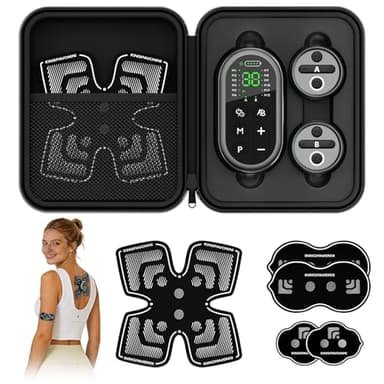
KingPavonini Wireless TENS + EMS Muscle Stimulator
TENS and EMS from two pods you stick on and wear, with no lead wires anywhere — which is the whole reason to pay this much, because it is the only version of the device you can use under a shirt and still move around in. The 48-mode count is marketing; the dual-zone independent control underneath it is not.
What it gets right
- Wireless pods rather than lead wires, so it works under clothing and while moving
- Two pods run independently — separate mode and intensity each, so a shoulder and a leg can run different settings at once
- Published 20 hours per pod on the 1040 mAh cell, charged over USB-C rather than off a disposable battery
- Ships with three pad sizes including a 4.3 in butterfly pad, which is the one that actually covers a lower back
What it does not
- Forty-eight modes is a mode count, not a specification — the same marketing this site flags on every cheap unit
- Several times the price of a wired dual-channel unit that treats a back just as well
- Two pods and a remote are three things to keep charged and not lose
- Listed only in December 2025 and rated 4.1 across 69 reviews, so there is very little ownership history behind it
Price as of November 22, 2026. #ad How we’re funded
TENS 7000 Digital TENS Unit
The unit clinics hand out, with manual control over pulse width and rate rather than a menu of preset programs — which is what you want once you know what setting helps.
What it gets right
- Manual pulse-width and rate control instead of fixed presets
- The long-standing clinic default, so accessories are everywhere
What it does not
- Runs on a 9 V battery
- Manual control is only an advantage if you know what you are adjusting
Common questions
What is the best alternative to the TENS 7000?
The AUVON Dual Channel TENS Unit. It gives you the same two-channel stimulation with separate intensity control on each channel, it recharges instead of running on a 9 V battery, and it is the cheapest unit here that does the job. The Belifu is the pick if you want EMS modes as well, and the KingPavonini Wireless if lead wires are the specific thing in your way.
Is there a TENS unit with manual pulse width control like the TENS 7000?
Not among the units we rank, and that is the honest answer. The TENS 7000’s own reference manual publishes a 50 to 300 microsecond pulse width range and a 2 to 150 Hz pulse rate range with a suggested 70 to 120 in both, and lets you set them. Every alternative on this page is preset-driven, with intensity as your only adjustment. If you have found a parameter setting that works for you, do not switch away from the unit that lets you keep it.
Why do people replace a TENS 7000?
Two reasons, mostly. The 9 V battery, which is an irritation every few weeks against a rechargeable unit that costs less. And the fact that manual control is only an advantage if you know what you are adjusting — for a reader who just wants a program that helps a sore back, a preset unit is easier to live with. Neither is a fault; they are the trade the design makes.
Will my TENS 7000 pads work with another unit?
Only if the connector matches. The TENS 7000 and AUVON use the 2 mm pin style; some units take 3.5 mm snap connectors, and the two do not interchange. Check the connector before buying a pack rather than after. Pad adhesive, not the unit, is the real running cost of owning a TENS device, and a pad that will not stick is the single most common reason a working unit seems to stop working.
Is a wireless TENS unit better than a TENS 7000?
It is better at one thing: being worn under clothing while you move around. It is worse on price, on simplicity and on the number of things you have to keep charged. If you treat a back sitting on a sofa in the evening, a wired dual-channel unit does the same job for a fraction of the money. If you need the stimulation to happen during a working day, the wireless premium is buying something real.
Sources
- 1.TENS 7000 — Reference Manual (pulse width 50-300 µs, suggested 70-120 µs; pulse rate 2-150 Hz, suggested 70-120 Hz; 5 modes; 1-60 minute or continuous timer; two channels; 9 V battery) — the published pulse width and pulse rate ranges, suggested bands, five modes, two channels, 1-60 minute timer and 9 V battery quoted above
- 2.Neuropathic Pain Relief Through Transcutaneous Electrical Neuromuscular Stimulation: Insights From a Systematic Review and Meta-Analysis of Clinical Evidence - BioMed Research International 2025 (PMC12543013) — systematic review and meta-analysis of transcutaneous electrical stimulation for neuropathic pain - the strongest case for this class of device
- 3.Transcutaneous electrostimulation for osteoarthritis of the knee - Cochrane Database of Systematic Reviews (PubMed 19821296) — the Cochrane review for knee osteoarthritis, included because it is the place the evidence for TENS is weakest and readers should know that
- 4.camelcamelcamel — TENS 7000 price history — independent price history for the original, so the price comparisons on this page can be checked
- 5.camelcamelcamel — AUVON TENS price history — independent price history for the top alternative