Massage Guns
Alternatives to a Massage Gun
For most people the honest substitute is a pair of hard massage balls: concentrated pressure into one dense spot, used against a wall so you never get on the floor, for less than a tenth of what a decent gun costs. For legs specifically a roller stick beats both. And if what you actually want is pain relief rather than tissue pressure, the alternative is not mechanical at all — it is a TENS unit or a heating pad, and we will say so.
By Stephen V.Published
Disclosure:Grip & Gait earns a commission when you buy through links on this page, at no extra cost to you. It never changes what we recommend or the order we rank things in — here is exactly how we’re funded.
Quick picks
Ranked on published manufacturer specs and what they mean for the job, not on testing we have not done. Tap a row for the full reasoning. How we score.
| # | Product | Best for | Score | Price |
|---|---|---|---|---|
| 1 |  Kieba Massage Lacrosse Balls Concentrated pressure into one dense spot is the job a percussion head does. A hard ball does it with no motor, no noise and no battery - and against a wall it needs neither the floor nor any grip strength. | Best overall, and the budget pick | 8.5 | $7.99 · View on Amazon Price as of November 22, 2026. #ad How we’re funded |
| 2 |  Idson Muscle Roller Stick Most massage-gun minutes are spent on legs, and a stick covers a whole leg muscle in one stroke while you sit in a chair with the muscle slack. Costs about what a takeaway lunch costs. | Best for calves, quads and hamstrings | 8.4 | $8.89 · View on Amazon Price as of November 22, 2026. #ad How we’re funded |
| 3 |  AUVON Dual Channel TENS Unit The one swap with a stronger evidence base than the thing it replaces. Electrical stimulation treats pain directly instead of pushing on tissue, and it is silent, hands-free and usable through a surface too sore to be hit. | Best if the problem is pain, not tightness | 8.2 | |
| 4 |  GENIANI Electric Heating Pad For stiffness rather than a knot, heat does the loosening while you do nothing, over an area no gun head can cover. It cannot reach depth and will not help a fresh swollen injury. | Best hands-off option | 8.0 | |
| 5 |  TriggerPoint GRID Foam Roller (13 in) The best-studied object on this site and the widest contact patch here. The trade is real: it needs the floor, your bodyweight sets the pressure, and getting down and up again is exactly what some buyers cannot do. | Best evidence base, whole-muscle coverage | 8.1 | |
| ✕ |  Hyperice Vyper 3 Vibrating Foam Roller A good object that is not an alternative to anything - a vibrating cylinder costs more than almost every massage gun on this site. If price, noise or batteries sent you looking, this solves none of them. Skip this | The one to skip as an alternative | 6.4 |
The short version
Buy a pair of hard massage balls. The thing a percussion head actually does is concentrate pressure on a small patch of muscle that you are not loading at the time, and a hard ball does exactly that — pinned between your body and a wall, a chair back or the floor, with your own weight supplying the force. It is silent, it never needs charging, it goes in a coat pocket, and it costs less than a tenth of the cheapest gun we recommend.
Two refinements. If your targets are legs— calves, quads, hamstrings, which is where most gun minutes go — a roller stick is better, because it covers the length of a muscle in one stroke while you stay in a chair. And if the reason you were shopping for a gun is pain rather than tightness, the right swap is not mechanical: a TENS unit treats pain directly, silently, through skin that is too sore to be pounded.
What a massage gun is actually good at
Worth being fair about this before replacing it, because percussion has a genuine and specific advantage that none of the picks above fully reproduce: it works on a completely slack muscle while you sit still. A foam roller needs you to load the muscle with your own bodyweight. A ball needs something to press against. A gun needs neither — you can treat a calf with your foot up on a sofa, and that is why it is the tool of choice for people who cannot get on the floor at all.
The evidence is narrower than the marketing but it is real. A study of percussive therapy on hamstring range of motion found acute changes in tissue dynamics and flexibility. A randomized trial of percussion massage for delayed-onset muscle soreness supports the soreness claim, and a systematic review of percussive therapy on performance and pain is the honest summary: short-term effects on range of motion and perceived soreness, little evidence of lasting structural change. Nobody should expect a gun to fix a problem; it buys you a window in which moving feels easier.
That framing is the key to this page. If the active ingredient is pressure applied to tissue for a few minutes, then the motor is a delivery mechanism rather than a mechanism, and the question becomes which cheaper delivery mechanism fits your particular reason for wanting out.
The five reasons people want an alternative
1. Price. The cheapest gun we are willing to recommend costs about what a week of lunches costs; the best-known brands cost several times that. Every mechanical pick on this page costs less than a third of the cheapest gun, and the top two cost less than a tenth. If money is the whole objection, read cheap vs expensive massage guns first — the floor of the category is lower than most people think, and a gun that publishes its specs at the bottom of the market may solve this without a swap at all.
2. Noise. A percussion device is a motor hammering a rubber head; the quietest unit we have found with a published figure states 51 dB, and most makers publish nothing. If the problem is a sleeping baby, a shared office or a partner watching television, no gun fixes it. A ball, a stick and a heat pad make no sound at all.
3. Grip, wrist and reach.This is the reason we take most seriously, and the one the category ignores. A full-size gun weighs around a pound and a half and has to be held at arm’s length, braced against your own body, for several minutes. With arthritic hands, a sore wrist, carpal tunnel or simply not much grip left at the end of a day, that is the limiting factor rather than the specification sheet. A ball against a wall requires no grip whatsoever. See hand and grip strength and carpal tunnel if that is your situation.
4. It is too intense, or the pain is not muscular.Percussion on a nerve-flavored pain — a shooting line down a leg, a burning patch, a numb area — is at best useless and at worst provocative. A systematic review of conservative treatment for lumbar radiculopathy is a useful reality check on what tissue work is expected to do for that pattern. When the complaint is pain rather than tightness, electrical stimulation is the better-evidenced tool.
5. You want hands-off.A gun requires an arm to hold it for the whole session. A heat pad, an acupressure mat and a pair of compression boots all work while your hands do nothing — which, for anyone treating their own back at the end of a long day, is the difference between a tool used nightly and a tool in a drawer.
Which alternative replaces which part
| Why you want an alternative | Buy | Why it works |
|---|---|---|
| One dense knot, and a tight budget | Kieba massage balls | Concentrated pressure on a small patch is what a percussion head delivers. A hard ball delivers it with bodyweight instead of a motor, against a wall if the floor is out. |
| Calves, quads and hamstrings | Idson roller stick | Covers the whole length of a leg muscle in one stroke, in a chair, with your arms setting the pressure rather than your bodyweight. |
| The complaint is pain, not tightness | AUVON dual-channel TENS | Treats pain through the nerve rather than pushing on tissue. Silent, hands-free, and usable through skin too sore to tolerate a gun. |
| Stiffness over a wide area | GENIANI heating pad | Heat loosens a region while you do nothing, over an area no gun head can cover. Best on chronic stiffness, wrong on a fresh swollen injury. |
| Whole-muscle coverage, best evidence | TriggerPoint GRID roller | The broadest contact patch here and the strongest literature. The cost is the floor, and the fact that your bodyweight rather than your hand sets the pressure. |
| No grip strength, no floor | Balls against a wall, or a heat pad | The two options on this page that ask nothing of your hands. This is the case percussion marketing never addresses. |
| Legs feel heavy and swollen, not knotted | Pneumatic compression, not percussion | A different problem entirely. Squeezing a whole limb rhythmically is not something a gun or a ball can imitate. |
| You wanted a quieter gun, not a different tool | Not an alternative - buy a quiet gun | Only one brand on this site publishes a noise figure at all. Start there instead of changing category. |
The balls, specifically, and why they are the top pick
Three things make a hard ball the closest honest substitute. First, geometry: a gun head and a ball apply force over a similar contact patch, which is why both are good at a glute, a trapezius or the arch of a foot and both are poor at covering a whole quad. Second, positioning: pinned against a wall, a ball reaches between your shoulder blades — the one place you genuinely cannot hold a gun without an awkward angle. Third, dose control: you lean in until it is a six out of ten and you stop. There is no speed setting to get wrong.
The published evidence on trigger-point work is more cautious than the enthusiasm around it. A review of trigger-point examination reliability found that clinicians agree poorly on where trigger points even are, which is a reason to treat “find the knot and destroy it” language with suspicion — from us as much as from anyone else. What a ball reliably does is apply sustained pressure to a tender area for a minute or two, which is the same thing a gun reliably does.
The honest limits. A ball cannot cover a large muscle in one pass; you are working spot by spot. It does nothing for a limb you cannot press against anything — the standard case for which a gun really is the answer. It can also be too much ball for a bony area, and rolling one under a foot first thing in the morning is a different job from treating a fascia with a contoured tool. The ranked ball options are in the massage ball roundup, and the direct comparison is in massage gun vs massage ball.
When the right alternative is electrical rather than mechanical
This is the swap most people never consider, and it is the one with the strongest paper trail. A TENS unit does not touch tissue mechanics at all: it runs a current between two adhesive pads to change how pain is carried and perceived. For knee osteoarthritis, a Cochrane review of transcutaneous electrostimulation is the reference point, and for nerve-flavored pain a 2025 systematic review and meta-analysis of TENS for neuropathic pain reports relief that percussion has never been shown to produce.
Practically, a TENS unit beats a gun on three axes buyers care about: it is silent, it is hands-free once the pads are on, and it works on skin and joints too sore to be hit. It loses on two: it does nothing for stiffness or range of motion, and the pads are a consumable, so the real cost is the unit plus pads forever. The ranked units are in the TENS unit roundup, the format question is in wireless vs wired TENS units, and the head-to-head is massage gun vs TENS.
When the right alternative is heat
If your complaint is a region that feels stiff and old rather than a muscle that feels knotted, heat is the cheaper and more comfortable tool, and the only one on this page you can use for twenty minutes without holding anything. A Cochrane review of superficial heat and cold for low back pain found moderate evidence that heat wrap therapy reduces pain in acute and subacute low back pain, and a Cochrane review of thermotherapy for osteoarthritis is the arthritic-joint version of the same argument.
Heat is not a depth tool and we will not pretend otherwise: it changes how a region feels and how willingly it moves, not what is happening three centimeters down. Used before stretching or before a walk it is genuinely useful; used instead of movement it is a pleasant dead end. The pads are ranked in the heating pad roundup, and if your region is the lumbar back specifically, the back-pain heat page is the one to read.
What the evidence says about swapping tools
Two findings should decide this purchase more than any specification.
First, the direct comparison of foam rolling and percussive massage for post-exercise soreness. The two come out closer together than the price gap between them implies, which is the clearest permission slip on this page: if you are buying for soreness after training, the cylinder and the gun are in the same bracket of effect and nowhere near the same bracket of cost.
Second, the meta-analysis of massage for delayed-onset muscle soreness alongside the meta-analysis of foam rolling as a preventive for soreness. Both support the broad category of sustained pressure applied to muscle, by hand or by foam. Nothing in either depends on a motor. That is the whole case for replacing one.
The one place the gun keeps a real edge is the slack-muscle problem described at the top. If you cannot get on the floor and cannot press against anything, percussion is not a luxury and we would not talk you out of it — the gun picks for older buyers weigh exactly that.
How we ranked these
- Does it reproduce pressure into a muscle you are not loading? That is the mechanical thing a gun does. A ball against a wall passes, a stick passes in a chair, a floor roller passes only if you can get down there.
- Does it solve the reason people leave?Price, noise, grip, intensity, hands-off. A pick that fails the reader’s specific reason is not an alternative for that reader, which is why the table above is organized by reason rather than by score.
- Does it cost materially less than the thing it replaces? An alternative that costs more than a good gun has to earn the difference with a capability the gun does not have. That is why a vibrating roller is the skip row.
- Is there evidence for it?Where a swap has a stronger literature than percussion — TENS for pain, heat for stiff backs, rolling for soreness — we say so and link it.
- Honest about what it cannot do. Every pick here loses to a gun on at least one job, and each row above names which.
Where an alternative is the wrong move
If the objection was price alone, the floor of the gun category is lower than most people realize: start with the budget gun roundup or the under-$100 page before you change category. If you already own a gun and it hurts to use, the problem is usually placement rather than the tool — where not to use a massage gun and how often to use one fix more complaints than a new purchase does. If you are weighing percussion against pressure as a category decision, that argument lives in massage gun vs foam roller. And if your legs feel heavy rather than knotted, the tool you are looking for squeezes rather than hits: see alternatives to compression boots for the cheap end of that shelf.
Every pick, in full
Specs below are the manufacturer’s own published figures, each linked to the page it came from. Where a maker does not publish a number, the table says so and names the page we checked — that absence is information too.
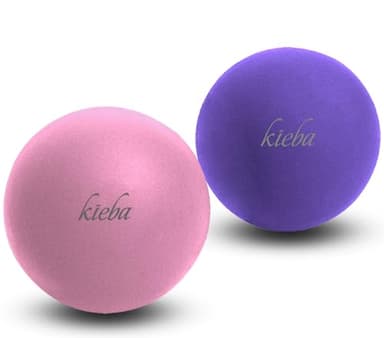
Price as of November 22, 2026. #ad How we’re funded
Kieba Massage Lacrosse Balls
The highest work-per-dollar tool on this entire site. A hard rubber sphere concentrates all your body weight into one square inch, which is more pressure than any handheld gun can generate.
What it gets right
- Concentrates body weight into a single point — more local pressure than any percussion device
- Nothing to charge, nothing to break, fits in a coat pocket
- Reaches under the shoulder blade against a wall, which a roller physically cannot
What it does not
- Unforgiving — very easy to overdo on a first session
- Wrong tool for broad surfaces like quads or lats
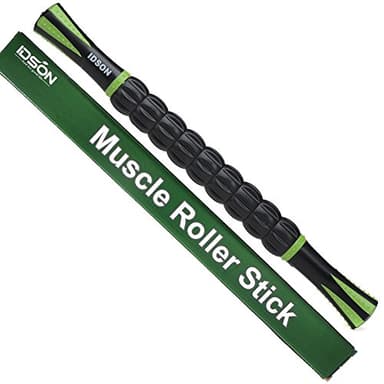
Price as of November 22, 2026. #ad How we’re funded
Idson Muscle Roller Stick
The segmented-bead stick that every team bag has, for less than a pair of socks — it does the core job of a stick, and the independently spinning beads are both its feature and its flaw.
What it gets right
- Costs a fraction of the branded sticks and does the same basic job on a calf
- Independently spinning beads roll with the limb rather than dragging the skin
- Light, short and genuinely packable
What it does not
- Segmented beads can pinch skin and leg hair — the one complaint the smooth-sleeve sticks exist to solve
- Shorter than the full-size sticks, so you cover less per pass
- No published dimensions or load rating of any kind
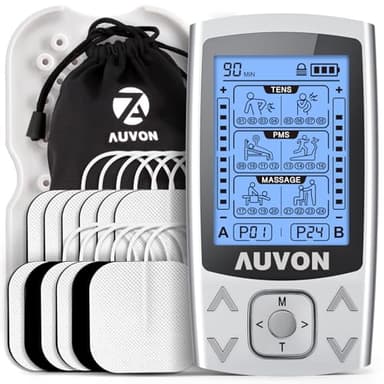
AUVON Dual Channel TENS Unit
Two independent channels so you can treat both sides of a problem at once, at a price where trying TENS costs less than one session of anything else.
What it gets right
- Two independent channels with separate intensity control
- Rechargeable rather than eating 9 V batteries
- Cheap enough to find out whether TENS does anything for you
What it does not
- Pad adhesive life is the real running cost, not the unit
- Interface is fiddly with cold hands
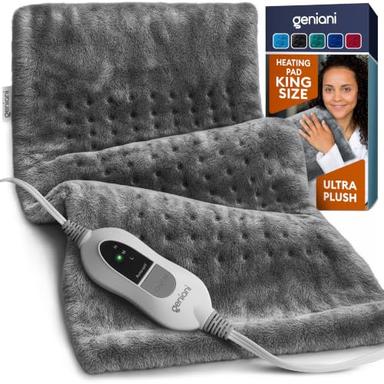
GENIANI Electric Heating Pad
Moist-heat capable with an auto-shutoff, which is the specification that decides whether a heating pad is safe to use lying down — and lying down is when you want it.
What it gets right
- Auto shutoff — the safety feature that matters if you fall asleep on it
- Moist-heat option penetrates better than dry
- Machine-washable cover
What it does not
- Corded, so your position is fixed
- Smaller than the XXL pads
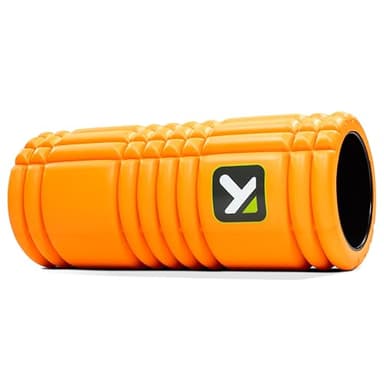
TriggerPoint GRID Foam Roller (13 in)
The multi-density surface is the reason to buy this over a plain foam cylinder: the raised sections concentrate pressure in strips instead of spreading it flat, which is what makes it usable on an IT band without needing to hold your breath.
What it gets right
- Hollow rigid core does not compress into a soft log the way plain EVA foam does after a year
- Multi-density surface gives you three pressure intensities on one roller
- 13 in length fits in a gym bag; the 26 in version does not
What it does not
- Costs roughly three times a plain high-density cylinder that also works
- The hollow core makes it noisier on a hard floor
- TriggerPoint's own page states a 300 lb support figure while retailer listings widely claim 500 lb — the maker's number is the lower one
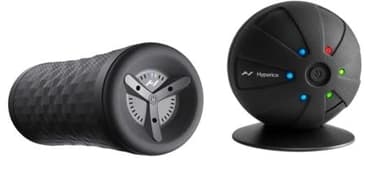
Hyperice Vyper 3 Vibrating Foam Roller
Three speeds of vibration on a 34 W motor, and the honest question is whether vibration adds enough over a $13 cylinder to justify twenty times the price — for most people it does not.
What it gets right
- Published motor, weight, dimensions and battery — more transparency than Hyperice gives its guns
- Vibration genuinely reduces the discomfort of rolling, which means people actually do it
What it does not
- Twenty times the price of a foam cylinder that does the mechanical part
- 2.7 lb and a 2-hour battery — it is a device, not a lump of foam
Common questions
What can I use instead of a massage gun?
A pair of hard massage balls is the closest cheap substitute: a percussion head and a ball apply force over a similar contact patch, so both suit a glute, a shoulder blade or a foot. Pinned against a wall, a ball also needs no floor and no grip strength. For calves, quads and hamstrings a roller stick is better, because it covers the length of the muscle in one stroke while you sit in a chair. If your complaint is pain rather than tightness, a TENS unit is the better-evidenced swap, and for a stiff region a heating pad does more than either.
Is a foam roller as good as a massage gun?
For post-exercise soreness they land in the same bracket: a direct comparison of foam rolling against percussive massage for delayed-onset soreness found the two closer together than their prices suggest. The roller wins on contact area, cost and evidence base. The gun wins on one thing that matters to a lot of buyers — it works on a completely slack muscle while you sit still, where a roller needs you to get on the floor and load the muscle with your bodyweight. Pick by whether the floor is available to you.
What is the quietest alternative to a massage gun?
Anything without a motor: a massage ball, a roller stick, a foam roller and a scraper make no sound at all, and a heating pad is silent too. A TENS unit is silent in use apart from its button beeps. This matters more than buyers expect — most makers do not publish a noise figure for their guns, and the quietest published figure we have found in the category is 51 dB, which is still audible in a quiet room.
I have arthritis and cannot hold a massage gun. What should I use?
The two picks that ask nothing of your hands: a ball pinned between your body and a wall or a chair back, and a heating pad that you simply lie against. A TENS unit also qualifies once the pads are on. A full-size gun weighs around a pound and a half and has to be braced at arm’s length for minutes at a time, which is the real limit for arthritic hands rather than anything on the specification sheet. Our arthritis page and arthritis-specific gun picks cover the case in more detail.
Is a TENS unit better than a massage gun?
For pain, it has the better paper trail; for tightness and range of motion, it does nothing at all. A Cochrane review of transcutaneous electrostimulation for knee osteoarthritis and a 2025 meta-analysis of TENS for neuropathic pain both report pain relief of a kind percussion has never been shown to produce. But electrical stimulation does not change how a muscle moves, so if your goal is to loosen a stiff hamstring before a run, it is the wrong purchase. Pain: TENS. Tightness: pressure.
Can I just use my hands instead of buying anything?
For an accessible area, yes — the literature on massage for soreness is hand-delivered massage rather than machine-delivered, so hands are the version with the evidence. The practical limits are reach and endurance: you cannot thumb your own mid-back, and treating a calf properly tires a hand faster than it tires the calf. The cheapest honest upgrade is a ball that borrows your bodyweight instead of your fingers, which is why it is the top pick here.
Sources
- 1.Acute Effects of Theragun Percussive Therapy on Viscoelastic Tissue Dynamics and Hamstring Range of Motion (PMC10499144) — acute range-of-motion and tissue effects for the tool being replaced
- 2.Percussion massage therapy and recovery from delayed onset muscle soreness — randomized controlled trial (PMC11979224) — randomized trial support for percussion and post-exercise soreness
- 3.The Effect of Percussive Therapy on Musculoskeletal Performance and Experiences of Pain: A Systematic Literature Review (PubMed 37020441) — systematic review - short-term effects, little evidence of lasting structural change
- 4.Foam Rolling or Percussive Massage for Muscle Recovery: Insights into DOMS (PMC12286022) — foam rolling against percussive massage for DOMS - closer together than the price gap implies
- 5.Massage Alleviates Delayed Onset Muscle Soreness after Strenuous Exercise: A Systematic Review and Meta-Analysis (PMC5623674) — hand-delivered massage for soreness - the pressure, not the motor, is the active ingredient
- 6.Preventive effect of foam rolling on muscle soreness after exercise: a systematic review and meta-analysis - Journal of Bodywork and Movement Therapies 2024 (PubMed 39593540) — preventive effect of foam rolling on soreness - the evidence behind the roller pick
- 7.Transcutaneous electrostimulation for osteoarthritis of the knee - Cochrane Database of Systematic Reviews (PubMed 19821296) — Cochrane review of electrostimulation for knee osteoarthritis - the pain-rather-than-tightness swap
- 8.Neuropathic Pain Relief Through Transcutaneous Electrical Neuromuscular Stimulation: Insights From a Systematic Review and Meta-Analysis of Clinical Evidence - BioMed Research International 2025 (PMC12543013) — TENS for neuropathic pain - relief of a kind percussion has not been shown to produce
- 9.Superficial heat or cold for low back pain - Cochrane Database of Systematic Reviews 2006 (PubMed 16437495) — moderate evidence for heat wrap therapy in acute and subacute low back pain
- 10.Thermotherapy for treatment of osteoarthritis - Cochrane Database of Systematic Reviews 2003 (PMC6669258) — thermotherapy for osteoarthritis - the arthritic-joint case for heat over percussion
- 11.Evidence-Based Conservative Treatment Strategies for Lumbar Radiculopathy: A Systematic Review - Cureus 2026 (PMC13349735) — conservative treatment for lumbar radiculopathy - why nerve-pattern pain is not a percussion target
- 12.Reliability of physical examination for diagnosis of myofascial trigger points: a systematic review of the literature - The Clinical Journal of Pain (PubMed 19158550) — clinicians agree poorly on where trigger points are - a caution against 'find the knot' claims, including ours